How-To Guide
Shopify subscription offers: show the first order and the renewal as two promises
Before promoting a subscription, write down what the customer pays first, what happens later and how they can manage the arrangement.
By the Superdirector editorial team.
Before promoting a subscription, write down what the customer pays first, what happens later and how they can manage the arrangement. Compare those facts with the configured offer and actual checkout. A banner that repeats the intended price is not proof that the subscription will charge correctly.
This guide describes an editorial verification workflow for a merchant. It is not a billing audit, legal review or evidence that a particular subscription app has passed a live test.
Identify the actual subscription system
Start with the name of the app managing the subscription, the product and purchase option, and the revision you are reviewing. Do not mix instructions for Shopify's first-party app with assumptions about a third-party provider.
For Shopify Subscriptions, official documentation describes order frequency, discounts and per-delivery shipping information at checkout. It also describes customer account management. Third-party apps can have different notification schedules. Shopify Subscriptions customer experience.
That tells you what to inspect. It does not tell you that your published theme, campaign link or subscription configuration is correct.
Make a one-page offer record
Before asking a designer to build a promotion, fill in these facts:
- Exact product and quantity per delivery.
- First product charge and later product charge.
- Billing and delivery cadence, noting any difference between them.
- Discount duration expressed in payments or cycles, where applicable.
- Shipping and tax treatment, including anything not yet known.
- Where the customer can find the actual cancellation and management terms.
- The person responsible for verifying each fact and the evidence date.
An empty cell is a question to resolve, not permission for copy to fill the gap. If a future shipping amount varies, say what is known and where the customer sees the applicable information. Do not turn an unknown into “all included” because it fits the design.
Separate product subtotal from total payable. A large first-order price next to a tiny shipping qualification can leave the buyer with an inaccurate impression even when each number is individually correct.
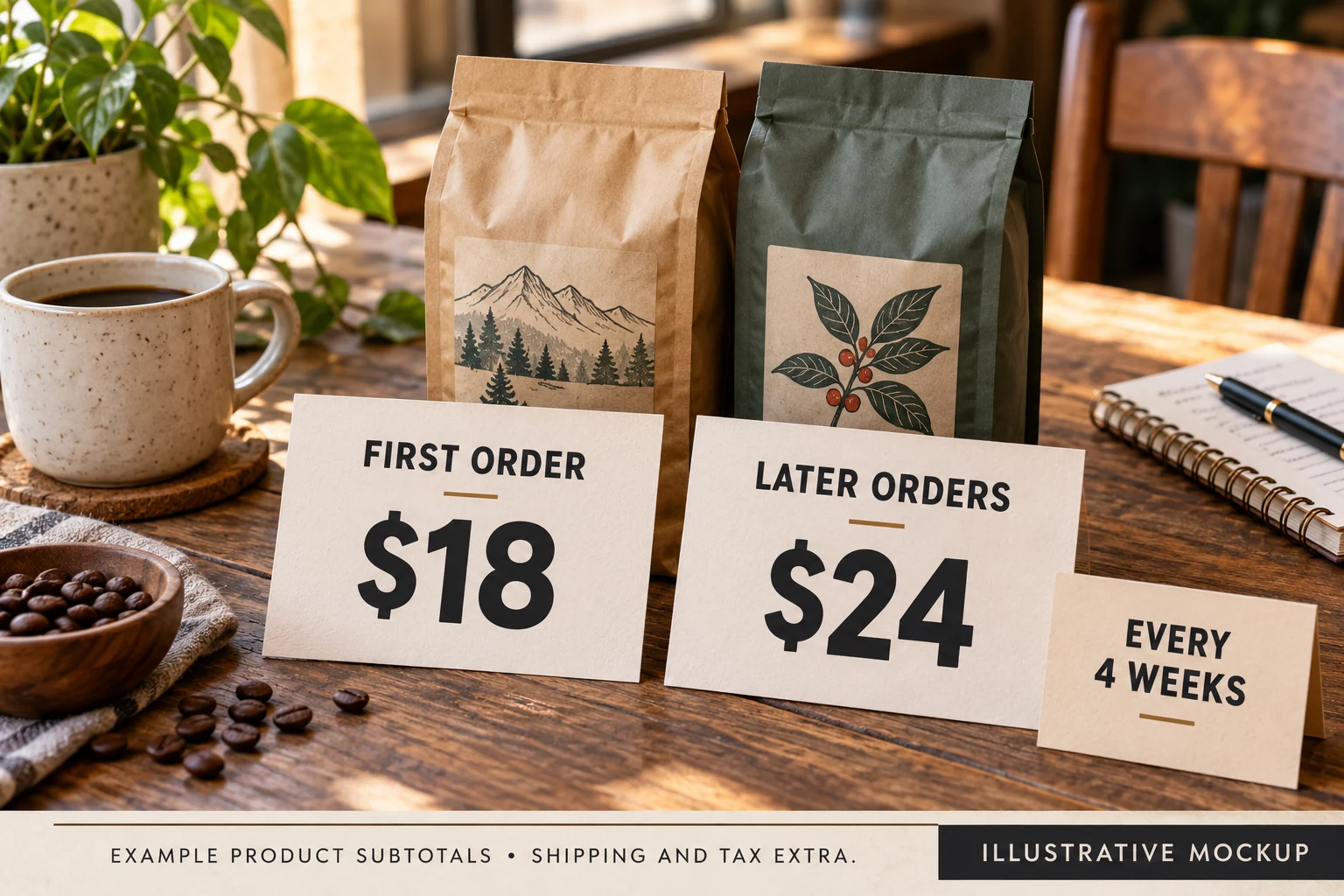
AI-generated illustrative mockup. Fictional teaching amounts: $18 initially and $24 on later four-week orders, before shipping and applicable tax. The mockup does not establish any configured discount or successful renewal.
Illustrative mockup by OpenAI image generation, editorial direction for this article. Created 2026-10-24.
A worked example: a refill subscription
Suppose a merchant is planning a two-bag coffee delivery every four weeks. For illustration only, the proposed product subtotal is $18 for the first order and $24 for later orders. Shipping and applicable tax are not included in these example figures. These are invented teaching values, not a real offer, recommended price or tested discount configuration.
The creative should show two labeled states:
- First order: two bags, $18 product subtotal.
- Later orders: two bags every four weeks, $24 product subtotal.
Now add the missing qualifications in ordinary readable text, not as decorative fine print. If those numbers are not supported by the configured rule, stop and correct the offer rather than exporting the image.
A second comparison is useful for a first-delivery shipping promotion. That offer changes shipping, not necessarily the product price. Give it a different row. Combining the two promotions under one “save now” headline can obscure which benefit continues.
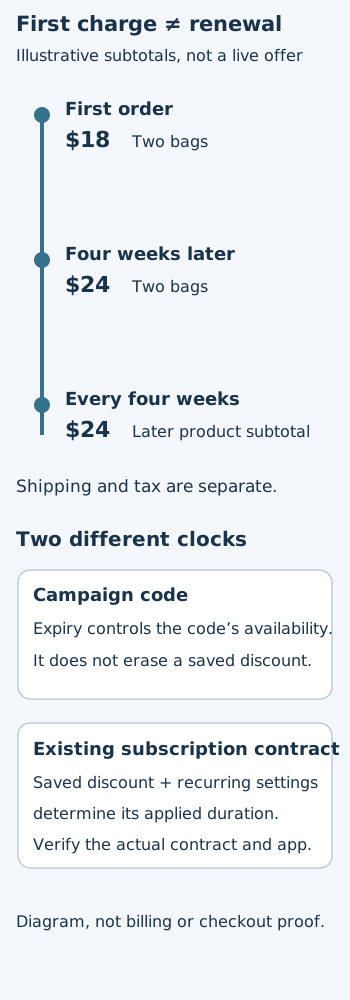
This is an original planning diagram. It is not an authentic checkout or a receipt, and it does not prove that the example renewal would charge successfully.
Original visual by the Superdirector editorial team. Creation date not recorded.
Do not confuse campaign expiry with discount duration
Shopify's documentation says a discount applied to a subscription is saved in the contract independently of the original code. Expiring or deactivating that code does not remove the saved discount from existing contracts. Recurring-payment settings control automatic cycle limits; changes to an existing contract require the subscription app. Subscription discount rules.
That distinction matters when a launch campaign ends. “The code expires Friday” and “this customer receives one discounted delivery” are different statements. A marketer may own the campaign date, while the subscription owner controls the rule that implements the promised duration.
Review both before launch. Do not change existing customer terms merely to make an internal spreadsheet agree, and do not infer permission to alter contracts from a request to improve promotional creative.
Follow one configuration across four surfaces
Choose a specific product, quantity and purchase option. Review it without switching to another offer halfway through the check.
- Creative: does the image or email distinguish the first charge from later charges?
- Product page: does the selected purchase option match the advertised quantity and cadence?
- Cart and checkout: do the displayed price components and frequency match the offer record?
- Customer-management path: can a customer locate the relevant terms and controls through the route your copy promises?
If you capture evidence, record the revision, app, device and selected configuration. Mask personal data. If the campaign has multiple links, verify the actual destination used in that campaign rather than a similar product page opened from the store's menu.
Do not complete a charge to finish this checklist without approval. Preview checks can establish what was displayed, not what was charged or what will renew.
Treat the first renewal as its own checkpoint
A successful initial checkout is not a successful renewal. Keep three statuses separate: offer prepared, first order verified, renewal verified. Later evidence should include the actual charged amount and the fulfilled contents, within the access and privacy scope you are authorized to inspect.
The customer also needs a usable way to manage the subscription. Shopify Subscriptions documents pausing, canceling and skipping through customer accounts. Its reminder timing is app-specific, not a universal rule for every Shopify subscription product. Customer controls.
A promotional image should not invent controls your current setup lacks. Likewise, a link labeled “manage subscription” is not accepted merely because it loads a login screen. Its destination and authorized customer journey need separate verification.
Review understanding before claiming performance
Ask someone unfamiliar with the offer to state the next two expected product charges, when the next delivery occurs and where they would change or stop the subscription. Compare their answer with the offer record, not with what you meant to say.
After an approved launch, distinguish pricing questions from delivery questions and payment failures. Track mature renewal outcomes separately from first orders. Do not call a campaign successful solely because it attracted discounted purchases, and do not infer retention from subscriptions that have not yet reached a renewal date.
The useful first deliverable is one evidence-backed offer record and a matched creative revision. Billing correctness and customer retention require separate evidence from actual orders and renewals.