How-To Guide
Sell the finished object, the pattern, or neither yet?
Before turning an original craft process into a paid pattern, decide which work the customer wants to do.
An attractive handmade object can prompt two different requests: “Can I buy that?” and “Can you show me how to make it?” Those requests can concern the same design without asking for the same product.
Before turning an original craft process into a paid pattern, decide which work the customer wants to do. Then decide whether you can transfer that work through instructions another appropriately skilled person can use. A finished sample establishes neither demand for a pattern nor the completeness of your instructions.
This is an offer-selection method for a maker’s own original, non-safety-critical accessory design. It is not a pattern-writing tutorial, a pricing formula or a claim that digital products inevitably produce passive income. The examples are fictional; no customer or making test has been conducted.
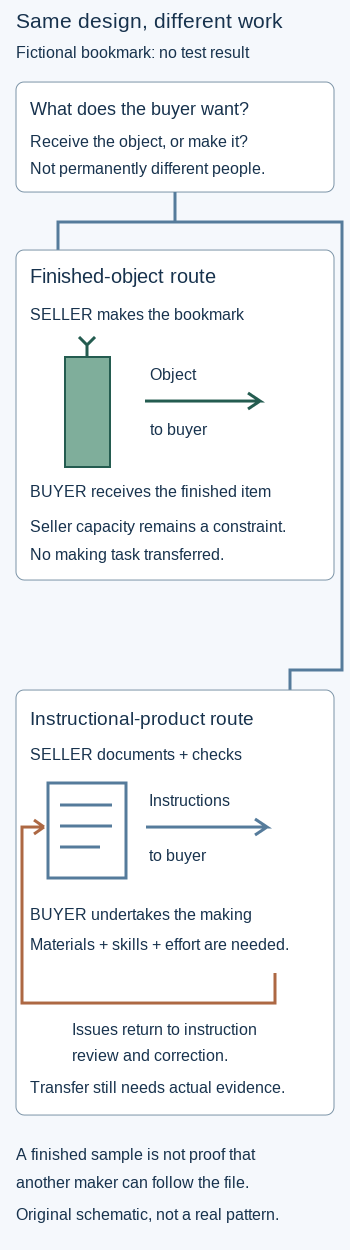
Original schematic of work allocation. It is not a real pattern, a customer test or evidence of lower cost.
 Superdirector
Make it work for your brand
Find it. Remake it. Post it. Superdirector turns the viral formats in your niche into your brand's carousels, X posts and video scripts, and keeps the calendar full.
Start with the outcome, not the file format
Keep the actual request and its context together. Someone seeking a ready-made gift by a particular date may value your making labor. Someone asking which techniques the design uses may want the activity of making it. A request for a pattern is more specific evidence for an instructional offer than a compliment on a finished object.
Do not force people into permanent “maker” and “non-maker” categories. The same person might make one item and buy another ready-made. A short deadline, unavailable equipment or a desire to give a gift can change the choice. Record the desired outcome in this instance rather than inventing mutually exclusive audiences.
For existing inquiries, note:
- Whether the person wants to receive the finished item or make it.
- Any stated deadline, technique limitation or material constraint.
- What they have actually asked or chosen, separately from your interpretation.
- Whether the next offer would require work they have not agreed to undertake.
This record is not a demand forecast. Do not combine likes, finished-item requests and pattern requests into one total and call it a market for both.
Follow the work when the offer changes
With a finished-object offer, the seller makes the item and the buyer receives it. With a pattern offer, the seller develops transferable instructions and the buyer undertakes the making. Physical production has not vanished from the overall job; some of it has moved to the customer. Meanwhile, documentation, checking and correction become part of the seller’s product work.
A useful transfer check asks whether a person with the stated prerequisites can proceed from the instructions without relying on decisions that exist only in your head. Separate an unclear instruction from a prerequisite the reader was never meant to learn in this product. Both matter, but they call for different changes.
The Craft Yarn Council’s project levels organize complexity around techniques. Use that as a reminder to describe the actual work, not as a guarantee that everyone carrying a “beginner” label will succeed. No project-level symbol is reproduced here.
Example: the bookmark has two possible jobs
Imagine a maker receives one inquiry about a completed bookmark for a birthday and another asking to make the design. These are fictional requests, not measured results.
For the birthday request, a pattern would move the making task to someone who asked for a finished gift. The relevant checks concern the maker’s actual capacity and the requested delivery outcome. For the making request, the relevant checks concern the intended maker’s prerequisites and whether a complete instruction candidate exists.
The seller could keep the finished offer and prepare one instructional candidate, but “both” is not automatically the best decision. If developing and checking the pattern would displace existing commitments, a dated deferral may be more supportable. If actual inquiries consistently seek the making activity, that would justify investigating the instructional offer, not assuming it has already sold.
A proposed decision record could say: “We will investigate an instructional offer for people who expressly want to make this original bookmark. We will retain the physical offer only within verified capacity. We will reconsider the pattern if the required steps cannot be transferred clearly or its support effort is not manageable.” There is no invented sales threshold or winning price in that record.
Example: the pouch exists, but the instructions do not
Consider a second fictional maker who can finish an original pouch reliably but improvises a join each time. A photograph of the finished pouch shows the maker’s result. It does not resolve what another maker should do at that join.
Exporting personal notes as a PDF would preserve the gap rather than solve it. The next useful work is to make the decision explicit, revise the instruction candidate and examine whether the intended reader can proceed. If that cannot yet be done, keeping the pattern on hold is a substantive product decision, not a failure to upload quickly enough.
Do not label a test “successful” just because the designer completed the object again. Record which instruction version was used, the intended prerequisite level, where assistance was necessary and whether a revision addressed the problem. Any actual test or recruitment would need its own authorized arrangement; none is represented here.
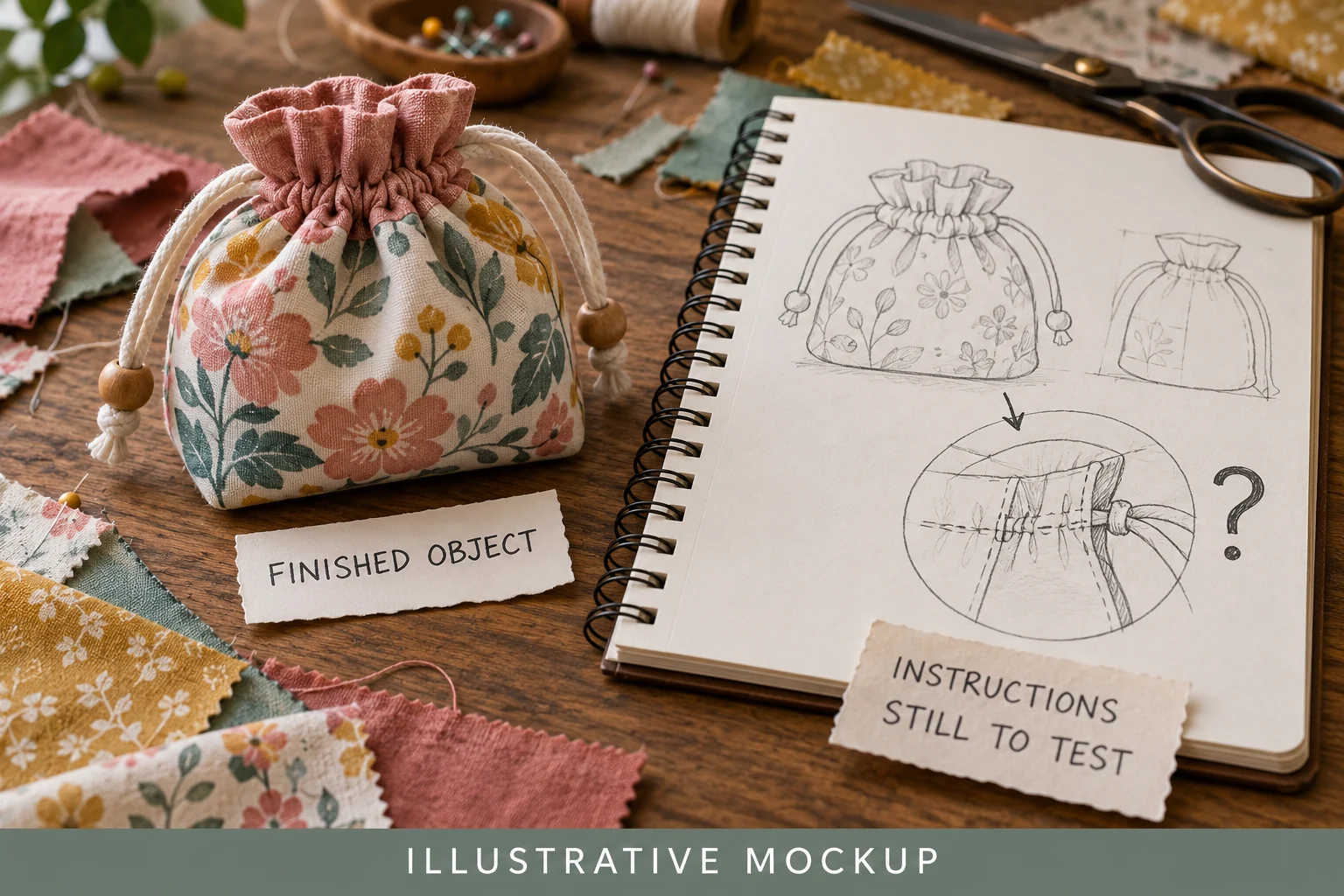
AI-generated illustrative mockup. A maker’s finished object does not establish that another person can reproduce it from instructions. The scene is fictional and contains no tested pattern or customer outcome.
Budget for the product that remains after delivery
A digital file can still generate product issues. LoveCrafts’ designer handbook asks for information such as materials, sizing and difficulty. Its published process also provides for escalating pattern issues to the designer and potentially disabling a pattern while a making-blocking issue is resolved. These are LoveCrafts-specific responsibilities, not universal rules for every marketplace.
Before adding an instructional line, identify who would handle corrections and how revised instructions would be distinguished from earlier versions. Keep actual development and support effort separate from physical making time. Without those records, neither a lower-cost claim nor a passive-income claim is established.
If the chosen route is Etsy, its digital-listing guidance distinguishes ready-to-download and made-to-order digital products and requires the digital item to be made or designed by the seller. Choosing a delivery type does not establish that an instructional product is ready. File retrieval and digital-versus-physical disclosure are later handoff tasks, not substitutes for this offer decision.
Make the next commitment small and specific
Choose among preparing one transferable instruction candidate, continuing a capacity-supported finished offer, investigating both separately, or deferring the new line. Write down what evidence would change that choice. Do not quietly replace a finished-item promise with a file because the file is easier to deliver.
A short demonstration can help show who does the work: the seller completing the object, or the intended buyer using an instruction candidate. It should illustrate the actual offer, not present a simulated completion as proof. Producing a polished video before deciding which job is being sold can make the wrong promise clearer rather than make the offer better.
What the research supports
A historical Etsy seller question explicitly asks about patterns versus finished work and possible cannibalization. A pattern-testing discussion asks how to begin testing while offering both. An adjacent stained-glass discussion raises whether an existing collection of designs merits an offer at all. These are qualitative contexts, not proof of popularity, profitability or non-overlapping customers.
Sources reviewed October 24, 2026. The fictional examples have not been tested with buyers or independent makers and do not establish demand, support costs or marketplace performance.