How-To Guide
Prove the Workshop subscriber path, not the copy already on your development machine
The puzzle-map examples here are fictional.
A tutorial can show a Subscribe click and then a playable custom map without proving the two are connected. The author may already have a local copy that the game loads independently. The map appearing on screen is useful evidence of playability, but not necessarily of successful delivery through Workshop.
For a game launching a map editor or mod feature, make the subscriber's route the subject of the demonstration. Keep the authoring route separate, and identify which state actually produced the content in the recorded session.
The puzzle-map examples here are fictional. They illustrate a proposed acceptance workflow, not a tested game integration or an instruction to change a player's existing mod setup.
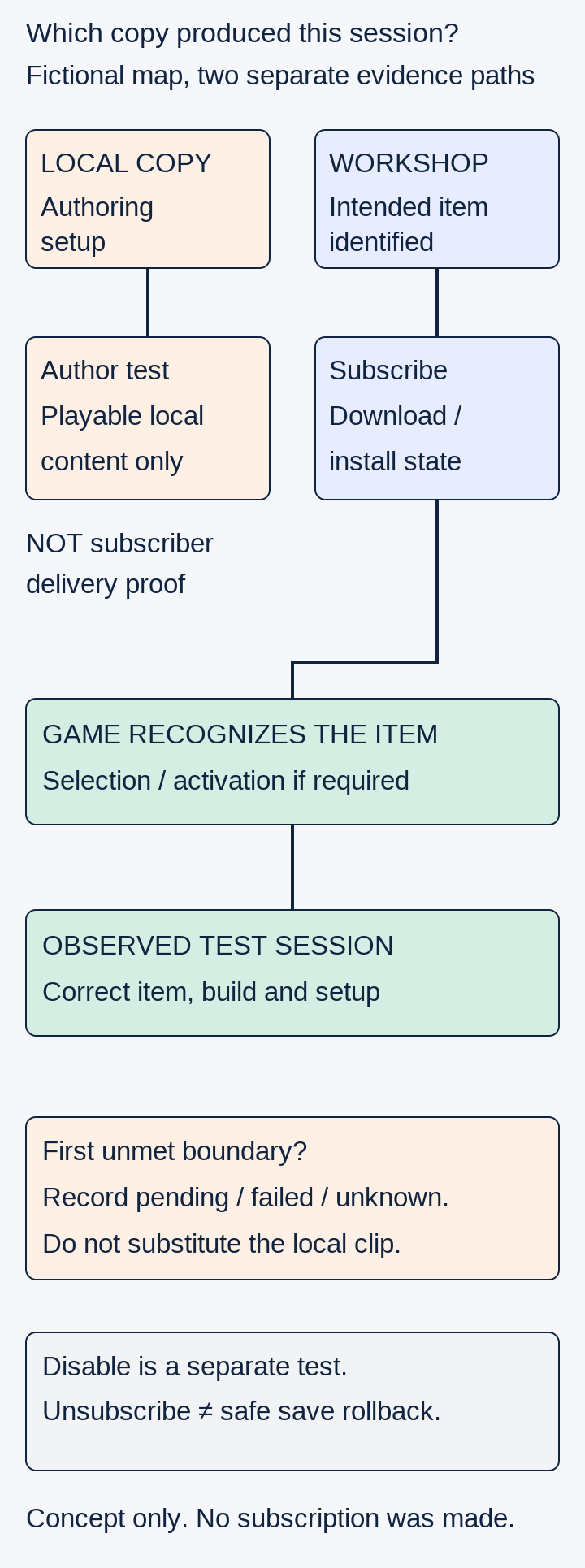
Original conceptual evidence map. A playable local copy is not proof of Workshop delivery, and no actual subscription or session has been tested here.
 Superdirector
Make it work for your brand
Find it. Remake it. Post it. Superdirector turns the viral formats in your niche into your brand's carousels, X posts and video scripts, and keeps the calendar full.
Identify the item and the starting setup
Before recording, note the game build, platform, Workshop item identity, relevant item version and supported test profile or environment. Also record whether a local authoring copy, previous subscription or other content source is present.
The point is not to erase every setting on the machine. It is to know what could make the item appear without the route being demonstrated. Use an existing permitted test setup that separates the subscriber path from authoring shortcuts. Preserve valuable saves and user content rather than deleting them to make the setup look clean.
A publisher guide for King's Bounty: The Legend offers a concrete reason for this distinction. It describes local testing separately from Workshop publication and warns that a local entry plus a subscription for the same mod can create duplicate content in that game. That is a scoped example, not a universal instruction to edit configuration files in every title.
In the fictional puzzle game, the developer's local map is called Glass Garden. The Workshop item has the same display name. Record a stable item identifier or other supported evidence of the source; the matching name alone is not enough to show which copy the session used.
Treat subscription, installation and use as different observations
Valve's Workshop implementation guide separates subscription from installation. It explains that newly subscribed items may still download after the game starts and provides distinct state, download and installation information for integrations. A successful subscription action is therefore not proof that the item is already available in the current session.
For the fictional route, observe these boundaries separately:
- The intended item is subscribed to.
- Its download and installation reach the state the game requires.
- The game recognizes the intended item.
- Any game-specific access or activation step is completed.
- The selected content appears in an actual test session.
Not every game exposes these steps in the same interface. Steam's Workshop explanation notes that some products need an additional activation or access step, while its Game Dev Tycoon section describes items being available on start. Do not invent a manual Enable button when the target game does not use one. Show its real supported path.
If the item is still pending when the game opens, keep that state in the evidence record. Cutting directly to a working map from another setup hides the boundary that a new player may encounter.

The fictional Glass Garden map is shown in a player-facing selection context. A matching map name or creator-side clip does not prove the subscriber route. Original AI-generated editorial illustration.
Investigate the first unmet boundary
If the map does not appear, distinguish what is known from what is merely expected. Is the intended item subscribed? Is installation still pending? Does the game identify the item but not offer it in the relevant mode? Does selection succeed while the session fails to load?
The next observation should follow the first unsupported step. Do not jump from “not visible” to “delete all mods” or “reset every save.” Those actions may destroy useful context without establishing the cause.
A developer's internal diagnostics may help identify the item and state, but a player-facing tutorial should not require undocumented commands unless those commands are part of an approved support workflow. Keep any unresolved integration behavior with the responsible owner rather than disguising it as a successful demonstration.
Test disabling separately, without promising an undo of saved progress
A second fictional test checks the game's supported disable route using a disposable test session. The reviewer records the selected state, any required restart and whether the item is absent from the next relevant session.
That result does not establish that every save created with the item remains usable without it. A map or mod can affect data the player has already saved. If compatibility is not established, leave it unknown and describe the limit instead of promising that unsubscribing restores the earlier game state.
Valve's subscription documentation also describes item removal after the game quits. Do not teach that the unsubscribe click instantly proves every file or running-session effect has disappeared. Match the explanation to the actual supported lifecycle and the scope you observed.
Finish the tutorial with a reproducible handoff
Keep the exact item and game version with the capture notes. Show the real selection path and identify any untested combinations. A title such as “install this map in the tested build” is more defensible than “all Workshop mods work instantly” when the evidence covers one item and setup.
When the item or integration changes, repeat the affected subscriber path instead of reusing an old successful authoring clip. Preserve earlier observations with their original versions so a later failure is not hidden by overwritten notes.
The useful outcome is a demonstration that another person can follow under the stated conditions, with local authoring, delivery, access and session behavior kept distinct. It is not a bigger count of Subscribe clicks or a universal compatibility guarantee.