How-To Guide
Plan an app-service retirement around the work existing subscribers still need
Removing an app from discovery is not the same as ending the service behind it.
Removing an app from discovery is not the same as ending the service behind it. A founder considering retirement or a long rewrite needs to know which customer tasks would stop, what existing paid periods remain, and whether the current service can continue while those questions are resolved.
The useful deliverable is a private service-runout decision. It is not a shutdown date, a cancellation procedure or a message ready to send to customers. No app, subscription, server, account or payment is changed here.
Original dependency illustration, not an actual account, shutdown schedule or guarantee of continuing functionality.
 Superdirector
Make it work for your brand
Find it. Remake it. Post it. Superdirector turns the viral formats in your niche into your brand's carousels, X posts and video scripts, and keeps the calendar full.
Start with the task that depends on the service
Describe what a person can actually do with the installed app and which parts require continued operation elsewhere. Opening a screen, viewing cached information, receiving fresh data and synchronizing a new record are different tasks. A screen that still opens does not establish that the paid service continues.
For a server-dependent product, name the concrete dependency: a content source, synchronization process, processing job or other operational component. Identify who can verify its behavior and what evidence already exists. Do not infer that a local cache is complete, current or permanent because it appears in one session.
This first step changes the decision. If the proposed retirement removes a dependency essential to the paid task, the plan must address that service gap. Hiding the listing does not address it, and a rewrite that may eventually replace the service does not make the gap disappear.
An operator question reveals the difference between an app and its service
In a historical developer discussion, a founder planning a rewrite asks about existing subscribers while trying to stop an expensive server. The author later explains that the product's data changes frequently, so an unchanged database would become progressively stale. The post also asks whether an expected provider payment date identifies subscriber expiry.
Those are unresolved questions, not a completed retirement plan. The author's proposed short continuation period and commenters' refund suggestions are not adopted here. A provider payout label is not evidence of each person's remaining service period. The account setup, applicable commitments and actual entitlement records would need their own authorized review.
A separate replacement-app discussion includes a maker's report that some people kept using an older app without realizing a replacement existed, followed by later compatibility problems. That is adjacent qualitative evidence about continuity and communication, not proof that every rewrite needs a new bundle or that a particular retirement schedule is safe.
Keep four decisions separate
First is new distribution: whether people can newly discover or download the app through a storefront. Second is the subscription offer: whether further signups or renewals can occur under the applicable configuration. Third is service delivery to people who already have access. Fourth is administrative removal of the app record.
Apple's app-availability guide distinguishes removal from sale from continuing updates and eligible redownloads, with the necessary contract condition. That does not keep your backend running or guarantee compatibility indefinitely.
Apple's app-record removal guide describes a different action with prerequisites and consequences for the name and identifiers. It is not a cleanup shortcut for ending service obligations. Do not perform that action just because an internal planning sheet uses the word “retired.”
A decision in one row must not silently mark the other rows complete. Keep current state, proposed action, authority and observed result separate for each.
Worked case: a cloud recipe organizer awaiting a rewrite
Imagine PantryPages, a fictional cloud recipe organizer. The founder wants to stop new promotion while rewriting the service. Existing monthly and annual paid periods have not yet been reconciled. No customer count, cost or deadline is supplied in this example.
The next planning artifact is a service-coverage record, not a preferred server termination date. It identifies the paid task, the applicable remaining periods, the operational work needed to preserve access and the person responsible for verifying it. Unknown durations remain unknown. The worksheet uses bounded internal identifiers rather than exposing customer details in editorial documents.
Suppose the proposed rewrite is not ready to serve existing recipes. That fact should remain visible. A promising prototype does not establish a migration path, complete data preservation or an alternative that subscribers have accepted. If continued operation is not feasible, the founder needs the applicable provider and professional review before committing to an outcome, rather than guessing that delisting solves the problem.
This is a planning decision about service continuity. It does not prescribe retaining an insecure system, moving private data, issuing refunds or making an unsupported replacement promise.
Read the subscription timing guidance within its actual scope
Apple's subscription-availability guidance says eligible subscribers must receive content through their subscription duration. It distinguishes removing the subscription from sale to stop further signups and renewals from stopping the service. Its minimum 31-day interval addresses monthly and shorter subscriptions; for longer periods that cannot be fulfilled, it directs developers to contact Apple. It also recommends advance notice.
That is not a universal 31-day shutdown clearance. This article does not determine anyone's contractual or legal obligations, approve a refund approach, or establish an actual end date. The owner must verify the applicable current terms and facts with appropriate support. Do not turn a minimum or recommendation into proof that all paid periods have finished.
Worked case: local reading remains, but sync does not
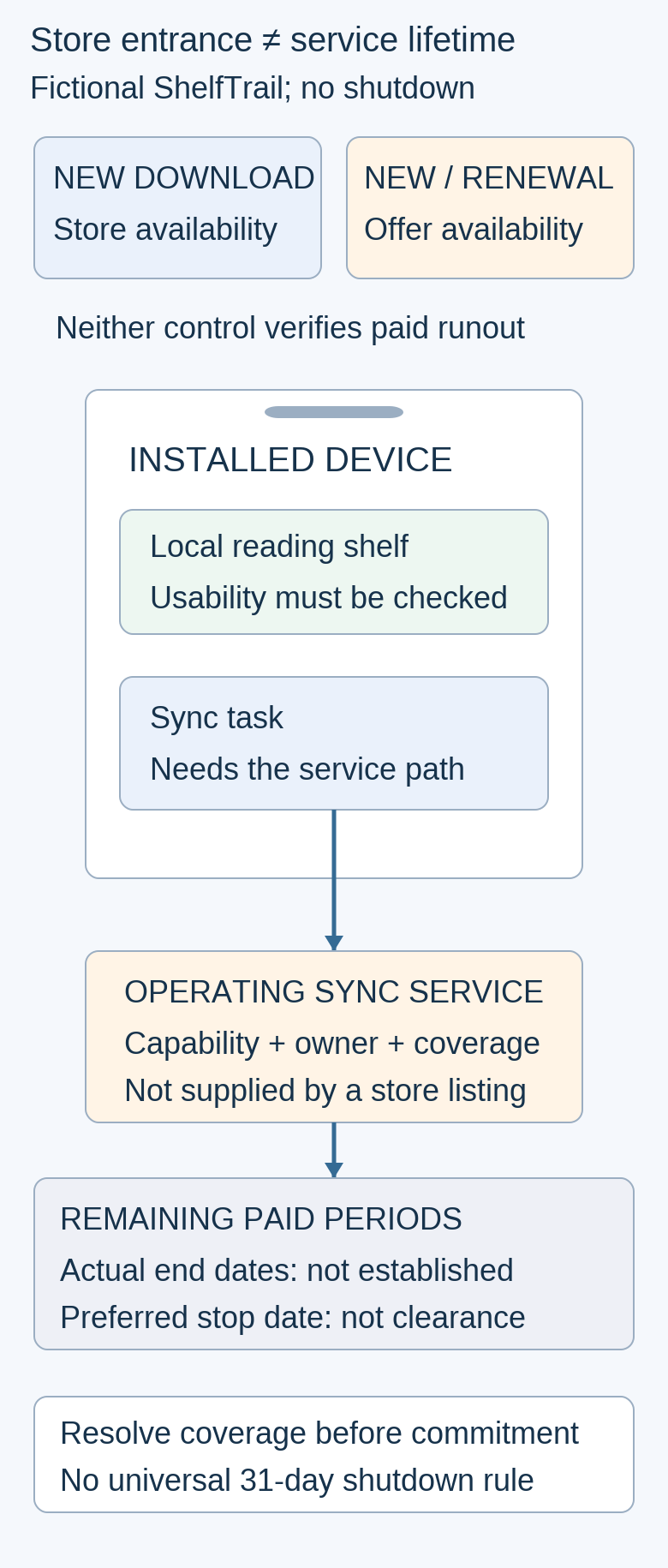
Consider ShelfTrail, a fictional reading log with a local reading task and a separately sold sync service. A proposed retirement plan says the app will remain useful offline. That statement needs a bounded definition.
What existing information is actually available locally? Can a person add a new record? What depends on the service when using another device? Which paid task was promised? A local shelf view may remain available while synchronization fails. Those are different outcomes, not interchangeable versions of “the app still works.”
Inspect the proposed surviving task with safe synthetic records and identify the conditions under which it is supported. Do not promise eternal compatibility or complete data custody from a one-device observation. If export is part of a separate continuity proposal, verify its actual contents and supported use rather than labeling any downloaded file a complete replacement for the service.
The next decision is whether the plan covers the real paid sync periods and preserves a truthful description of the remaining local task. An untested local fallback does not justify ending a promised service early.
Prepare the communication decision after the facts
Before proposing an external notice, establish the affected task, intended change, supported options and unresolved dates. Have the authorized owner review any commitment. Do not tell people that their data is safe, their payment will be refunded or the replacement will arrive on time unless the applicable evidence and approvals support those statements.
A communication plan can identify the approved channels and the information each audience needs without sending anything. It should not assume that every installed user reads release notes, that an email reaches everyone or that silence means acceptance. Existing communication permissions still apply.
Use the blank service-runout worksheet to connect the actual paid-period evidence to the service capability and next decision. If those records are incomplete, the date remains unresolved. That is a material finding, not a reason to fill the cell with the founder's preferred date.

Original AI-generated editorial illustration. Locally retained reading and continued synchronization are different service capabilities. This is not a product capture, customer scene or completed test.
End with a pre-action gate
The decision is ready for the next authorized step only when the relevant owner can explain what changes for new customers, what remains for existing customers, how the applicable periods are accounted for and which operations still need support. A plan may conclude that more evidence or provider clarification is required.
The source discussions are historical or adjacent. They do not establish current costs or an appropriate schedule for another business. Use the plan to resolve service coverage and remaining paid periods before committing to a retirement date.