How-To Guide
Plan a first market around the product you want customers to understand
No application, purchase, customer contact or order-taking was carried out.
A maker who normally produces to order faces a different decision at a retail market: should the table hold finished items people can take away, samples of the core product, or both? Filling the space with unrelated inexpensive goods may create transactions without telling you much about demand for the product you intended to introduce.
Begin with one concrete question: what should a visitor understand about your core offer, and what can you actually provide at this event? The answer needs to fit the approved product range, available stock and existing production commitments. It does not come from multiplying an organizer's attendance claim by an invented buying rate.
This article describes a planning exercise, not an event booking or inventory recommendation. Sources were checked on October 24, 2026. No application, purchase, customer contact or order-taking was carried out.
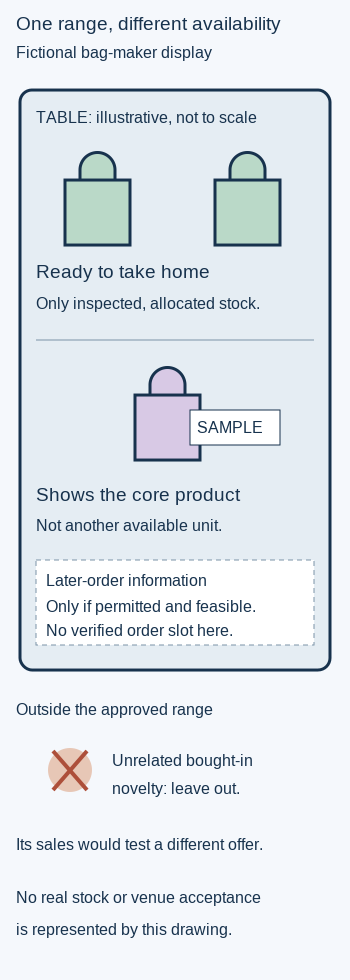
The drawing explains offer roles. It is not a venue-compliant construction plan, a real inventory count or a photograph of a booked booth.
 Superdirector
Make it work for your brand
Find it. Remake it. Post it. Superdirector turns the viral formats in your niche into your brand's carousels, X posts and video scripts, and keeps the calendar full.
Separate three things that can look identical on a table
A finished item available to take home, a demonstration sample and an example of something that might be ordered later can look similar. Their availability is different. Make the distinction visible before a shopper becomes attached to an item you cannot sell or reproduce on the suggested schedule.
For a fictional fabric-bag maker, the table could hold finished bags from one design family and a clearly marked sample showing a different available configuration. The finished bags are actual stock. The sample is there to explain construction or options, not to imply another ready item exists.
Any later-order route is a separate decision. Establish whether the event permits it and whether the maker can support it before presenting it as an available purchase. A sample's presence does not establish permission to take a deposit, a feasible completion date or an order slot.
The planning record should therefore distinguish the physical item, its role on the table and the next action the seller can genuinely support. “See this sample” and “take this item home” should not be interchangeable labels.
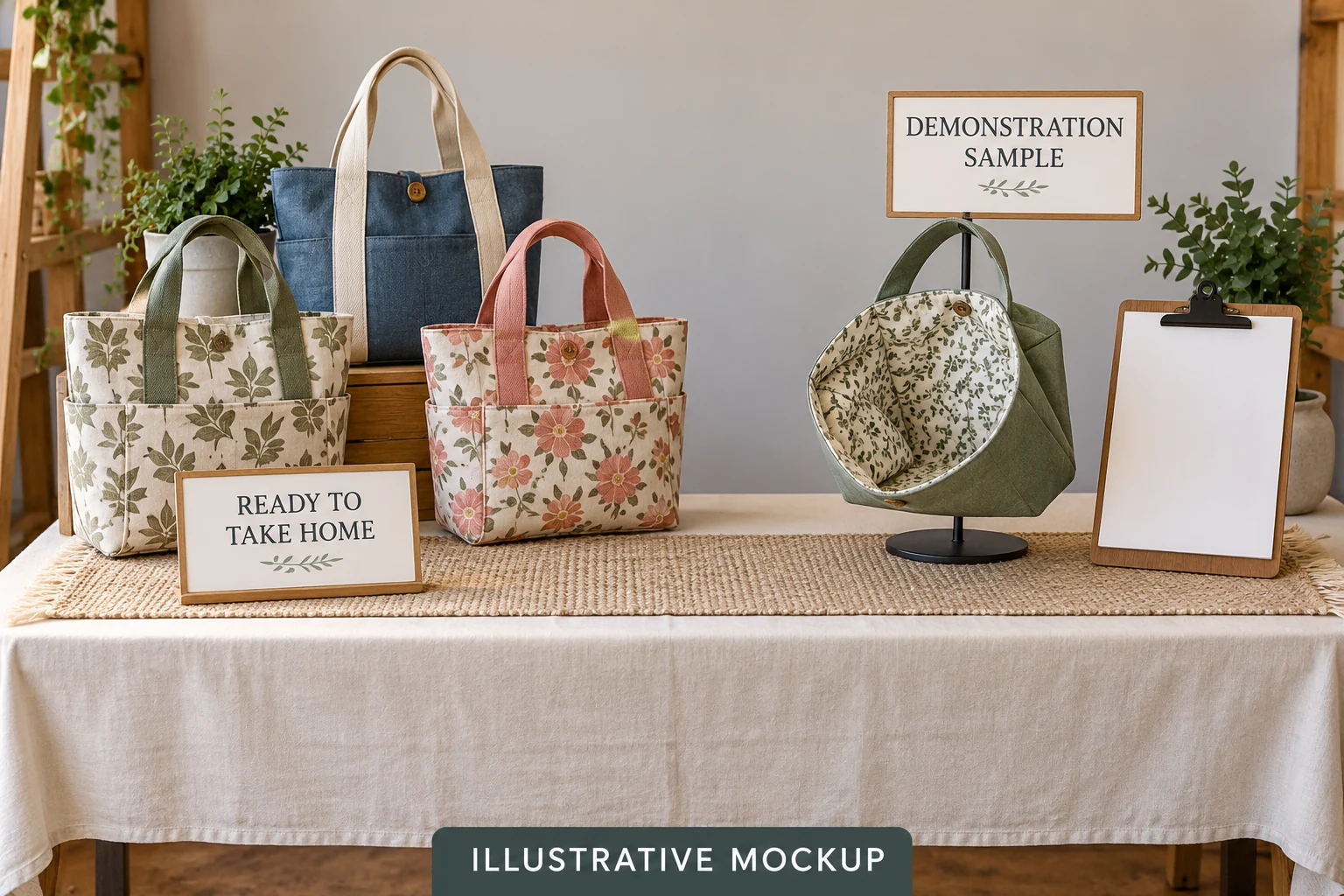
AI-generated illustrative mockup. The table is a fictional rehearsal, not event inventory or an approved booth. Available stock, samples and possible later work must remain visibly distinct and match the actual event rules.
Keep the event's approved assortment in view
Read the requirements for the actual event, not just advice from sellers at other markets. For example, Renegade's San Francisco participation kit restricts sales to products included in the approved application. It also places conditions on outsourced items and requires displays to stay within the assigned footprint. Those are named-event requirements, not a universal craft-fair policy.
Suppose the fictional bag maker considers adding bought-in novelty accessories to make the table look fuller. If the approved range covers the handmade bags but not those accessories, the seller cannot treat the additions as automatically acceptable. Even apart from eligibility, their sales would answer a different product question.
Renegade's application guidance describes its originality and production criteria and currently states that 2026 applications are closed. It excludes premade resale and AI-generated art or designs under its stated criteria. This article is not a recommendation to apply now, an acceptance prediction or a source of artwork to submit. A different event may have different requirements.
The participation page mixes seasonal wording and operational dates. Verify the relevant event edition before relying on its timetable. Permission for a particular later-order arrangement was not established in this research.
Choose a coherent offer before choosing a stock target
The useful choice is not simply “more stock” versus “less stock.” Ask which items help a visitor evaluate the same core offer. A finished bag in the same design family can demonstrate the workmanship while offering immediate availability. An unrelated impulse item might earn a sale but reveal little about willingness to buy the bag.
Write the reason for including each proposed item. Does it demonstrate a material difference, provide a ready version of the core product or serve a clearly distinct business objective? Keep those objectives separate when interpreting the result.
If you cannot prepare a relevant ready-stock range without displacing existing commitments, that is a planning constraint. A smaller demonstration, a different permitted format or deferring participation may be more appropriate than inventing an unrelated product line. This is not a claim that samples never lead to orders or that ready stock always performs better.
Bound preparation by what you can actually make
Start with finished stock you have inspected and are willing to allocate to the event. Keep demonstration samples out of that available-stock number. Then identify the work still required for any additional pieces, alongside existing orders and ordinary operating responsibilities.
The missing information matters: material availability, making time, finishing or inspection steps, packing and transport can constrain what is realistic. Leave unknowns visible rather than turning a hopeful preparation schedule into a customer promise.
Do not adopt another seller's suggested quantities as a benchmark for your product. Differences in price, audience, production method and event conditions make that shortcut unreliable. The first event's audience is not yet your measured audience, and an organizer's total attendance is not the number of people who will consider your particular offer.
Rehearse the explanation before the event
Arrange a small mock display using the actual items or clearly identified stand-ins. From a visitor's position, check whether someone can tell which goods are available now, which are samples and which options require a later discussion. Do not rely on the seller remembering to explain every distinction after someone asks to pay.
Prepare a short product demonstration showing the core item, its meaningful options and the availability distinction. This can also inform an Instagram post or a professional YouTube walkthrough, but the creative should show what the seller can actually provide, not a table made to appear fully stocked through repeated images.
If a permitted next step uses a phone or online page, test that route before claiming it works at the venue. The named San Francisco kit warns that connectivity may be unreliable. A demonstration that depends entirely on a live connection needs its own verified contingency. No connection, payment or onsite test has been performed here.
Observe the core offer separately from the surrounding activity
After an authorized event, distinguish questions about the main product, inspection of samples, purchases of ready pieces and any permitted later-order requests. A compliment is not a paid order. A sale of an unrelated accessory is not proof that a custom bag offer worked. A request for an unavailable option may identify a question to investigate, not a production commitment to accept immediately.
Record the offer and stock available at the time of each observation where practical. Selling out of a ready item changes what later visitors can do; comparing those visitors as if they saw the same offer can mislead the next preparation decision.
The next decision might be to bring more of an observed relevant configuration, improve the sample explanation, reduce an unrelated range or reconsider the event. It requires actual results and costs. Nothing in this research establishes a profitable quantity, repeat-order expectation or universal event strategy.
Why this question is worth testing, not treating as settled
A made-to-order Etsy seller preparing for a first market asked how much ready stock to bring alongside the core offer. A separate first-time juried-event applicant asked which items fit the event. These are independent self-reported situations, not sales benchmarks or verified evaluations of their products.
Do not adopt suggested stock quantities, deposit tactics or judgments from those replies without checking the actual event and offer.
The immediate next action is a small offer map: the core product, actual take-home stock, marked samples and any later route whose permission and capacity are still unresolved. Review that map against the exact event requirements before committing more preparation. A coherent, feasible offer is the starting point; a busy-looking table is not the same result.