How-To Guide
Music creators or app reviewers: choose by the demonstration your music app needs
Compare music creators and app reviewers using a shared demonstration brief, real task evidence, audio rights and complete quotes.
For my music app, should I shortlist music creators or app reviewers before paying for a micro-influencer test?
Shortlist music creators when the app's value is best understood inside a real music activity. Shortlist app reviewers when the main question is how the software works, which device it supports or how its controls differ. If you do not yet know the app's strongest use case, compare both types before paying either.
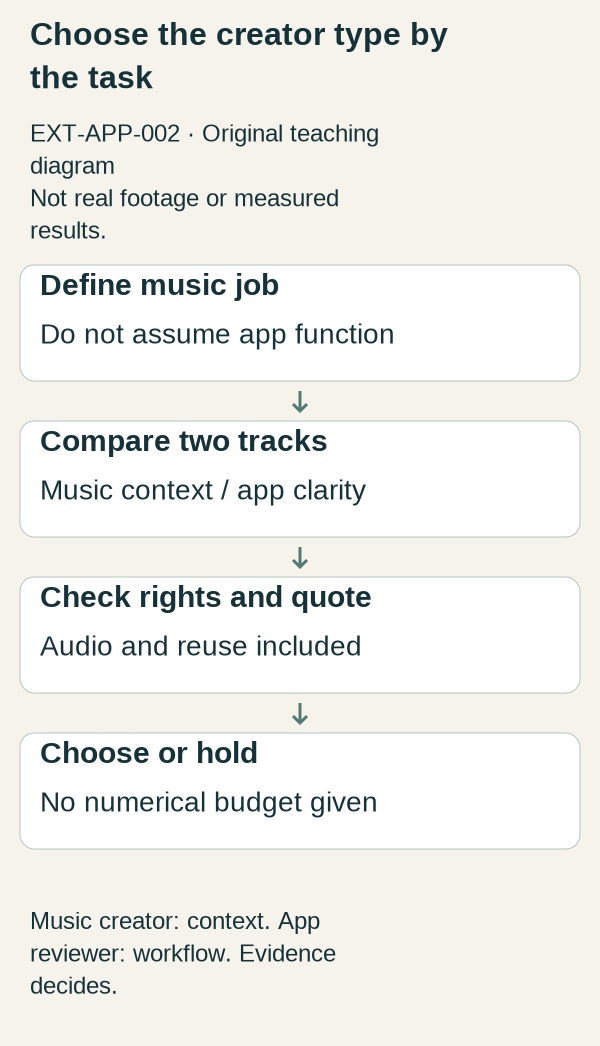
Original illustrative teaching diagram. Choose music creators versus app reviewers by the music job, demonstration evidence, audio/reuse rights and actual quote; no numeric budget is invented. This is planning guidance, not product footage, customer evidence or measured results.
Shortlist music creators when the app's value is best understood inside a real music activity. Shortlist app reviewers when the main question is how the software works, which device it supports or how its controls differ. If you do not yet know the app's strongest use case, compare both types before paying either.
“Music app” is too broad to decide the answer. A listening organiser, practice aid, creation tool and discovery app can require different demonstrations. The question behind this page named a general music app and a limited budget, but no specific function, country or numerical spending limit. Do not import a book-app's $200 budget into this decision.
 Superdirector
Make it work for your brand
Find it. Remake it. Post it. Superdirector turns the viral formats in your niche into your brand's carousels, X posts and video scripts, and keeps the calendar full.
State the job in a single sentence
For this fictional example, LoopNotebook lets people save their own short musical ideas and organise notes about them. It is not a streaming service, does not license commercial songs and does not promise professional audio production. The example assumes the founder can supply cleared demo audio and an actual working build.
Its decision sentence is: “We want someone to demonstrate capturing an original idea and finding it later.” That sentence points to two plausible creator tracks. A music creator can show the activity in context, and an app reviewer can explain the capture-and-retrieval workflow. Neither type wins merely because of the category label.
Replace the example with your actual product task before you research accounts. A listening-discovery app, for instance, would change which posts are relevant and which rights questions you ask.
Track A: music creators
Look for existing content that includes the activity your app supports. In the fictional example, that might be a creator explaining how they hold on to original ideas during practice. Look at the actual post and note what the creator does, beyond the instruments visible in the thumbnail.
One strength is that the product can appear in a believable workflow. One limitation is that the audience may care about the performance but not the tool, or the creator may skip the software details a viewer needs to understand it.
Keep unknowns explicit: compatible device, language, audience location, willingness to demonstrate an unfamiliar app, audio rights and paid availability. A musician's skill does not establish that their audience is eligible to install your app.
Track B: app reviewers
Look for creators who demonstrate comparable software interactions on the supported device. In our example, check how they explain recording, saving, search and permissions. A roundup that merely flashes app icons is not a walkthrough.
A reviewer's walkthrough may explain setup, controls and limitations more clearly. The video may also lack the music context that makes the feature feel necessary, and a technically accurate tour can still fail to explain why someone would use the app.
Do not infer purchase intent or installation rates from view counts. Reviewers may attract people browsing for novelty. The research question is whether their actual format can communicate your task honestly.
A completed two-track comparison
Music Candidate A is fictional. Its invented example post shows the creator recording an original phrase during practice and revisiting it later. The task fit is strong, but the creator explains the software only briefly. Device compatibility, audience geography, quote and reuse rights are unknown. Decision: ask whether the creator can include the full save-and-retrieve sequence, provided the real account evidence supports the same fit.
App Reviewer B is fictional. Its invented example post clearly demonstrates a phone utility's setup and limits. The workflow format fits, but the post gives little music context. Decision: ask whether the creator can demonstrate an original idea-capture scenario using cleared sample audio instead of a generic feature list.
Neither candidate is a real recommendation or purchase-ready lead. The example shows how to find the missing evidence that matters, without producing a falsely precise score.
Give both tracks the same core brief
Use this complete draft brief when requesting a scoped proposal:
“Demonstrate [verified app name] performing [one real music task] on [supported device/build]. Use your own cleared original audio or the cleared sample we provide. Show the starting situation, the actual app action and the saved result. Include any material setup work and an honest limitation. Do not imply the app licenses commercial music, guarantees audience growth or produces professional results unless those claims are separately established. Please describe the format you propose, any required access, the complete price and the exact usage rights. A positive review is not required.”
Then add a track-specific question. For a music creator: “How will viewers follow the software action as well as enjoy the performance?” For an app reviewer: “How will the musical use case stay understandable and not become a menu tour?”
Choose the proposal that best resolves your actual communication problem. Do not force both into an identical style if that removes the reason you considered them.
Check audio rights before treating a clip as reusable
Record who owns the composition, recording and any samples used in the proposed demonstration, and what permission you have for each intended use. A familiar song heard in a creator's ordinary content is not automatically cleared for your sponsored post, website or paid advertisement.
Ask whether the quoted rights cover the creator's original post, your organic reposts, edits, captions, paid distribution, territories and duration. Do not assume a platform's music availability transfers across platforms or into advertising. Resolve uncertain rights before publication; removing a credit and hoping the problem disappears is not a fix.
The simplest teaching asset is often an original short musical phrase with documented permission for the specific uses. That is a production option, and it is not a legal conclusion: an “original” file can still contain third-party elements.
Decide whether to buy one test, two tests or neither
This music-app scenario comes with no numerical budget. Set your own all-in ceiling before you ask anyone to commit. Get complete quotes that cover deliverables, revisions, fees, rights and cancellation conditions.
If one creator can demonstrate the whole task within the available budget, a single well-scoped test may answer the immediate question. If you compare two types, keep the task and destination comparable and note the differences in audience and format that you cannot avoid. Two posts are not a controlled experiment, and they cannot prove that one creator category is universally better.
If neither proposal makes the use case clear, make a founder-recorded walkthrough first. That can sharpen the brief and show whether the product itself is hard to demonstrate. Keeping the money is a legitimate decision.
Reusable comparison sheet
App task ___; available regions/languages/devices ___; music-track post evidence ___; reviewer-track post evidence ___; proof each format can show ___; unanswered audience questions ___; audio ownership and permissions ___; deliverable/rights quote ___; total cost ___; disclosure plan ___; destination ___; learning question ___; decision ___.
For applicable US endorsements, the FTC's influencer guidance calls for clear disclosure of material brand relationships. Build that into the proposal; a paid test should not masquerade as an unsolicited discovery. Check additional local and platform requirements before publishing.
Your next step is to write down the real app task and inspect one substantive post from each track. The useful output is a reasoned choice with documented unknowns. A list of “top micro-influencers” assembled from follower counts is not that. This framework and its fictional comparisons are original; the page claims no creator availability, price or acquisition result.