How-To Guide
Make an audio-cleanup demo fair enough for a buyer to judge
A louder “after” clip can sound more impressive without proving better cleanup. A shorter clip can hide the very consonant the tool damaged.
A louder “after” clip can sound more impressive without proving better cleanup. A shorter clip can hide the very consonant the tool damaged. For an audio-app founder preparing a first release, the useful launch asset is a reproducible listening comparison, not an unexplained dramatic waveform.
Define the buyer's task first: perhaps making a spoken tutorial understandable while preserving the speaker's words. Then design a comparison that lets the listener judge both remaining noise and unwanted changes to speech. This article describes a proposed protocol. No audio experiment or performance improvement is claimed here.
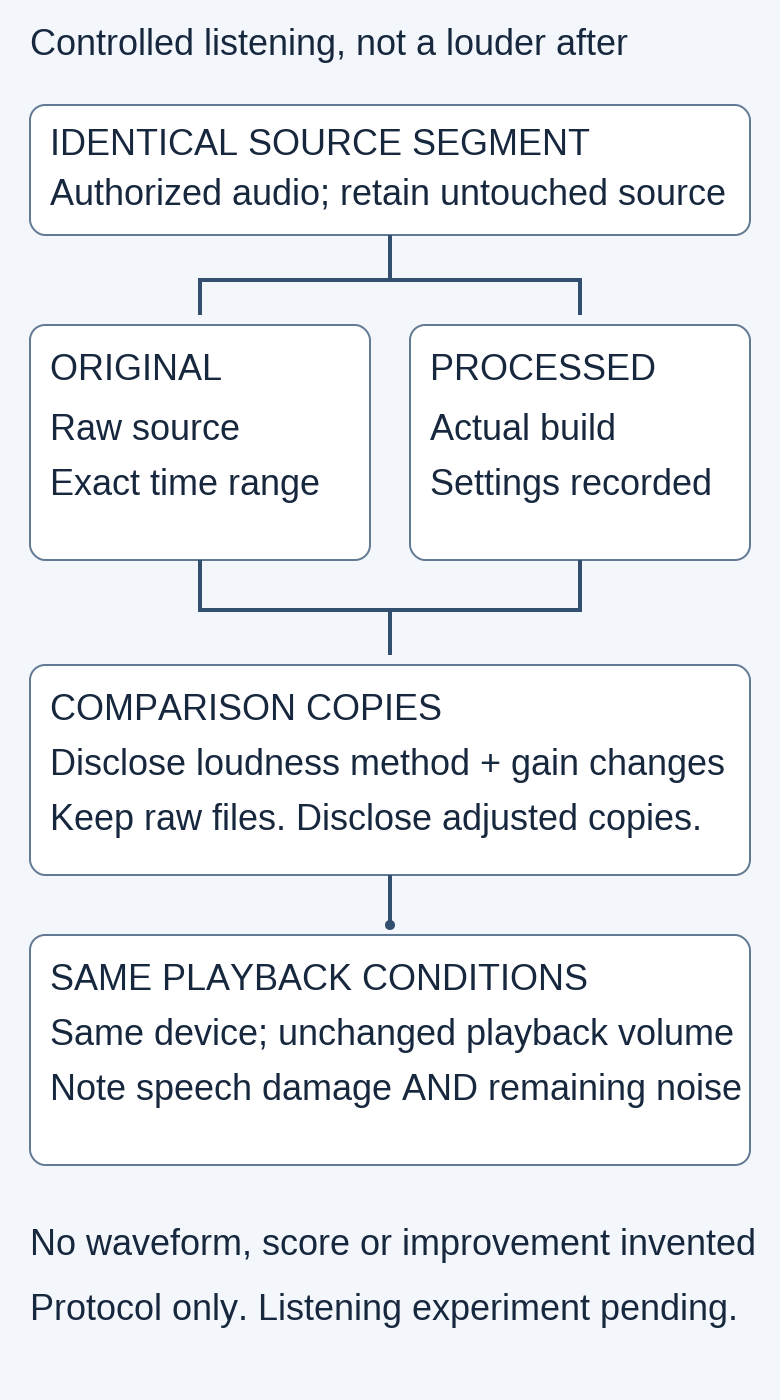
The diagram contains no waveform, decibel improvement or observed test result. It shows which variables the proposed experiment should hold or disclose.
 Superdirector
Make it work for your brand
Find it. Remake it. Post it. Superdirector turns the viral formats in your niche into your brand's carousels, X posts and video scripts, and keeps the calendar full.
Keep the spoken segment identical
Use audio you own or have permission to use. Select the same start and end points for the original and processed versions, and preserve an untouched source. Record the app build, processing settings, file format and any later adjustments.
Do not trim a difficult word from only the processed version or conceal an awkward transition with background music. If the product changes timing, document that behavior rather than silently aligning away the difference. A demo should expose the decision a buyer must make: is the resulting speech more usable for this task, and at what cost?
A hypothetical example might contain a steady fan behind a short spoken passage. Keep a quiet consonant and a pause in the selected section. These provide something concrete to listen for without inventing a score or promising that every kind of noise will disappear.
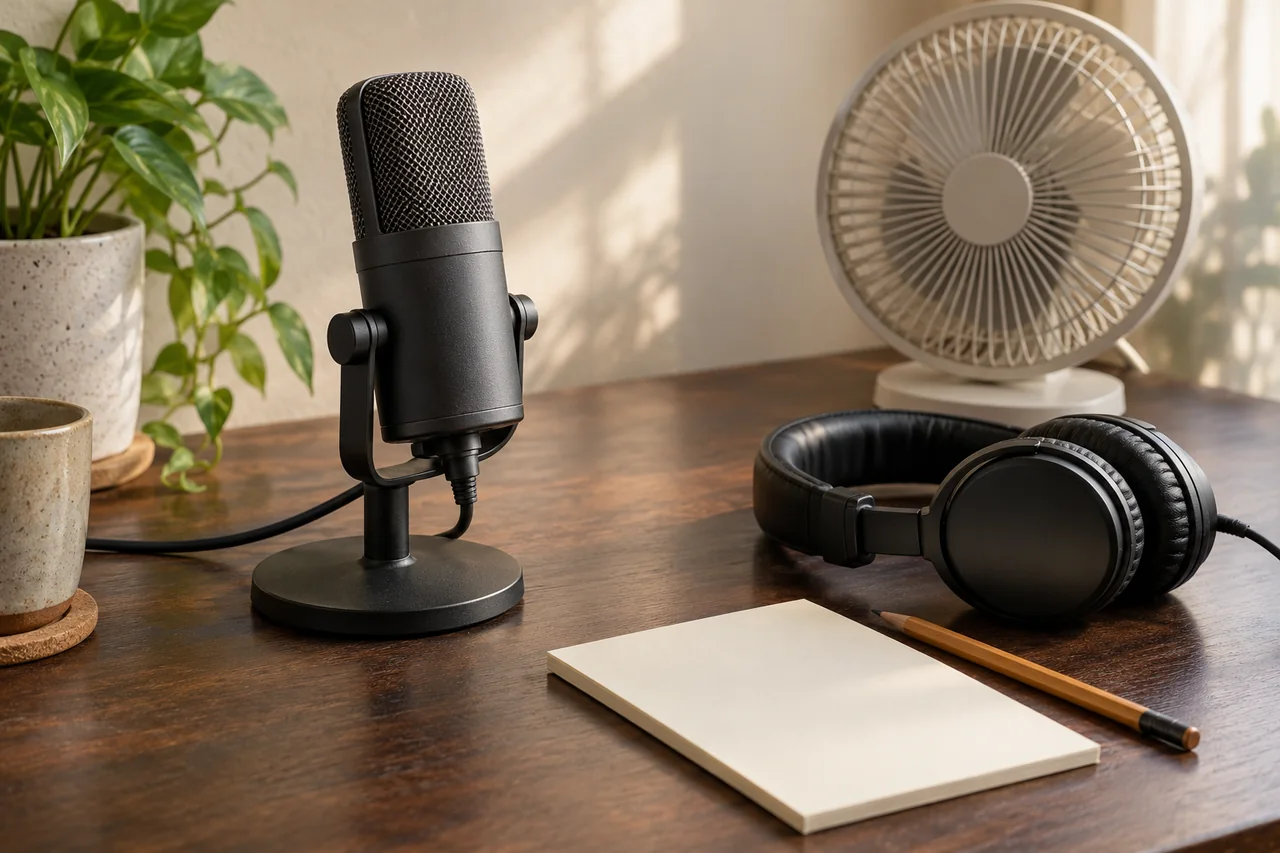
AI-generated editorial illustration of a voice-recording setup with a nearby fan. It depicts the steady-noise scenario discussed here, not equipment used in a completed test or proof of audio-cleanup performance.
Match listening level transparently
Audacity's Loudness Normalisation documentation distinguishes a target loudness from a target peak. Matching the highest peaks alone is not the same comparison. It also warns that separately normalizing stereo channels changes their balance.
For your demonstration, preserve raw original and raw processed exports. If preparing level-matched comparison copies, disclose the loudness method and every gain adjustment rather than passing those files off as untouched product output. Use the same selected passage and document the measured values when you actually measure them. Do not invent a target or measurement merely to fill a worksheet.
Once prepared, keep the playback device and its volume control unchanged during the A/B comparison. Separately document any normalization or enhancement added by the player or distribution platform. If those conditions cannot be controlled, state that limitation and provide the authorized comparison files where appropriate. Loudness preparation is a disclosed comparison step, not permission to turn up the favorable version mid-playback.
Listen for damage, not just silence
Audacity's Noise Reduction guide describes its noise-profile workflow for steady background noise and warns that overly aggressive settings can damage wanted audio. Its removed-noise audition helps inspect whether desired content is being discarded. This is a description of that particular effect, not a specification for every AI denoiser.
For the app being demonstrated, ask a listener to note missing syllables, altered consonants, unnatural tails and distracting artifacts, alongside remaining noise. Record time locations and the listener's words. Do not summarize “no issue noticed” as proof that no distortion exists.
If the app has an equivalent residual or difference-monitoring tool, inspect it as documented. If it does not, do not manufacture one in the video. Listening to the same phrase before and after is still more informative than judging the background gap alone.
Include a difficult case the product may not solve
Prepare a separate clip with a different disturbance, such as an isolated interruption, if it fits your intended scope. Label it separately from the steady-noise example. Do not use success on fan hiss to imply success on every transient sound.
A podcaster's public question describes hollow-sounding output and labor-intensive cleanup. It concerns mouth noise and a noise gate, so it is adjacent evidence of a buyer's concern about usable speech, not proof that a stationary-noise algorithm is defective. Product recommendations in replies do not supply a controlled benchmark.
A failed or no-benefit example can usefully explain a product boundary. It should not be hidden merely because the acquisition asset aims to persuade. The buyer needs a realistic route to their task, not a guarantee inferred from a cherry-picked segment.
Package the comparison so it can be challenged
Use the blank listening worksheet to record source rights, exact segment, processing settings, raw files, comparison-copy adjustments, playback conditions and listening observations. Keep numerical measurements blank until performed. Retain the unfavorable observations and any revision history.
Before release, obtain an independent listening review and inspect the final page and social encodes. A source-file comparison can be valid while a platform's playback processing changes the delivered experience. Verify the actual published version separately if publication is approved.
Useful listening evidence, audience understanding, repeated use and paid adoption are separate outcomes. A careful comparison protocol makes later performance claims testable; it does not make them true in advance.