How-To Guide
Is founder-assisted onboarding teaching the app or delivering the service?
A successful setup call can hide two very different products. In one, the founder explains a confusing step and the person then uses the app independently.
A successful setup call can hide two very different products. In one, the founder explains a confusing step and the person then uses the app independently. In the other, the founder performs essential work each time the customer needs a result. Both can be legitimate experiences, but they have different capacity requirements and should not be marketed as the same self-service software.
Before replacing calls with a video or sending more people into the signup flow, identify exactly what the founder contributes. The output of this exercise is a labor-and-offer decision: retain bounded assistance, improve a named product step, or hold wider self-service promotion while continuing existing commitments. It is not a hiring, pricing or withdrawal plan.
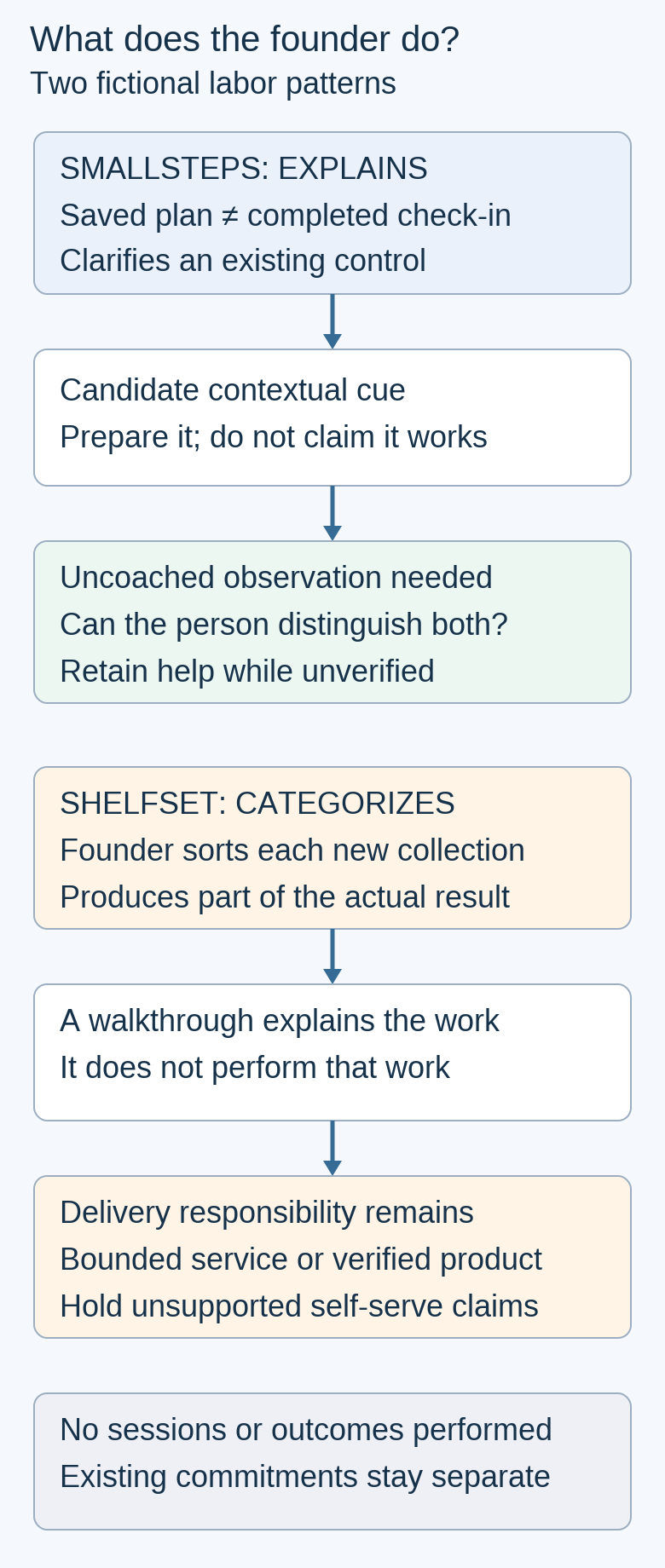
Original fictional labor map. No call, manual service, automation or customer result has been executed.
 Superdirector
Have your AI do this for your brand.
7 days free, then $29 a month.
Record the work, not just the call length
For one authorized, already documented interaction, separate four kinds of contribution. An explanation helps someone understand an available control. One-time setup prepares the person's environment. A workaround compensates for a defect or missing capability. Continuing delivery labor produces part of the result whenever the service is used.
These are editorial categories, not a validated scoring model. A single session can contain several. Record the actual action and what would happen without it rather than assigning a convenient label to the whole call.
For example, saying what “Save plan” means is different from manually reorganizing a customer's collection. A help video could explain the first action. It cannot perform the second action merely by existing. Calling both “onboarding” makes the ongoing work disappear from the offer.
Do not collect credentials or private customer material to complete this editorial record. Use permitted notes or a synthetic rehearsal. Keep necessary security and permission boundaries intact.

Original AI-generated editorial illustration. Assistance can explain a control or perform essential delivery work; record which contribution is needed. This is not a product capture, customer scene or completed test.
Three questions, with different evidentiary weight
A habit-app maker's comment asks how repeated spoken explanations can become in-product onboarding for people arriving without a live walkthrough. The relevant evidence is the question about explanation transfer, not the surrounding thread's easy-growth claims or the commenter's self-reported metrics.
An adjacent B2B founder discussion describes demos, migration help and continuing support competing for time. The author later agrees with a proposed direction, but does not report a completed transition. Its economics and labor figures cannot establish what a consumer app can afford.
A separate question asks what gave founders confidence that setup would still work without live help. The author's own operating experience is not established. These are qualitative contexts, with date and authenticity limits, not three proven success cases or a popularity estimate.
The common decision is what the assistance actually does. Whether a person completes a coached session is only part of that answer.
Worked example: turn an explanation into a testable product change
Consider the fictional habit planner SmallSteps. In the illustrative case, the founder repeatedly explains that a saved plan is not a completed check-in. The underlying controls exist, but the distinction is unclear to new people.
Record the explanation in neutral terms: which two concepts were confused, what the founder clarified and which action followed. Do not record the customer's ordinary task as a sensitive personal story or turn their confusion into a testimonial.
The proposed product change is a contextual distinction beside the relevant control, using a fictional task such as packing a bag. The next observation would ask whether an intended user can distinguish planning from recording completion without that spoken cue. A prototype can test the wording before a production change is considered.
Keep optional help available while the new design remains unobserved. A prepared label is not proof that the explanation is no longer needed. If the person still needs clarification, record the dependency rather than coaching them through it and declaring the flow self-service.
The business decision here concerns learning from repeated explanation. It does not justify removing all contact routes or promising that every user will understand the same wording.
Worked example: a video cannot replace recurring delivery labor
Now imagine the fictional catalog app ShelfSet. In this second illustrative case, the founder manually sorts each new collection into useful categories. That sorting is part of the delivered result, not merely an explanation of a button.
A walkthrough could show the customer how the process works, but it would not eliminate the actual categorization work. The founder must decide whether to retain a deliberately assisted service within real capacity, develop and verify a product capability, or hold broader self-service promotion. The worksheet does not choose a fee, a hire or an automation provider.
Keep the current service boundary honest. If assistance is essential, the offer should not imply that the software produces the result unaided. Likewise, a plan to automate later does not establish present independence or a delivery date.
Do not assume every collection will take the same effort. Use actual permitted observations to understand variation before making commitments. A synthetic example cannot establish serving cost, capacity or a sustainable customer count.
Use manual work for learning without borrowing a growth guarantee
Paul Graham's 2013 essay argues that early manual work can reveal what a product should do. It is historical founder advice, not an empirical rule that unlimited assistance is affordable or that every app should become a service.
Use that idea as a question: what have repeated interactions taught us that can change the product or clarify the offer? Do not use it to excuse concealed manual work, unbounded availability or access to customer accounts without permission. This article does not adopt the essay's distinctive company examples or growth projections.
If the same work recurs but no learning is recorded, call that out. It may be a continuing service requirement, a product gap or an unresolved process problem. Adding an AI helper, hiring someone or changing prices would be separate decisions requiring their own evidence and authorization, not automatic outcomes of the category label.
Separate research observation from customer support
An uncoached attempt is useful only when the participant understands the activity and agrees to the relevant observation arrangements. Nielsen Norman Group's moderation checklist distinguishes session expectations, observers, recording permission, realistic tasks and follow-up questions. Its guidance does not authorize recording a customer or silently withholding promised support.
Prepare a research activity separately from a support request. Explain the intended task, the observer's role and how assistance will be handled. Use appropriate consent and avoid unnecessary personal information. If the activity is only a prototype review, label it accordingly.
When help is provided, record what it contributed. That does not make the session worthless; it changes what it demonstrates. A person completing the task after a founder supplies the crucial instruction is evidence about assisted use, not proof of unaided use.
This is a proposed observation plan; no completed session is reported. Do not invent a session, participant or success rate to close the worksheet.
Choose an honest next delivery boundary
Use the blank assistance worksheet to identify the task, founder contribution, recurrence and proposed next action. Keep existing customer commitments separate from an experiment about future self-service acquisition.
For repeated explanation, prepare and review a specific contextual improvement. For a product defect, investigate the actual failure. For essential continuing labor, retain a truthful bounded service description while assessing capacity or product work. If evidence is insufficient, hold the broader self-service claim rather than pretending the dependency is gone.
Measure later outcomes separately: assisted completion, unaided completion, the actual useful result, founder effort, repeated useful work and payment. Fewer calls can reflect less need for help, fewer customers or an inaccessible support route; the count alone does not identify the cause.
The next small action is to name one contribution the founder currently makes and ask whether it teaches, prepares, repairs or delivers. That distinction determines what kind of work must change before the acquisition promise can honestly change.
Frequently asked questions
Can a walkthrough replace the founder’s recurring manual sorting work?
SuperdirectorHave your AI do this for your brand.
7 days free, then $29 a month.