How-To Guide
Is a game jam the right use of your next development week?
That is a different job from finding buyers for an existing game.
A game jam can give an indie team a concrete constraint: make something playable within a particular event's rules. That is a different job from finding buyers for an existing game. Before moving work off the main project, decide which problem the jam would help you investigate and what you would postpone to participate.
The choice is not “jams are useful” versus “jams are a distraction.” It is whether this particular creation exercise, with this audience and these constraints, is worth the time it takes from your current work. A prize, a participant count or an attractive event page does not answer that question.
The examples below are fictional planning cases. They do not recommend an event, establish eligibility or authorize a submission.
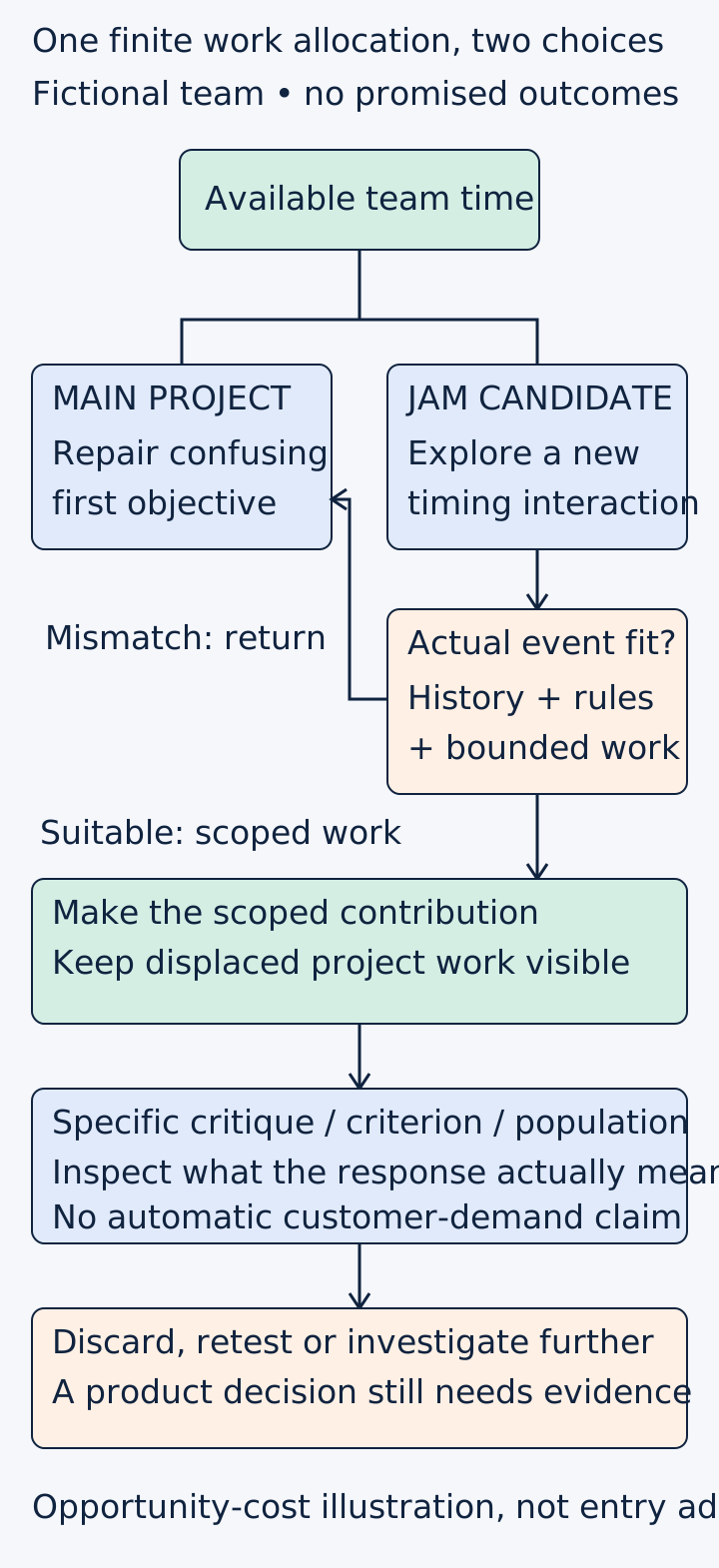
Original opportunity-cost diagram. No event entry, completed prototype, prize or customer outcome is represented.
 Superdirector
Make it work for your brand
Find it. Remake it. Post it. Superdirector turns the viral formats in your niche into your brand's carousels, X posts and video scripts, and keeps the calendar full.
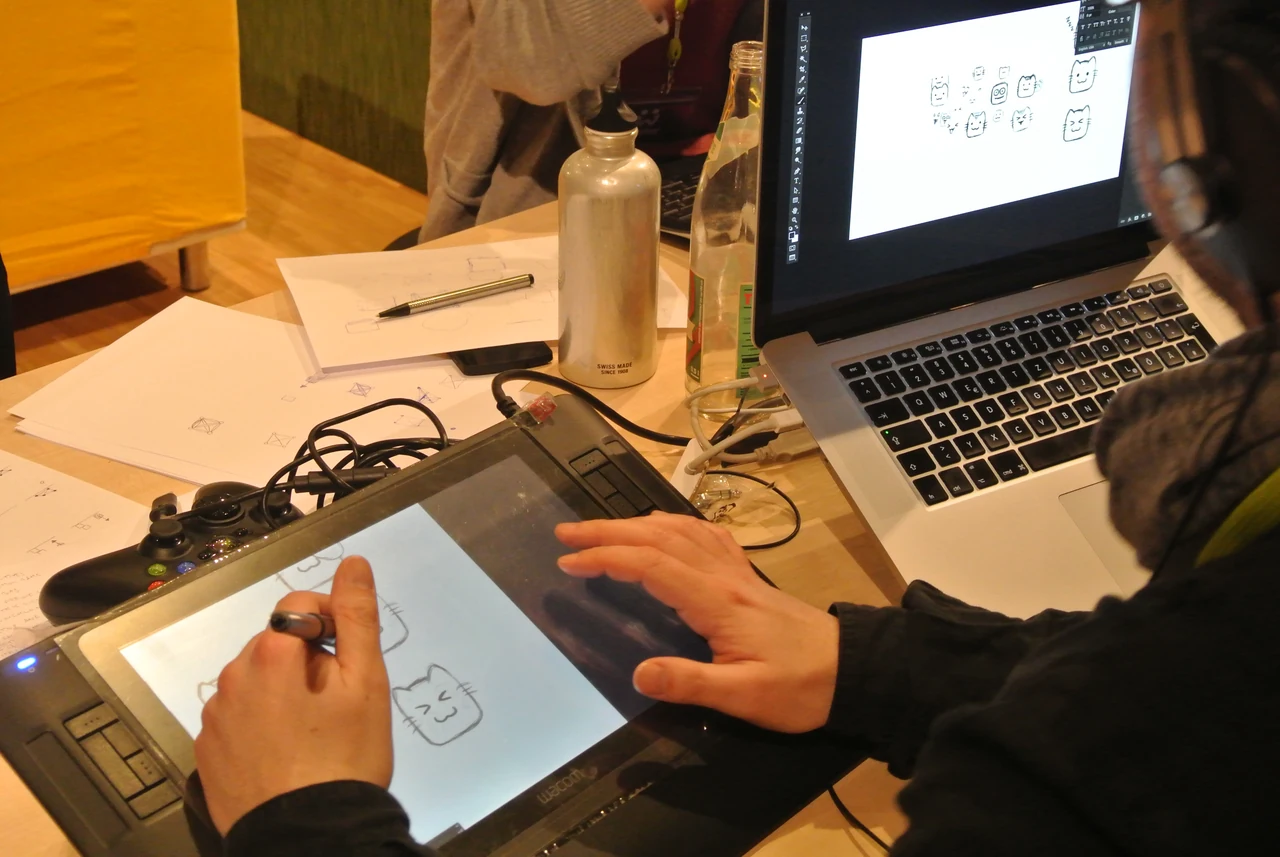
An artist working on a graphics tablet at Global Game Jam Berlin, January 2014. Historical context for a focused creation exercise, not evidence of a typical jam outcome or endorsement. Photo: Iwan Gabovitch, CC BY 2.0. Display resized and format-converted; photo content unchanged.
Photograph by Iwan Gabovitch.
Name the job before choosing an event
A founder with a browser puzzle already in development might want to explore a new interaction without carrying the whole game's systems into the experiment. Another might mainly want more people to visit an existing commercial page. These intentions call for different routes.
For the first founder, a small jam project could be a candidate learning exercise. The decision should specify what to make and what uncertainty the exercise addresses. For the second, submitting the commercial build to whatever jam is visible is not a substitute for an acquisition plan.
An actual developer asked whether participating was worth the time compared with polishing and marketing existing projects. Their later clarification centered on opportunity cost, not simply winning money. The discussion is historical and its replies are personal opinions, not evidence of a typical financial return. Read the original question and clarification.
Write the two alternatives as work, not slogans: “Explore one new timing interaction in a separate prototype” versus “Repair the current game's confusing first objective.” You can now compare something real. “Get exposure” versus “keep grinding” hides both the purpose and the cost.
Check whether the work belongs in the jam
itch.io explicitly prohibits adding a game to unrelated jams merely for promotion, and prohibits creating a jam solely to advertise your own project. A technically available submission button does not make that use appropriate. Read the platform's jam-related quality rules.
Then inspect the particular event, because rules about existing work differ. The Official 2026 Unity Game Jam page requires original games not made before the event or for prior jams. It also distinguishes community ratings from its judge-panel prize decisions and restricts updates during judging. These are rules for that edition, not a universal definition of a jam. Read the Unity edition's eligibility and judging sections.
A contrasting example is Checkpoint's FAQ. It allows an existing project only under stated conditions, including no previous jam submission or public release, and requires substantial new work during the jam. It also has other participant and submission conditions. That is not blanket permission to enter an already public demo. Read Checkpoint's project and participation conditions.
For the fictional browser-puzzle founder, this check might eliminate the idea of submitting the commercial build to a new-work event. The remaining choices are a genuinely separate eligible experiment, another suitable route, or continuing the main project. Renaming the build or making a new cover does not resolve its history.
Do not turn these examples into a copied event calendar. At the October 24, 2026 research check, the Unity page displayed conflicting start-time and voting-duration information in different sections. An actual participation plan would need that uncertainty resolved through the appropriate organizer information before commitment. This article does not supply a corrected deadline.
Compare the new contribution with the displaced task
For a possible jam project, identify the smallest coherent creation that would answer the chosen question. A prototype intended to explore a timing interaction does not need an invented campaign, elaborate progression and a large content library just to look like a future commercial release.
Next, name the main-project task that would wait. Is it optional polish, a promised delivery, a blocking defect or an important experiment of its own? Those have different consequences. A short event does not make the displaced work disappear, and unpaid participation still uses finite attention.
Suppose a second fictional team has an unpublished experiment that could meet a specific event's existing-project conditions. Its proposed new contribution is a cooperative rule that changes how players coordinate. Eligibility alone does not settle the allocation. The team should still compare that experiment with the unresolved work in its main release, including preparation and the time needed to inspect any feedback afterward.
Set a stop boundary before expanding scope. If the contribution cannot remain small enough to complete responsibly within the actual constraints, reduce it or keep working on the main project. Do not budget a prize or imagined future customers as the evidence that the trade-off will pay for itself.
Read feedback as feedback from a particular setting
A separate developer described a recent-relative GMTK experience as useful for finishing, cutting scope and working with a team. The same post links and promotes its own entry. That makes it attributable practitioner context, not an independent measurement of benefits or a promise that your game will receive useful critique. Search and page-relative dates also differ. Read the developer's account.
Before interpreting results, inspect who can rate and what they rate. itch.io lets hosts choose voter eligibility and criteria; some events are unranked. A rating queue changes how eligible voters encounter entries, but does not turn the resulting sample into your commercial audience. Read how jam ranking and feedback work.
For the timing prototype, a comment that the recovery window is unclear may be a useful design lead. A high visual score answers a different question. Neither demonstrates that players would purchase a larger game. Preserve the actual comment, criterion and relevant context rather than merging every favorable response into “validated demand.”
Do not seek reciprocal high ratings or treat criticism as a promotional obligation. Participation should follow the event's actual community rules. You can learn from a small amount of specific feedback without claiming the whole event endorsed your project.
Decide what happens after the prototype
At the end, compare the result with the original purpose. Did you create the intended interaction? Which observation changed your understanding? What remains unresolved? Did the main project's delayed task become more urgent?
A useful outcome could be to discard the mechanic, preserve one idea for a later test, or continue exploring a promising prototype. Those are separate decisions from turning it into a commercial product. The jam build's constraints and shortcuts remain part of its history; recognition does not certify release readiness.
Your next step is a short comparison: the creation question, the actual event fit, the bounded contribution, the displaced work and the evidence that would justify continuing afterward. If those fields are unclear, do not let the event deadline make the decision for you. A well-chosen experiment can be valuable without pretending it is a shortcut to customers.