How-To Guide
How does the Instagram algorithm rank Reels, carousels and Stories?
Instagram's own ranking cards read surface by surface: what Feed, Reels, Explore and Stories predict, how carousels are scored and what is unpublished.
By the Superdirector editorial team. Instagram and Meta pages read November 7, 2026.
At a glance
How does the Instagram algorithm rank Reels, carousels and Stories?
Instagram ranks each surface with its own system. Feed orders about 500 posts from accounts you follow on predictions such as swiping through a whole carousel, time on the post and sending it to someone in a direct message. The Reels tab scores about 100 reels per viewer on leaving inside three seconds, watching more of a reel than 95% of viewers of reels the same length, resharing and using the audio. Explore cuts up to 1,500 items to 100 and ranks them on likes, saves, shares and watching nearly all of a video (over 95% of its length). Stories rank only accounts the viewer follows. Meta's cards list predictions and signals without weights, and Instagram's 2023 post gives only a rough order of signal groups.
- Each surface has its own Meta ranking card, last updated between September 2025 and June 2026.
- A carousel is scored on whether the viewer swipes through it; a Reel on whether they stay past three seconds.
- Since April 30, 2026, accounts that mostly post unoriginal content, in photos and carousels as well as reels, are not recommended.

The loop Instagram's 2023 ranking post and Meta's ranking cards describe, run separately by each surface. Original diagram; the cards publish predictions and no weights.
 Superdirector
Make it work for your brand
Find it. Remake it. Post it. Superdirector turns the viral formats in your niche into your brand's carousels, X posts and video scripts, and keeps the calendar full.
How Instagram ranks Reels, carousels and Stories
There is no single Instagram algorithm. Instagram's own explanation says Feed, Stories, Explore, Reels and Search each use a system built for how people use that surface, and Meta now publishes a card for each one. Instagram's ranking post and the cards describe the same loop: gather the posts or Reels that could be shown, narrow them with a light model, predict what this viewer will do with each, then sort by score. The cards name the predictions and the signals behind them, with no weights and no order. The 2023 post goes a step further. For Feed, Explore and Reels it lists four groups of signals and says they are roughly in order of importance. Feed starts with your own activity, then information about the post, then about the person who posted, then your history with that person. Explore's list starts with how popular the post is, and the Reels list starts with your activity. Neither source puts numbers on any of it, so a list that ranks single signals one by one goes further than Instagram does.
| Surface | Who sees it, and what it is for | What Meta says it predicts | Candidates named | Card last updated |
|---|---|---|---|---|
| Feed | Followers. Use it to keep them engaged | Swiping through a whole carousel, enjoying or skipping a post, time on it, sending it in a direct message | About 700 selected, about 500 scored | Jun 29, 2026 |
| Feed recommendations (suggested posts) | Non-followers. Use it to put a photo or carousel in front of new people | An LLM-generated informativeness signal, clicking Interested, scrolling on, opening the profile, turning audio on | Not stated | Jun 29, 2026 |
| Explore | Mostly non-followers. Use it to be found by interest | Following the author, viewing over five seconds, watching over 95% of a video's length, liking, commenting, resharing, saving | Up to 1,500 retrieved, 100 passed on | Jun 22, 2026 |
| Reels tab | Followers and others. Use it to reach new people with video | Leaving within three seconds, watching more of a reel than 95% of viewers of reels the same length, commenting, resharing, sharing off Instagram, using the audio, following | About 100 | Nov 11, 2025 |
| Stories | Followers only. Use it to stay close to them | Tapping a story, replying, sending a like, answering a question or poll, swiping on, closeness to the author | Not stated | Sep 18, 2025 |
Two limits on that table. Meta says the predictions and signals change frequently, so each row is a snapshot with the date of its card. And it covers ranking only. Whether a post can be recommended at all is a separate eligibility question, covered under Account Status below.
- Feed. The Feed card is the one Meta page that names carousel signals. It predicts whether a viewer swipes through the whole carousel from their swipes to the next card, how many of its cards they view, whether the carousel was reordered in their Feed and how many cards it has. Its direct-message prediction names informative content (news, product reviews, tutorials, how-tos) among its inputs. Meta adds that Feed tries to keep a balanced mix of content types.
- Reels. The Reels card scores about 100 reels per viewer. Among its predictions are watching less than three seconds, watching more of a reel than 95% of viewers of reels the same length, resharing, sharing off Instagram and using the reel's audio in a new reel. That 95% compares one viewer with other viewers; the 95% in Explore is the share of a single video watched. Instagram's 2023 post adds that it aims to show less of watermarked, muted, bordered, mostly-text and already-posted reels.
- Explore. The Explore card retrieves up to 1,500 items from authors the viewer engaged with and from posts similar to ones they engaged with, then cuts them to 100 before the last stage. The 2023 post says how many people like, comment, share and save a post, and how fast, matters much more in Explore than in Feed or Stories.
- Stories. The Stories card says stories are shown from accounts the viewer follows. Question responses, poll and slider votes, replies and likes each have their own prediction, and so does the chance that viewer and author are family or good friends.
- Search. The Search card says results can include hashtags, places, reels, posts, profiles and audio, matched to the words searched.
One more card matters for suggested posts. The Feed recommendations card lists a signal for how informative a post is, and says it is generated by an LLM from the post's content quality. Meta does not say what the model counts as informative.
Advice you will read, checked against Instagram's pages
Many of the guides that rank for this question are published by companies that sell social media software or marketing services. Some of their claims hold up and some come from Instagram's older posts. Each row below names the company whose page makes the claim, then sets it beside the Instagram and Meta pages read on November 7, 2026.
| Whose page | The claim | Closest Instagram or Meta statement | What to do with it |
|---|---|---|---|
| Aspire, 2024 blog post | Six factors drive the algorithm: interest, recency, relationship, frequency, following and usage | Aspire itself dates the list to 2018. Instagram's 2023 post replaced it with a separate list of predictions and signal groups for each surface, and Meta's cards now publish one list per surface. | Read the card for the surface the post is aimed at. |
| The Marketing GP, an outsourced marketing firm | Relationships, interest and timeliness are the main three signals | The 2023 post's Feed order is your activity, then information about the post (which includes when it was posted), then the person who posted, then your history with them. Relationship and timing sit inside larger groups, not at the top. | Plan a post around the surface it is for, not around three signals. |
| Meltwater, 2024 blog post | "Recent posts are given higher priority" | Meltwater's own page adds that Feed, Stories and Reels each use a different algorithm. In the 2023 post, when a post was shared is one detail inside the second Feed group, information about the post. | Compare posts at the same age, such as seven days after posting, so age does not skew the result. |
| SocialBee, which sells an Instagram management tool | In its Explore section: "Likes, saves, and shares carry the most weight" | This one matches. The 2023 post names likes, saves and shares as its most important Explore predictions, and says popularity counts much more in Explore than in Feed or Stories. Its top five for Feed are different: a few seconds on the post, a comment, a like, a share and a tap on the profile photo. | For a post aimed at Explore, make it worth saving or sending on. |
| SocialBee | Original content gets "up to 60% more engagement than reposts or recycled material" | SocialBee links the figure to a blog post on stackinfluence.com, not to Instagram data. Instagram's own published number measures something else: 75% of US recommendations now come from original posts. | Treat the 60% as unverified. Post your own footage and words because originality decides whether you can be recommended. |
| Hootsuite, which sells a scheduling tool | Adam Mosseri says watch time, likes and sends matter most, for followers and non-followers alike | Hootsuite's source is one of Mosseri's own Reels, not a written Instagram page. In writing, the 2023 post lists resharing, watching a reel all the way through, liking and opening the audio page as its most important Reels predictions, which fits the spoken list closely. | Make posts people want to watch to the end and send to someone. |
| Popsters, a post-analytics service | Posting often does not push you down the feed, but posts made close together get other accounts' posts placed between them | This fits the 2023 post, which says Instagram tries to "avoid showing too many posts from the same person in a row." None of the Instagram pages read for this guide sets a posting frequency. | Space posts out and pick a pace you can keep with original work. |
How the published rules changed
The record is short and dated. The oldest Instagram post read for this guide is from 2021, and most of what changed since is about who gets recommended.
| Date | What Instagram published | Source |
|---|---|---|
| Jun 8, 2021 | Adam Mosseri opens a series on how Instagram works: each part of the app, such as Feed, Explore and Reels, uses its own algorithm | |
| May 31, 2023 | Updated post covers Feed, Stories, Explore and Reels, each with its top predictions and its signal groups in rough order of importance | |
| Apr 30, 2024 | Announced, to roll out over the coming months: eligible reels go to a small audience first, copies are replaced by originals and aggregators are removed from recommendations | Instagram for Creators |
| Dec 10, 2024 | Trial Reels show a reel to non-followers first | Meta |
| Sep 18 and Nov 11, 2025 | Latest update dates shown on the Stories card and the Reels tab card | Stories card, Reels card |
| Apr 30, 2026 | The originality rule covers photos and carousels as well as reels | Instagram for Creators |
| Jun 22 and 29, 2026 | Latest update dates shown on the Explore, Feed and suggested-posts cards. The Feed card is the one that lists the carousel swipe prediction | Explore, Feed |
Match each post to the surface that ranks it
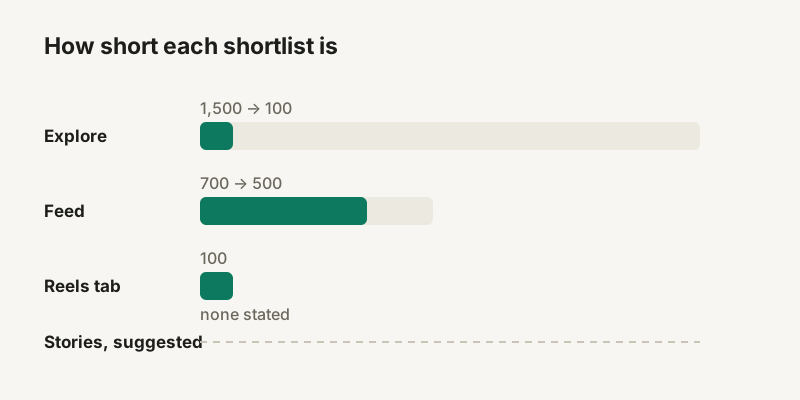
Start the plan from the audience. Followers meet a post in Feed and in the Stories tray. Strangers meet it in Explore, the Reels tab, suggested posts in Feed and Search. The same post can be a candidate in several places, but each one scores it on different predictions. The bar chart of candidate counts shows how narrow each shortlist is before the final order is set.
| If the goal is | Lean on | Ranked where |
|---|---|---|
| Reach people who do not follow you | A Reel or a carousel with one clear topic | Reels tab, Explore, suggested posts in Feed |
| Keep current followers watching | Stories and carousels | Stories tray, Feed |
| Be found by a search | The words people type in your caption, bio and profile | Search, which lists hashtags, places, reels, posts, profiles and audio |
The complete list of predictions and inputs Meta names for each surface is in the ranking signals sheet, 33 rows with the card each came from.

The candidate counts Meta's cards state, drawn to one scale so the narrowing is visible. Original diagram; counts from the Explore, Feed and Reels cards, last updated November 2025 and June 2026.
Build the carousel for the swipe-through
A carousel is scored on whether the viewer keeps swiping. The Feed card predicts a swipe through the whole carousel from the swipes to the next card, the number of cards viewed, whether it was reordered in Feed, the number of cards and whether it is a recommended post. Meta does not say that more cards or fewer cards score better, so choose the count the idea needs.
- Make card one a promise and card two its first proof. A viewer who stops after card one tells the system the carousel did not hold them. This is our reading of the swipe prediction, not a rule Instagram states. A guide to hooks that stop the scroll covers opening lines.
- Put one idea on each card. Each card is a decision to swipe or leave, so each one should pay off what the card before it set up.
- Teach something specific. The direct-message prediction names informative content such as tutorials and how-tos as an input, so a carousel a colleague would forward gives the system a reason to send it.
- Keep text on photo cards short. Text overlaid on a photo is an input to time spent on the post. Meta does not say whether more text helps or hurts.
- Make it yours. Since April 30, 2026 accounts that mostly re-upload other people's photos or carousels are not shown where Instagram recommends content. Adding your own information, context or point of view to someone else's idea counts; a border, watermark, subtitles or a credit does not.

A six-card carousel plan with one idea per card, drawn as the swipe path rather than a template. Original diagram; the swipe prediction is Meta's Feed card, which states no ideal card count.
Give each Reel a reason to keep watching and to send
The Reels card gives viewers an early exit: it predicts watching less than three seconds, so a slow opening is a prediction the system can act on. It also predicts whether a viewer watches more of the reel than 95% of viewers of reels the same length, and resharing, sharing off Instagram and using the audio. The Reels growth guide covers the production side.
- Open with the payoff. Show the result or the problem in the first second, then explain.
- Let length follow the idea. Instagram's 2023 creator guidance says a reel must be 3 minutes or less to be recommended, and publishes no target length below that.
- Post originals and remove watermarks. The 2023 post lists watermarked, muted, bordered, mostly-text and already-posted reels among those it aims to show less. Edit for engagement shows how to clean up a cut.
- Test a new format on non-followers first. Trial Reels show a reel to non-followers, give metrics after about 24 hours and can share it with followers automatically if it does well on views in the first 72 hours.

An authored storyboard for the reel opening this guide recommends, planned shots rather than frames from a published video. Original diagram; the three-second exit is the prediction Meta's Reels card names.
Use Stories for the people who already follow you
The Stories tray only ranks accounts the viewer follows, so Stories cannot be your reach to strangers. They keep the audience you already have. The card gives a separate prediction to a question response, to a poll response or slider vote, to a reply, to a like and to swiping on or leaving. It also predicts whether viewer and author are family or good friends from past replies, messages and connection strength.
- Use stickers that ask for a response. Questions, polls and sliders each feed a named prediction.
- Answer what comes back. Replies and messages build the interaction history the closeness prediction reads.
- Keep each Story short. Exits and swipes to the next story are predictions too. Our reading, not a rule Meta states: a long run of weak frames gives viewers more chances to leave before your next story.
Check Account Status before you read any metric
Instagram calls Account Status the best way to see whether an account and its content can be recommended. Check it before you read any reach number, because an account that is not eligible is not shown where Instagram recommends content, whatever its posts would score. Eligibility depends on community and recommendation guidelines and, since 2024 for reels and since April 30, 2026 for photos and carousels, on originality.
Instagram says an aggregator account becomes eligible again when a significant share of what it posted recently, across photos, carousels and reels, is original, measured over a rolling 30 days, and Account Status lets the owner remove content or appeal. If you remake a format, build it from your own footage, product and words; the competitor content guide covers how to log what a format does without copying it.
Read audience reach and compare with your own median
Instagram's insights split accounts reached into followers and non-followers. That split describes audience status; it does not identify the surface that delivered the post. Use source-specific insights separately if available. Record each post's reach from each group at seven days and compare with the median of your last ten posts in the same format. This is our working comparison, not an Instagram threshold: twice the median can suggest a format to test again, while two posts below half may prompt a review. If fewer than ten comparable observations or the current metric is missing, treat the comparison as inconclusive. If the median is zero, the ratio is undefined; inspect absolute reach and collect more data before deciding.
| Field | Where it comes from | What it tells you |
|---|---|---|
| Reach from followers | Insights, accounts reached | How well the post held your own audience |
| Reach from non-followers | Insights, accounts reached | Reach among accounts that did not follow you; this does not identify a surface |
| Ratio to your median of ten | Your sheet | Whether the format beats your own normal |
| Surface it was built for | Your plan from the first step | Whether it reached the audience you aimed at |
Here is the arithmetic on a made-up account, so the numbers are invented and show only the method. A small candle brand's last ten carousels reached 310, 420, 260, 380, 900, 350, 290, 410, 330 and 370 non-followers at seven days. Sorted, the middle two values are 350 and 370, so the median is 360. One very good post (the 900) does not move a median the way it would move an average, which is why the median is the better baseline for a small account.
| Next carousel (illustrative) | Non-follower reach at 7 days | Ratio to the median of 360 | Reading |
|---|---|---|---|
| A: a checklist carousel | 780 | 2.2x | Twice the median or more: make another in this format |
| B: a quote carousel | 160 | 0.44x | Under half the median |
| C: a second quote carousel | 170 | 0.47x | Second post in a row under half: stop this format |
Keep the same sheet for Reels, but give them their own median. Reels and carousels reach different audiences, so a Reel compared with a carousel median tells you nothing about either format.

The invented worked example from the table above, plotted against a median of 360 non-follower accounts. Original diagram; the twice and half marks are this guide's comparison, not an Instagram threshold.
Where Superdirector fits
This guide comes from Superdirector, and nothing in the product changes how Instagram ranks posts. Its main plan costs $199 a month and runs one Instagram account with AI. You choose which accounts, competitors, keywords and hashtags it watches, and you set the brand and the creative direction. It picks out the formats taking off in your niche and rebuilds each one as a carousel in your brand's voice and look. Eligible Instagram carousels can be published to a connected account under its standing posting permission, subject to account readiness and plan entitlement. Two things are not available yet: finished AI video, so Reels still need your own footage, and full autopilot. The site lists both as coming soon ("AI video and full autopilot are coming soon"). The $29 a month plan is for doing the work yourself: it connects Superdirector to Claude or ChatGPT and makes individual assets when you ask, without the recurring posting. See what runs today.