How-To Guide
How to show an organizer's usable space, not just its outside dimensions
A storage product has at least two different fit questions. Will the organizer fit on the buyer's shelf? Will the buyer's object fit inside the organizer?
By the Superdirector editorial team.
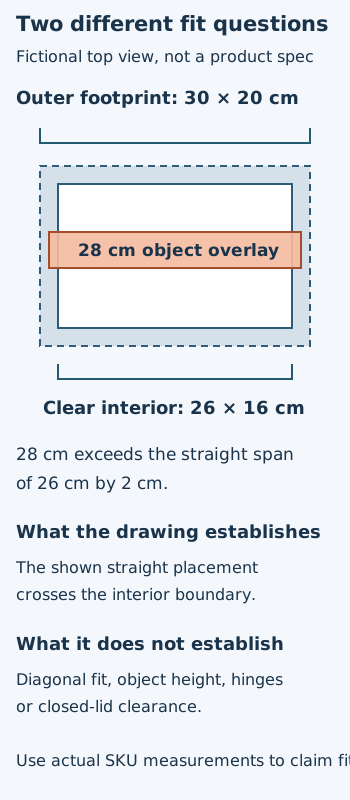
Original explanatory drawing with fictional measurements. It shows why exterior size alone cannot establish interior fit. It is not a real product specification.
 Superdirector
Make it work for your brand
Find it. Remake it. Post it. Superdirector turns the viral formats in your niche into your brand's carousels, X posts and video scripts, and keeps the calendar full.
A storage product has at least two different fit questions. Will the organizer fit on the buyer's shelf? Will the buyer's object fit inside the organizer? A photograph with one ruler and an unlabeled dimension can answer the first while appearing to answer both.
For a seller preparing a product demonstration, the goal is to make those two spaces visible. Show the outside envelope, the usable cavity, and any obstruction that changes the proposed fit. Do not use a capacity headline or a staged object to imply that every similarly named item will fit.
This is a measurement-and-creative planning guide, not a report of a tested organizer. Reference pages were checked on October 24, 2026. Actual product claims still require measurements and review of the exact SKU being sold.
Separate the shelf footprint from the object cavity
Start by asking what the buyer is trying to fit. A toolbox going into van shelving needs an external envelope. A tool going inside the box needs internal clearance. Those are related measurements, not interchangeable ones.
Milwaukee's page for model 48-22-8424 explicitly lists different exterior and interior dimensions. Its dimension image separately labels the main cavity and removable trays. That is a useful presentation pattern: identify the measured space instead of relying on the product name to explain it. It is not evidence about another model or an object you have not tried. Milwaukee model reference
Measurement conventions also differ between product categories. Uline's carton guide says its listed box dimensions are internal and explains the length, width and height order. Do not carry that convention over to an organizer listing that does not define its measurements the same way. Uline measurement guide
Write the measurement's meaning beside the number. “Exterior width” and “minimum clear interior width” are more useful than an isolated width label.
Record the configuration before measuring
Choose the exact product revision and photograph it before rearranging anything. Record whether the lid is open or closed, which inserts are installed, whether dividers are adjustable, and whether handles or latches protrude beyond the main body. Keep the units and axis order consistent across the notes, diagram and caption.
A removable tray creates more than one configuration. If the larger object fits only with that tray removed, say so near the demonstration. Do not show an empty cavity and then use a finished photograph with every insert installed as if both views establish the same usable space.
For the exterior envelope, include the features that matter to the stated shelf or transport fit. For the interior, identify the surfaces that limit the object rather than measuring only the widest opening. A tapered wall, hinge intrusion or raised base can reduce the useful space where the object actually rests.
Draw the relationship before filming it
Consider a fictional organizer with an exterior footprint of 30 by 20 centimeters and a clear rectangular interior of 26 by 16 centimeters. A 28-centimeter-long object does not fit straight along that 26-centimeter interior span, even though it is shorter than the outside length.
That comparison does not prove the object fails in every orientation. A narrow object might fit diagonally; a wider one might not. Its height, shape and the closed lid also matter. State the orientation shown and avoid turning one failed arrangement into a universal incompatibility claim.
Use a cutaway or top-down drawing to distinguish wall thickness from cavity space. A dashed external boundary and solid internal boundary remain understandable without relying on color alone. If you add a hinge or lid intrusion, label it as a separate obstruction rather than hiding it behind a large overall dimension.
Film one supported fit question
Select an object relevant to the buyer's task and identify its actual dimensions and configuration. If it has a case, handle or attachment, record whether that feature is present. “Fits a drill” is much less precise than a demonstration of the exact tool and setup shown.
Film the placement without forcing the object or bending the organizer to manufacture a fit. Show the limiting edge and, when relevant and appropriate for the product, the lid closing normally. Stop if closing requires pressure that the product's instructions do not permit. Do not use a camera angle that hides a protrusion.
A useful sequence is: empty configuration, measured object, placement, relevant clearance, and final lid state. Preserve enough continuity that a reviewer can tell whether an insert or accessory disappeared between shots. Where a cut is necessary, disclose the configuration change.
No footage has been produced by following this guide yet. This sequence is a proposed test plan, not a completed compatibility result.
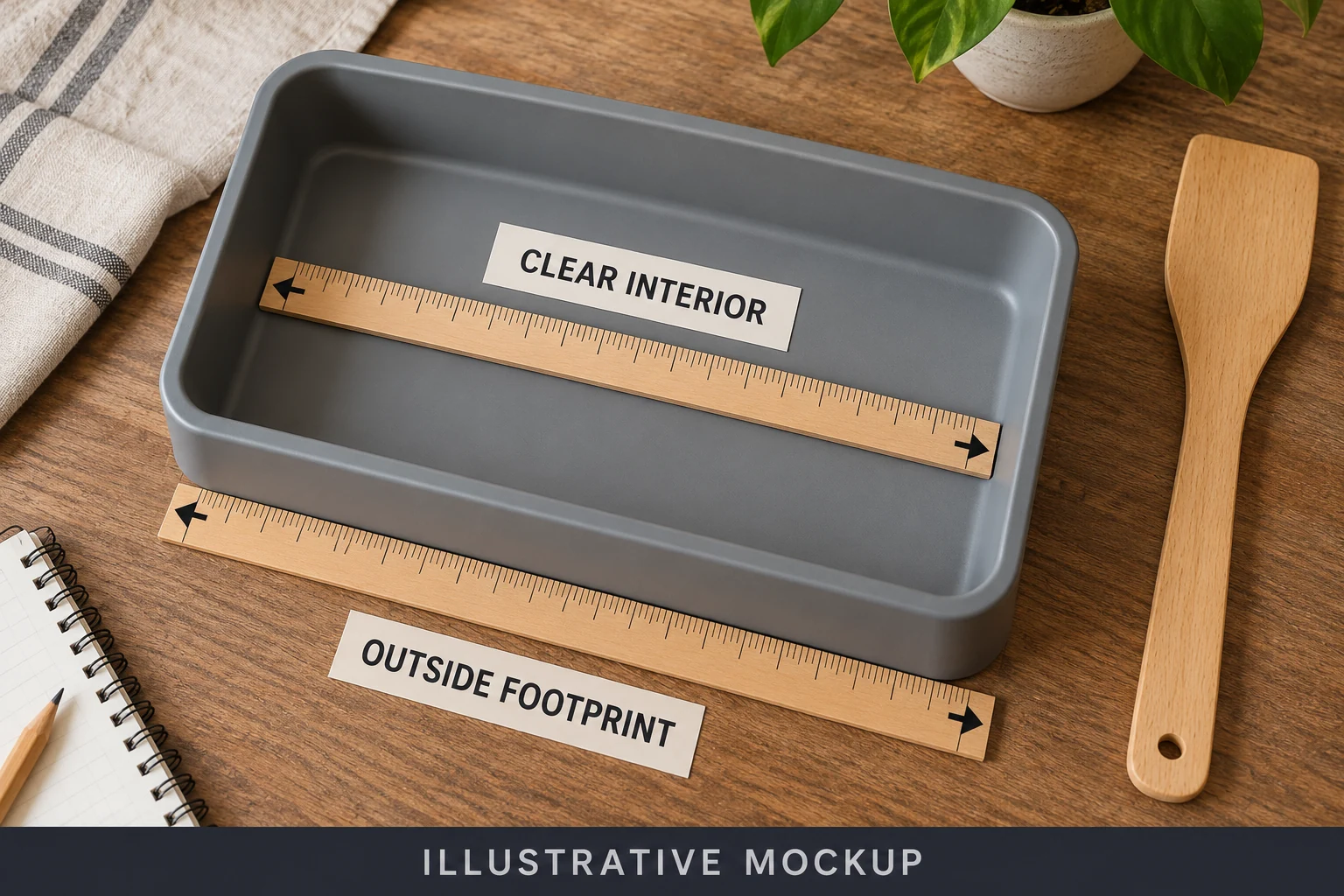
AI-generated illustrative mockup. This mockup shows where fit evidence comes from. It is not a measured product, and outside dimensions alone do not establish that the nearby object fits.
Check the caption against what the footage proves
Describe the narrow observation you actually established. A caption can identify the model, object, insert configuration and orientation. It should not extend the result to all objects with a similar category name or nominal size.
If the demonstration only establishes open-top clearance, do not call it a closed-lid fit. If measurements come from the manufacturer rather than your own inspection, identify that source and avoid presenting them as independently measured. Keep any discrepancy between the source and sample on the review list instead of choosing whichever number makes the offer look better.
Capacity in liters can be useful for another comparison, but it does not describe the shape of the available space. Keep it separate from the dimensional evidence needed for a particular object.
Have someone reconstruct both fit decisions
Before releasing the creative, ask a reviewer to explain the organizer's outside footprint and usable interior without hints. Then ask which configuration and object were demonstrated, whether the lid was shown closed, and what remains unknown.
If they use the exterior number to answer the interior question, revise the labels or image order. If they infer a universal fit guarantee, narrow the caption. Save the reviewed revision alongside the measurement record and actual footage.
The deliverable is a clearer explanation of two physical spaces and one bounded fit observation. It is not a promise about every shelf, every accessory or every production unit. Repeat the relevant review when the product, inserts or claimed use changes.