How-To Guide
Give players a useful support route, not just a community invite
A player who cannot start a session and a player who wants to discuss the next update may both click Help. They do not necessarily need the same destination.
A player who cannot start a session and a player who wants to discuss the next update may both click Help. They do not necessarily need the same destination. A community invitation can be useful, but it does not tell either person whether a known answer exists, whether their details will be public, or who can act on an account-specific problem.
Before adding another support channel, make the existing routes understandable. The objective is not to move every conversation out of chat. It is to let a player find reusable instructions without unnecessary membership steps, while keeping private cases and reproducible defects in appropriate places.
The examples below describe a fictional indie game and a proposed review method. They are not tested support flows or evidence of faster resolution.
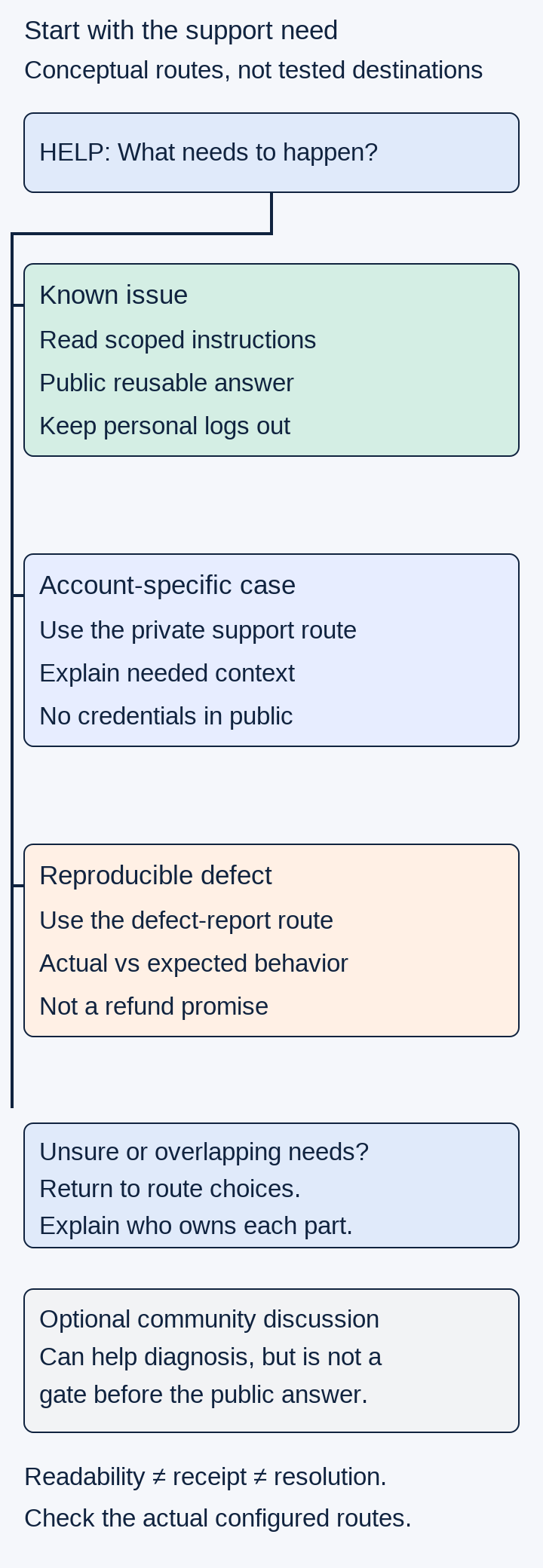
Original conceptual routing map. Destinations and responsibilities must match the actual game; no support response or resolution is implied.
 Superdirector
Make it work for your brand
Find it. Remake it. Post it. Superdirector turns the viral formats in your niche into your brand's carousels, X posts and video scripts, and keeps the calendar full.
Separate the need before choosing the channel
Start with three questions rather than a list of service logos:
- Is there an existing, version-relevant answer the player can read?
- Does this issue require information or action tied to an individual account?
- Is this a reproducible behavior that the development team needs to investigate?
These categories can overlap. A defect might also affect an individual purchase, and a public answer might help someone collect a useful report. Explain those relationships instead of implying that submitting one kind of message automatically completes another process.
EVE Frontier's published bug-reporting guide, updated May 7, 2026, provides a concrete example: it distinguishes bug reports from customer-support tickets and design feedback. Its bug-report route is not the destination for assistance or reimbursement requests. That is evidence of this game's operational separation, not a universal rule for every studio. Copy the distinction only where it reflects your own team's responsibilities, not the other game's troubleshooting procedures.
Turn a solved conversation into a bounded answer
Imagine a fictional controller issue that occurs in build 0.8 when a particular menu is opened. A support conversation may contain useful diagnostic questions, irrelevant guesses, personal details and an eventual workaround. Publishing the whole conversation would mix all four.
A reusable answer should instead identify:
- The behavior it addresses and the build or platform scope that was actually checked.
- The supported steps, in the order the player should try them.
- What successful completion should look like.
- What to do if the observed result differs.
- The last review date and the change that should trigger another review.
If the team has only reproduced the issue on one controller configuration, say so. Do not silently broaden the title to all controllers. If the instructions were supplied by a player but not checked by the team, preserve that distinction rather than marking the answer confirmed.
Keep the original player's logs, account identifiers and unrelated screenshots out of the public answer. The reusable knowledge is the supported procedure and its limits, not the identity of the person who discovered it.
Keep private cases private without hiding the route
Now consider a fictional player whose paid content does not appear. A public help page can explain where to request account-specific help and what ordinary context is useful, such as the platform and visible error. It should not instruct the player to post credentials or unrestricted account records in a public discussion.
Do not promise that a ticket will result in reimbursement, restored access or a reply within a particular time unless the team has an applicable, supportable policy. A successful form submission is evidence that the request was submitted, not that the underlying problem is resolved.
Check the actual route. Does the link reach the intended support destination? Does it explain who receives the request? Are attachment instructions appropriate for that destination? If someone must sign in to submit a private case, make that requirement visible before they begin. That is different from requiring membership merely to read a known-issue explanation.
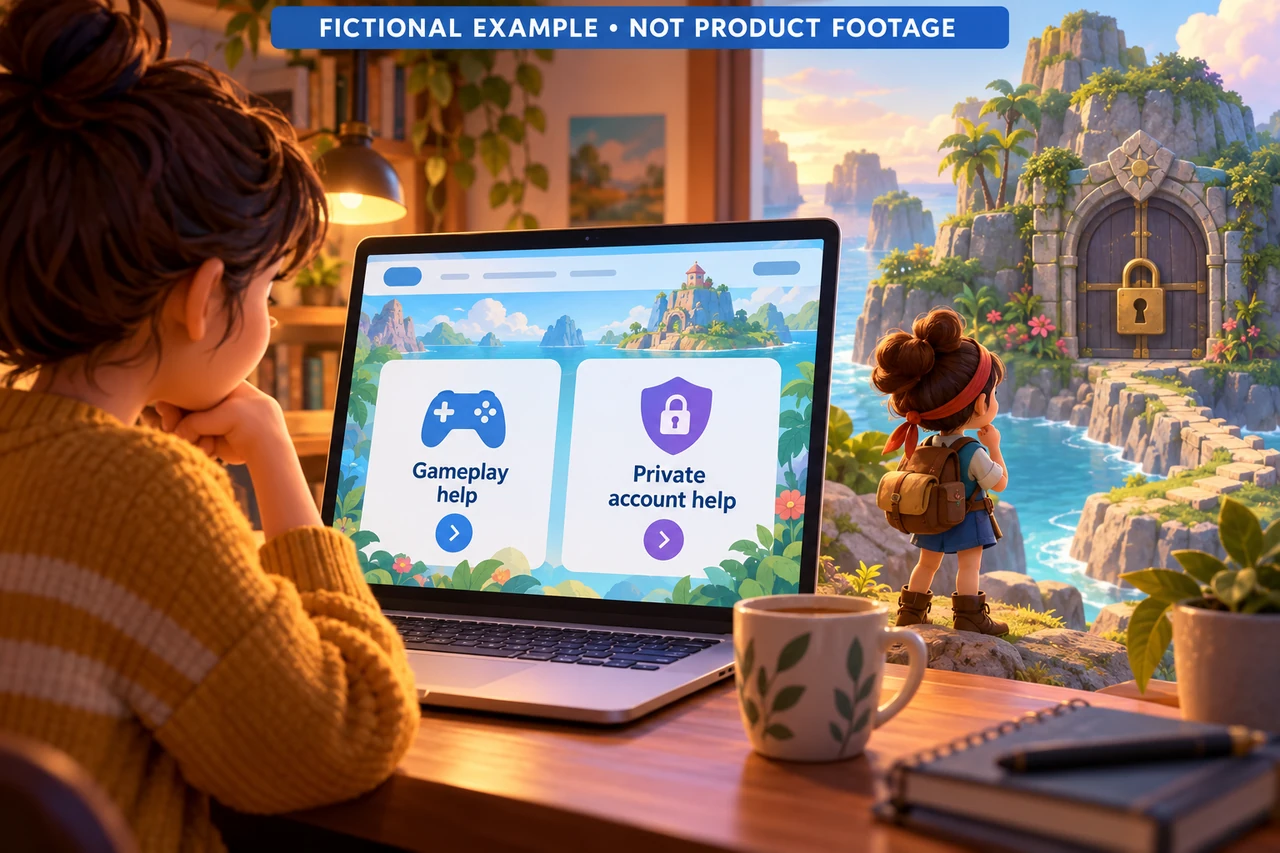
A fictional help page separates general gameplay guidance from account-specific assistance without asking players to expose private details publicly. Original AI-generated editorial illustration.
Do not turn this into a rule against Discord
A self-described indie-game support operator in a community discussion describes using Discord for interactive troubleshooting, then documenting common external issues on a Wiki. The same conversation includes a hobby developer concerned about community-management effort. These are situated experiences, not evidence that one channel is universally best or that every public article will be found through search.
The useful distinction is between the live diagnostic conversation and the durable answer. A chat conversation may be the better way to clarify a confusing report. Once the answer is stable, an accessible reference can prevent the next player from needing to reconstruct that conversation.
If you already use Steam Discussions, Valve documents separate controls for subforum visibility and posting rights, along with pinned threads and marked answers. These tools can help surface information. Their existence does not prove that your specific page is readable by the intended visitor. Check the configured result rather than treating a pin as an accessibility or indexing guarantee.
Rehearse the routes from the player's starting point
Choose one representative question for each route and begin at the link players actually see, not an administrator's bookmarked destination.
For a known issue, use a signed-out browser where appropriate and try to reach the instructions. Record whether the page loads, whether it unexpectedly demands community membership, whether its build scope is visible, and whether the next step makes sense when the instructions do not work. Do not equate signed-out readability with search indexing.
For an account-specific case, inspect the destination and its explanation of privacy and required information. Do not submit a real or invented support case merely to fill a checklist. Use an authorized test process if one exists; otherwise mark submission and receipt behavior untested.
For a defect report, check whether the route asks for the actual behavior, expected behavior and relevant reproduction conditions. Avoid collecting everything by default. A long log or recording can contain unrelated private information, and more data does not automatically make the report useful.
Finally, test a question that does not fit neatly. A player should be able to return to the route choices or find a clear fallback rather than repeatedly moving between channels that each deny responsibility.
Maintain the answer after the build changes
Assign an owner to the public answer, not just to the channel. When an update changes the relevant behavior, review the instructions against the new build. Keep an old answer explicitly version-scoped if players still need it; retire misleading steps through the team's normal content process rather than leaving contradictory advice unexplained.
Record separate outcomes: the answer is readable, the route is correct, a permitted test request has a receipt, and the underlying issue is resolved. Only mark the outcomes you observed. The result is a help system whose promises match its actual responsibilities, not a larger collection of community links.