How-To Guide
Give an app sample a clear route into the user’s own work
An app that needs a document, a list or a prepared project can ask for substantial work before demonstrating anything useful. An interactive sample may…
By the Superdirector editorial team.
An app that needs a document, a list or a prepared project can ask for substantial work before demonstrating anything useful. An interactive sample may help someone understand the product before gathering that input. But a populated screen is not automatically good onboarding. The person must know what belongs to the example, what they have created, and how to begin their own task.
The useful deliverable is a sample-to-own-input plan. It specifies a small practice action, an optional route to personal input, and the treatment of edits, copies and dismissed examples. It is not a recommendation to bypass permissions, remove necessary account protections or claim that sample activity proves activation.
Identify the prerequisite you are trying to remove
Write the first meaningful action and everything the user must bring to it. For a document reader, the action might be following a section link in a document. The prerequisites could include having a suitable file, knowing where it is stored and selecting it through the supported interface.
A person who arrives out of curiosity may not have that file ready. A short original example could let them try the reading interaction now. Conversely, if the product's value depends on its treatment of their particular document, a polished sample cannot settle that question. It can teach an action without proving fit for personal work.
Keep the prerequisite specific. “Onboarding is too long” does not tell you whether the missing piece is input, explanation, access, trust or a feature. A sample is one design option for one kind of obstacle, not a universal answer.
Learn from two contrasting founder reports
A Markdown-reader founder describes asking new users to prepare files and connect a folder before reading. The author then describes supplying example documents. Their account includes distinct handling for the sample's access limit and analytics, but those are self-reported implementation choices, not independently tested behavior.
The later clarification is important: an initial “ever opened” description referred to the same UTC day because the analytics identity changed daily. The report therefore does not establish a cross-day lifetime outcome. This article does not reuse its conversion figures or purchase anecdote.
A separate shared-household app founder describes a populated example household that people may not understand. The author considers moving the explanation earlier. That is a hypothesis, not a verified cause or completed improvement. The thread's alleged platform requirement to provide a tour is not adopted here.
Together, the questions suggest a useful contrast: a sample can remove an input prerequisite, yet still confuse people if its purpose and exit are unclear. Their dates conflict across search and rendered views. They provide qualitative context, not measured popularity or proof that samples increase conversion.
Worked example: one original document, one action
Consider the fictional reader MarginDock. Its proposed sample is a short original document titled “Example: a weekend packing note.” It contains two sections and one internal link. The practice task is to follow the link and return to the original section using actual supported controls.
The document is visibly an example. A nearby explanation identifies the action being practiced rather than asking the person to memorize a long tour. Separate choices let them try the sample or open their own document. Neither choice should silently imply that personal files have already been accessed.
Apple's onboarding guidance favors interactive learning and contextual tips where appropriate, while advising that nonessential setup can be postponed. It also preserves the need to explain necessary resource requests. That guidance supports considering this pattern; it does not establish that MarginDock implements it or that its users will prefer it.
If the real reader cannot perform the proposed link action, change the sample task. Do not build a simulated interaction that teaches a capability the product lacks. Use original or rights-cleared material, not a conveniently copied customer document.
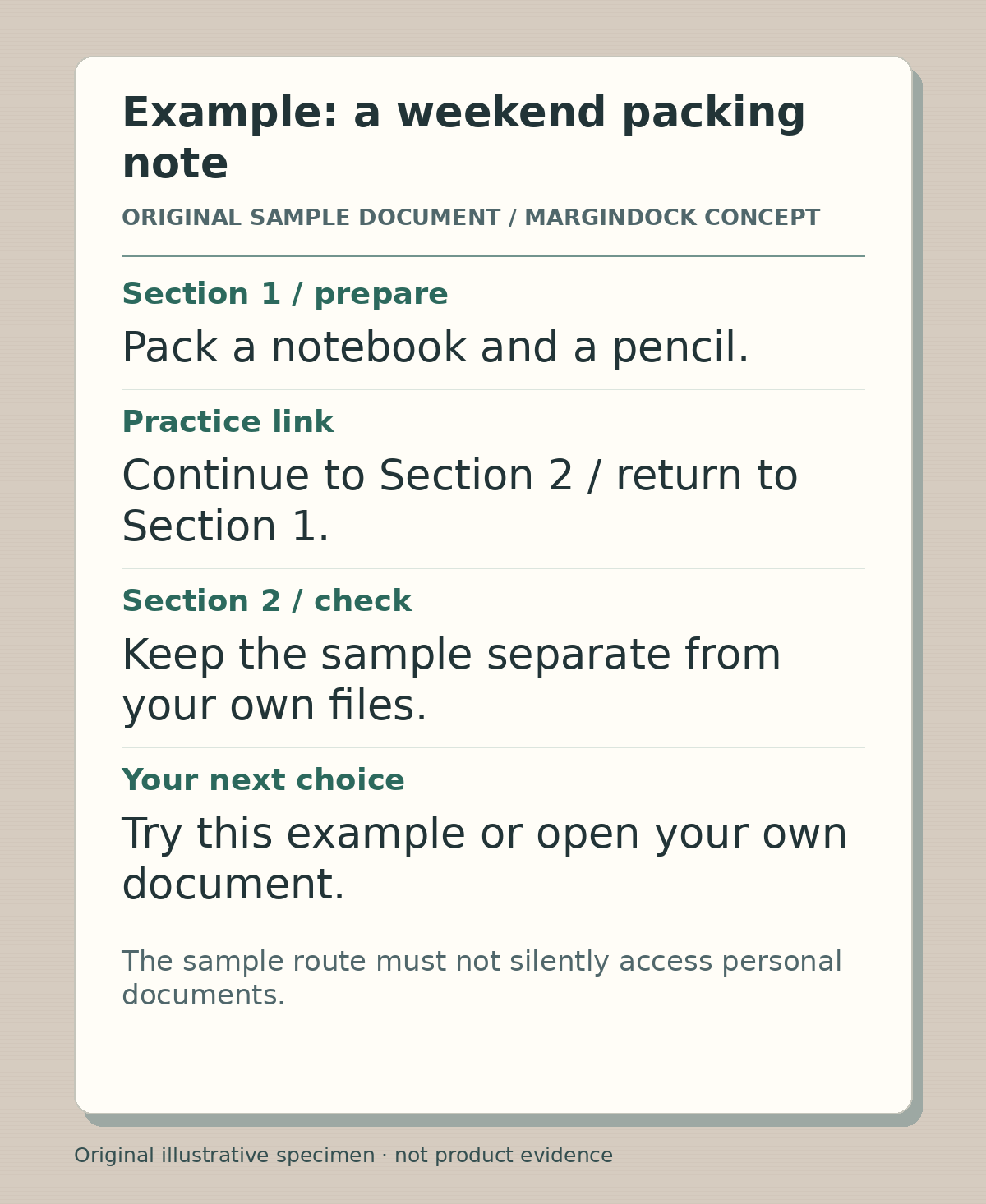
Original sample-document specimen for the fictional MarginDock reader. It teaches the proposed link task but does not show an implemented product or access any personal file.
Illustrative worked example by Editorial assistant, original text and raster artwork. Created 2026-10-24.
Decide what an edit belongs to before offering cleanup
Now suppose the person adds their own line to the example. The product can no longer safely treat every object in that space as untouched demonstration material. A plan that says “delete the sample later” is incomplete until the team defines what happens to that edit.
For MarginDock's illustrative design, one option is to preserve the untouched original example and create a clearly named personal copy when the user chooses to make their own version. The interface must distinguish those identities and explain where the copy can be found. That is a proposed ownership rule, not a claim that copying happens automatically in a particular framework.
Specify the alternatives too. What if the product permits editing in place? What if the person dismisses the tutorial before making a copy? What if the same sample appears again on a later launch? Do not silently overwrite, merge or discard user-created changes to keep onboarding tidy.
Apple's one-time setup documentation describes copying templates or modifiable data into writable app storage. It establishes that such provisioning is a supported implementation pattern in that UIKit context. It does not supply your app's ownership, dismissal or recovery policy. Those require design and implementation review.
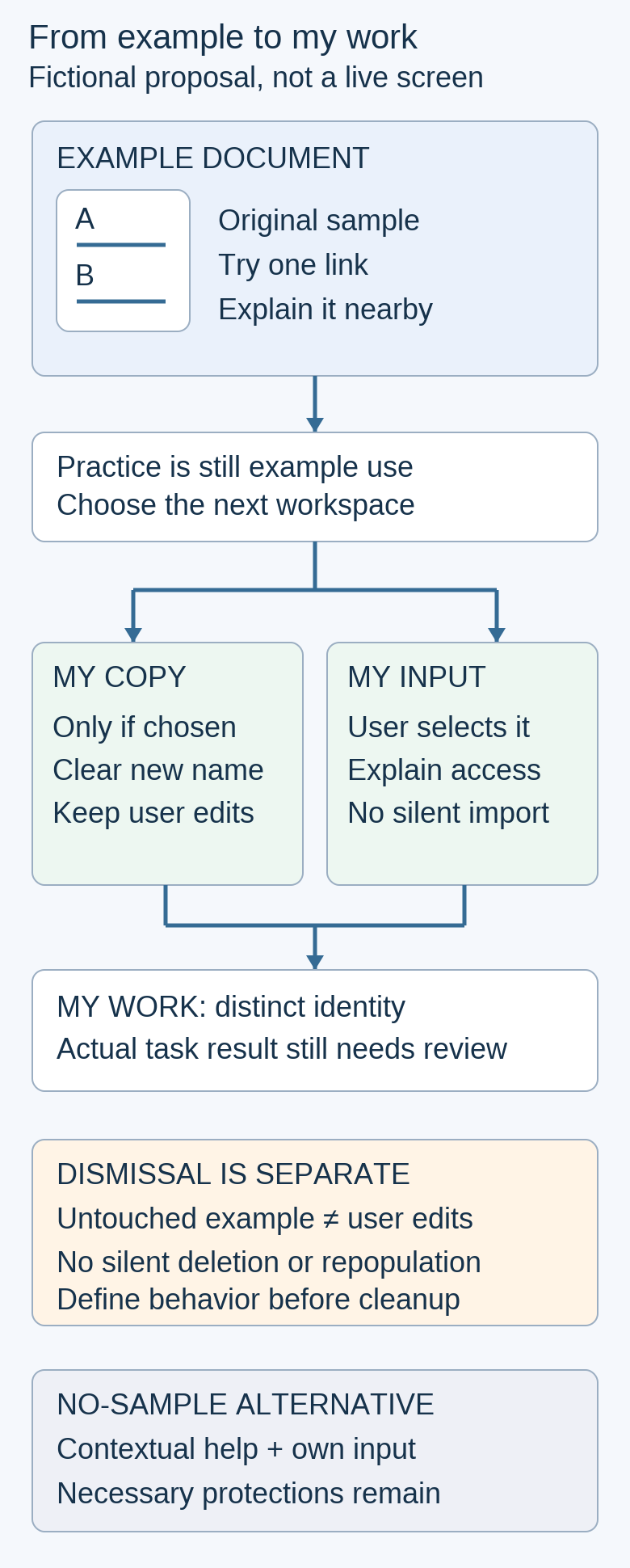
Original fictional interaction proposal. No document was imported, edited or deleted, and no real product behavior is claimed.
Original visual by the Superdirector editorial team. Creation date not recorded.
Worked example: a sample household that does not become your household
Imagine a second product, the fictional organizer SharedShelf. It begins with a visibly fictional grocery list so a person can try checking an item. The list contains ordinary demonstration items, not real people, expenses or inferred household details.
After the practice action, the person can choose to start their own list through the supported setup route. The sample does not silently create household members or transfer fictional spending into a real account. If authentication or permissions are required for the personal workspace, the product explains that boundary at the relevant moment.
The design should answer a plain question: “Am I still practicing, or is this now my list?” An attractive populated dashboard that cannot answer it may be less useful than a simple empty state with contextual help.
If the team cannot separate edited examples from personal records safely, keep the sample route on hold. A no-sample alternative remains valid: explain the first action beside the input control and let the person choose their own material. Do not require a fictional household merely because another product uses one.
Rehearse the transition, not just the opening screen
Use a prototype or authorized test build with synthetic material. Label which it is. Ask a reviewer to identify the example, perform the practice action and explain how they would begin their own task. Do not coach them through an unclear control and record that as independent comprehension.
Then inspect the ownership cases: untouched sample, edited sample, personal copy, own input and dismissed tutorial. Keep destructive actions out of an editorial exercise. A safe prototype can express the proposed behavior without deleting real data. Actual implementation and recovery behavior require separate checks and appropriate authorization.
Include a return visit in the planned review. Can someone find their personal copy without mistaking it for the original example? Can they find optional help again? Does dismissed instructional content stay out of the way according to the actual design? This is a proposed product test; no completed result is reported.
Record distinct outcomes and make one decision
Use the blank sample-transition worksheet. Keep sample displayed, practice attempted, practice understood, own input selected and useful personal task completed as separate observations. Automatic opening of an example is not evidence that someone chose the product or completed their own work.
Any later analytics interpretation must respect the real identity and observation window. A same-day record cannot establish cross-day retention. A purchase does not prove the personal-input transition succeeded, and a sample that is useful in its own right should not be disguised as personal work to improve a metric.
Choose one next action: prepare the bounded interactive sample, improve the transition and ownership rules, or retain contextual setup without a sample. The plan is complete when its identities and choices are understandable, not when the screen looks busy. Test the implemented transition separately before claiming it works.