How-To Guide
Free product discovery: choose the next useful task across overlapping Google surfaces
Begin with one product family and one buyer task.
Approved products and a quiet traffic report can leave a small merchant with several plausible next jobs: repair product data, improve the buying explanation, inspect a reporting gap, or investigate a different audience. Editing the entire catalog before choosing among those jobs makes it harder to learn what the problem actually was.
Begin with one product family and one buyer task. A print-on-demand seller might investigate a particular shirt design rather than treating every size and color as a separate audience. Catalog size describes submitted inventory representations. It does not measure how many people want the product.
This guide is an original investigation framework, not a ranking recipe. Primary documentation was checked on October 24, 2026. No Merchant Center account, Search Console property, live product feed or indexing result was inspected.
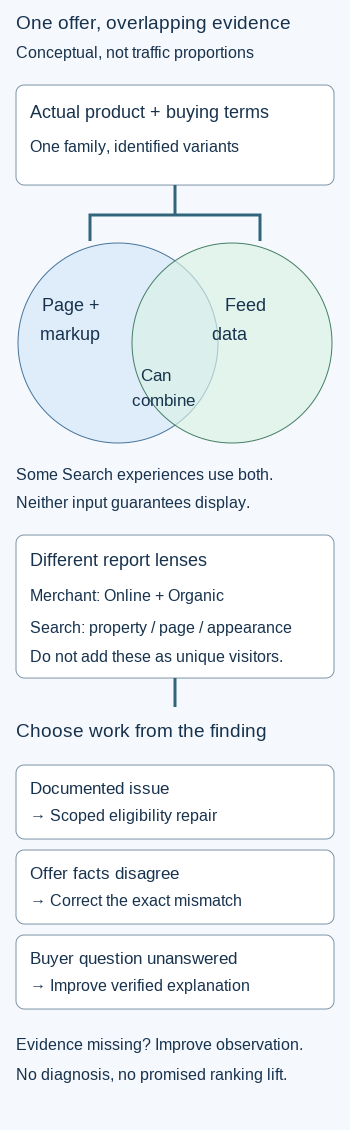
This is a conceptual relationship, not a measured share of traffic, an exhaustive map of Google services or a mandatory sequence from feed to sale.
 Superdirector
Make it work for your brand
Find it. Remake it. Post it. Superdirector turns the viral formats in your niche into your brand's carousels, X posts and video scripts, and keeps the calendar full.
First establish what “approved” is telling you
Google's free-listing guidance distinguishes permission to show products from guaranteed display. Eligibility can make an appearance possible without establishing impressions, clicks or purchases. A product page can also be discovered through crawled site content independently of a particular free-listing setting.
Keep the actual account status, product status, destination and observation date. If there is a concrete issue requiring attention, record its wording and affected product instead of replacing it with a broad diagnosis such as “Google does not trust us.” Conversely, no visible issue is not proof that the product answers a useful shopper need.
The Google and YouTube app guidance for Shopify describes supported countries and account-creation-dependent checks. Verify the real setup and intended market. A country appearing in a broad availability list does not establish that every shopping surface is available there, or that a specific store is eligible. Paid advertising is not a prerequisite established by these free-listing guides.
Treat feeds and product pages as complementary inputs
Do not draw two sealed boxes called “Merchant Center traffic” and “SEO traffic,” then assume every visitor belongs to exactly one. Google's product structured-data overview explains that page markup and Merchant Center feeds can both supply product information, and some experiences combine them. Product snippets and merchant-listing features also overlap.
For the selected product, compare what each representation actually says. Does the page explain the same item as the submitted product? Are the available variant, price and purchase terms accurately represented? A mismatch deserves a precise correction. It does not justify inventing reviews, identifiers, availability or a discount just to fill a field.
The immediate goal is agreement about the actual offer, not making every input identical regardless of purpose. A readable buying explanation and structured attributes do different work. A helpful diagram in an article is not automatically an acceptable main shopping image.
Write the report scope before interpreting its silence
In Merchant Center, record the product selection, date range, online versus physical-store scope and Organic versus Ads traffic filter. Its performance guide defines impressions, clicks and purchases separately and notes that insufficient data can affect reporting. A missing report and an observed zero are different evidence states; even a displayed zero needs its reporting context.
In Search Console, record the property, page filter, country, device, search type, appearance and time period relevant to the question. The performance overview explains that dimensions change aggregation and that a personal search can differ by context. It also warns that unavailable markers can become zeros in exports. Preserve those markers when moving the evidence into a worksheet.
Search Console is not merely a count of plain blue links outside shopping experiences. Its cross-report introduction describes richer Search results too. Do not add its clicks to Merchant Center clicks and call the sum unique visitors. Nor should a difference between the reports automatically become “lost traffic.” First establish whether the scope and units answer the same question at all.
Select a task from a finding, not from a superstition
Use four possible routes. These are editorial decision rules, not official ranking factors or a validated priority score.
- A documented eligibility or product issue exists. The next job is a narrowly scoped repair through the responsible owner. Record the exact issue and the evidence that would establish the correction. A later clean status would resolve that issue, not guarantee discovery.
- The actual offer and its representations disagree. The next job is factual reconciliation for the affected product. Preserve the prior value, approved replacement and intended destination. Do not change unrelated prices or delete sources merely to provoke activity.
- Product facts agree, but an observed buyer question is unanswered. The next job may be a clearer product-page explanation or accurate image. Identify the question and the missing information first. Low click count alone does not prove that an image, title or price is the cause.
- The evidence is too incomplete to choose a correction. The next job is a better observation: obtain an authorized scoped report, establish the product-to-page relationship or record a relevant search context. Do not label this an implementation failure or fabricate a ranking diagnosis.
Avoid combining all four into a simultaneous catalog overhaul. If the changes are bundled, a later movement cannot tell you which explanation was useful.
Work through one fictional product-family decision
Imagine a small apparel seller whose approved variants receive little visible activity. The owner chooses one real design family for review and finds, hypothetically, that its page uses an internal artwork name while shoppers' independently observed questions concern the depicted activity and available material. The actual product facts must be checked before that example could become a real finding.
If the mismatch is verified, the proposed task is to clarify the design and material accurately in the relevant page content, not add every popular phrase to every variant. The expected immediate observation is that a reviewer can identify the actual offer and find the answer. Any subsequent Search observation is separate and has no promised date. A clearer page would not by itself prove additional qualified visits or paid orders.
If instead the page is clear and the only evidence is an incomplete report, the owner should not invent a content defect. A scoped observation may be the better next task. If the product is unsuitable for the intended audience, better metadata cannot turn that into established demand.
A second fictional merchant sees its product page in a Search result while its Merchant Center view appears quiet. The useful response is to preserve the specific page, surface, country, device and observation time, then inspect the matching report scopes. It is not to declare that SEO replaced free listings or to sum the two views into a success total.

AI-generated illustrative mockup. This is a fictional evidence-gathering scene. Approval, feed eligibility, page content, report scope and observed discovery remain separate checks, with no ranking or sales improvement claimed.
Close the small loop without declaring a ranking win
Before an authorized revision, save the exact product, proposed change, source evidence, responsible owner, expected immediate check and later observation needed. Afterward, distinguish prepared content, the served page, processed product data, an observed search appearance, qualified visits and actual purchases. Only claim the stages supported by receipts.
Preserve other changes and observation gaps. A campaign launched during the same period does not establish that advertising unlocked organic eligibility. Repeated personal searches do not become a representative ranking panel. There is no fixed wait period in this method that guarantees display or sales.
An India merchant asks where to allocate free-channel work and also asks about approved variants with little activity. A separate clothing-store discussion describes reduced visible listings after several changes. These are unverified operator accounts, not evidence that a particular change caused a traffic result.
The useful output is one justified next task with an explicit observation that could change the plan. That is more actionable than either waiting without a question or rebuilding every product listing at once.