How-To Guide
Explain continuous fabric cuts before a buyer mistakes total yardage for one usable piece
This guide proposes a workflow for listing images and demonstrations.
Two pieces can contain the same total fabric length as one continuous cut without serving the same project. A buyer who needs an uninterrupted panel cannot swap in shorter pieces just because the order adds up to the right number of yards.
A useful product explanation for a fabric seller separates three things: the unit selected in the listing, the total length purchased, and how that length is cut. A selector labeled only “quantity” tells the buyer none of them reliably.
This guide proposes a workflow for listing images and demonstrations. It reports no actual order, inspects no fabric bolt, and does not show that any length fits a particular pattern. Merchant references were checked on October 24, 2026; their rules are examples, not a universal fabric-store policy.
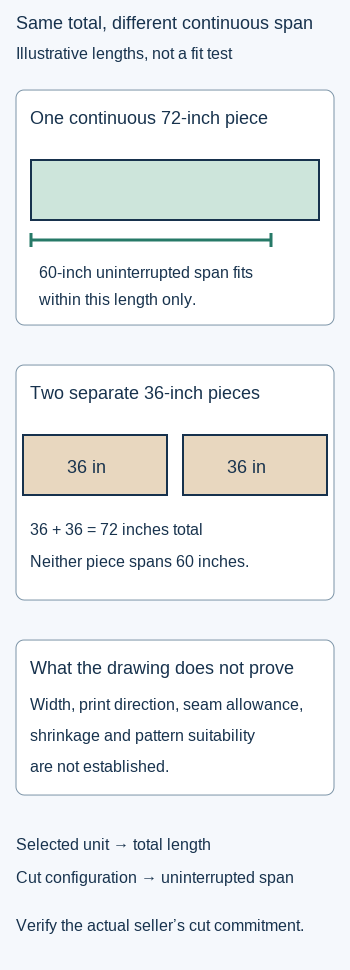
Original schematic with illustrative dimensions. Equal total length does not imply the same longest continuous piece. No physical fabric or project fit was tested.
 Superdirector
Make it work for your brand
Find it. Remake it. Post it. Superdirector turns the viral formats in your niche into your brand's carousels, X posts and video scripts, and keeps the calendar full.
Define what one selected unit means
Start with the exact offer. Is one unit a half yard of full-width fabric, a whole yard, a meter, a swatch, a panel or a separately cut piece? Write the selected size and fabric type beside that definition.
Flat Creek Fabric’s FAQ describes its own half-yard ordering model: the quantity sets the total yardage, which is ordinarily supplied as one continuous cut. Its published exception says the shop will contact the buyer before cutting if it cannot supply that continuous length, so the buyer can choose smaller cuts or cancel. Study it as a concrete disclosure pattern. Another seller cannot borrow it as a policy without building the same process. Flat Creek ordering explanation
Under a fictional offer sold in half-yard increments, quantity four represents two yards in total. That arithmetic alone does not tell us whether the shipment contains one two-yard piece, two one-yard pieces, or four half-yard pieces. The cut commitment must be stated separately and supported by the actual fulfillment process.
Width is a separate axis. Raising the quantity of full-width yardage usually lengthens the order under that offer’s definition and leaves the fabric’s width alone. A long horizontal product photograph should not imply that both dimensions grow with the selector.
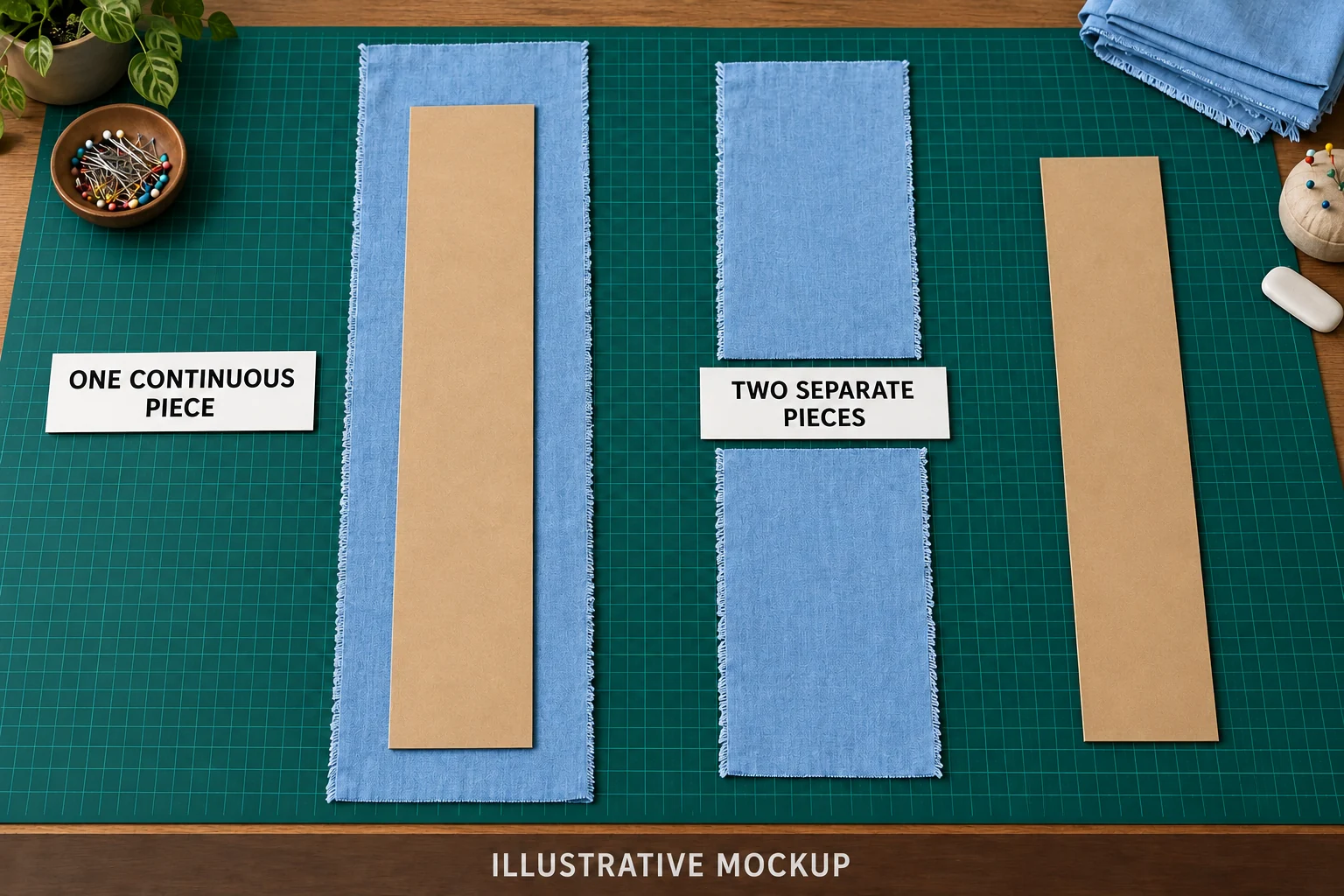
AI-generated illustrative mockup. Equal total yardage does not establish the same uninterrupted usable length. This is a visual planning example, not measured fabric or a tested pattern fit.
Show why equal totals can produce different decisions
Consider an illustrative straight piece that must span sixty inches without a join. One seventy-two-inch length covers that span. Two separate thirty-six-inch lengths add up to the same seventy-two inches, but neither holds an uninterrupted sixty-inch span.
This comparison intentionally ignores width, seam allowance, print direction, shrinkage and the buyer’s pattern. It explains continuity only. It is not a recommendation to purchase two yards for a garment or a guarantee that the pictured material is suitable.
For a real product image, photograph a measured sample of the actual offer and label the cut boundaries. A folded stack can hide whether it is one long piece or several. If you fold the fabric for presentation, add a second view that shows plainly whether the length is continuous or separate.
Do not draw dashed cut lines across a continuous piece to show the pricing increments unless the caption calls them measurement intervals and says they are not cuts. A diagram that turns half-yard units into separate pieces by accident brings back the original confusion.
Read the selected-size rule, not just the quantity number
Spoonflower shows why one selector rule should not cover every product. Its ordering guide separates swatches and fat quarters, which are printed and cut individually, from yard or meter quantities, which print as continuous fabric. It also says the cart combines items of the same design and fabric into one continuous piece, and that separate pieces need separate orders. Spoonflower’s fabric ordering guide
Another store has no need to reproduce that checkout procedure. What carries over is the explanation of how the selected size changes what the number means. Four swatches and four yards are different fulfillment instructions even though both use the number four.
When filming a selector, keep the selected size on screen long enough to read. Do not cut from a swatch selection to a continuous-yardage photograph under the same narration. If the selected fabric or size changes, say so and check the new offer again.
Make the exception actionable before cutting
Ask the fulfillment owner what happens when the available bolt cannot provide the requested continuous length. Is the order held for a buyer decision, offered as an explicitly split cut, or handled under another documented policy? Record the actual answer before writing the sales copy.
A vague line about possible multiple cuts does not describe what a particular shipment will look like. Where the workflow lets the buyer choose, say when the choice happens and what the buyer receives: proposed piece lengths, what is still unknown and the decision route. Do not promise advance contact if no one owns that step.
Do not invent cancellation or return rights from another merchant’s FAQ. Keep the explanation consistent with the seller’s applicable policy and verified process. A creative team can show what information is missing, but a caption cannot create a fulfillment commitment.
If a particular piece configuration is not yet known, label it unresolved. Showing a pristine continuous sample is not evidence that the warehouse can supply every order that way.
Review the order explanation as a buyer would
Prepare a short sequence: selected unit and size, quantity, resulting total, promised cut configuration, and any exception that applies. Use the same SKU and configuration throughout, and record which sample and revision you filmed.
Then ask someone unfamiliar with the offer to answer four questions: What does one unit buy? How much total length is selected? How many pieces are promised? What happens if that continuous length cannot be supplied? Do not explain the intended answers first.
If they answer “four pieces” only because quantity four is shown, change the label or visual. If they assume every order is continuous even though an exception is unresolved, correct the promise. Repeat the comprehension check after each revision, and check the actual cart and fulfillment instructions separately.
A buyer report about a split three-yard order illustrates why cut configuration can matter to a project. A separate question about half-yard units and fabric width illustrates confusion about which dimension quantity changes. These individual reports are not verified merchant investigations or evidence of conversion or return-rate effects.
The deliverable worth making is a buyer-facing explanation that matches a real fulfillment rule, and a clear diagram supports only part of that. Keep the actual order configuration, fulfillment acceptance, published presentation and later customer outcomes separate until each has been checked.