How-To Guide
Does your product quiz help someone choose, or just give them another activity?
A quiz earns its place when its answers change an explainable shortlist.
Before building a quiz for a small online shop, write down the buying decision it is supposed to simplify. “Which kit can I use with the equipment I already own?” is a product-choice question. “Which creative personality am I?” can be enjoyable content, but the answer does not automatically identify a suitable kit.
A quiz earns its place when its answers change an explainable shortlist. If the same items remain equally suitable regardless of the answers, a clear comparison page may do the job with less effort. This is an editorial design test, not a claim that quizzes improve sales. Sources were checked on October 24, 2026; no app was installed or customer questionnaire launched.
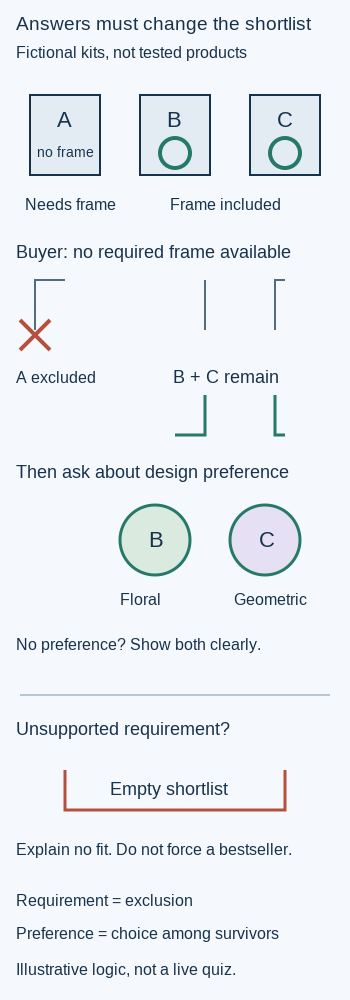
The illustration explains selection logic. It does not represent a deployed quiz, actual product compatibility or measured customer behavior.
 Superdirector
Make it work for your brand
Find it. Remake it. Post it. Superdirector turns the viral formats in your niche into your brand's carousels, X posts and video scripts, and keeps the calendar full.
Start with the product distinction, not the question count
Take the actual products you intend to recommend and identify a difference that matters before purchase. Use documented requirements, included components and intended uses. A style preference may help someone choose between otherwise suitable options, but it should not erase a missing requirement.
Consider a fictional craft shop with three kits. Kit A requires a frame the buyer already owns. Kits B and C include a frame. B has a floral design and C has a geometric design. The first useful question is whether the buyer has the required compatible frame, not whether they consider themselves adventurous.
For a buyer without that frame, A leaves the shortlist. A later preference for A's colors must not bring it back as a supposedly suitable choice. B and C remain candidates because they address the missing equipment differently. These are invented products used to explain the reasoning, not tested inventory or a statement that any frame will fit a real kit.
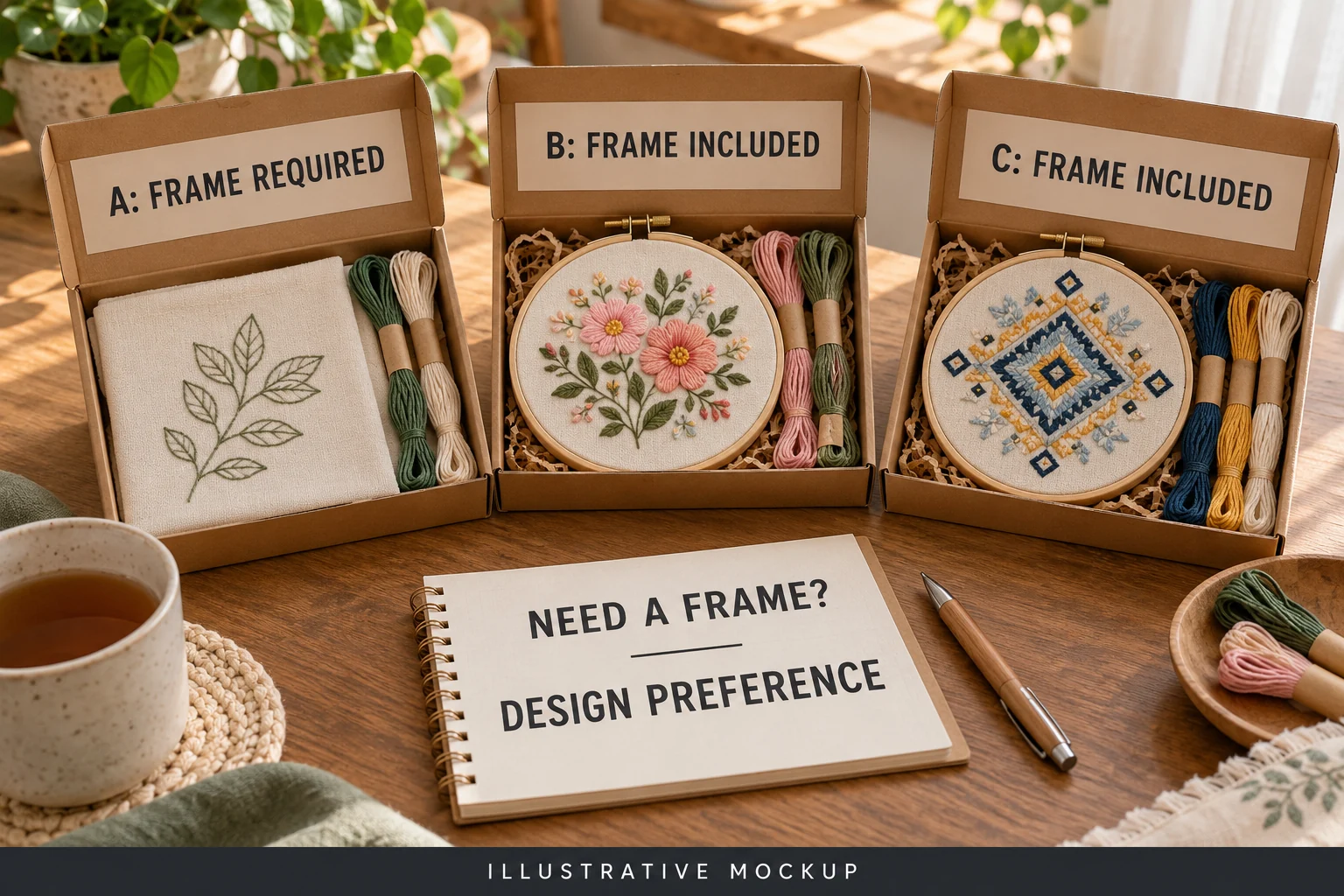
AI-generated illustrative mockup. Requirements remove unsuitable options; preferences distinguish the remaining choices. The mockup is not a tested quiz, actual kit inventory or guaranteed recommendation.
Give requirements and preferences different jobs
Build a small answer-to-product record before writing the results copy. For each answer, state whether it removes an unsuitable option, changes the order of suitable options or merely changes descriptive wording. If it does none of those things, ask whether the question belongs in a buying guide at all.
In the fictional kit example, “I do not own the required frame” is a requirement constraint. “I prefer floral designs” is a preference. When B is the only remaining floral choice, explain both parts: it includes the frame and has that design. Do not call the result a perfect match simply because a scoring rule selected it.
If a customer needs a feature none of the kits supports, the result should say that the current range has no supported match for that requirement. A bestseller is not a substitute for a missing capability. Offer a straightforward way to inspect the range without presenting an unsupported recommendation as personalized advice.
Decide what a tie or empty result means
A recommendation system can produce a list without resolving the customer's decision. If B and C meet the same requirements and the buyer has no design preference, presenting both with a concise comparison is more honest than inventing a reason one is uniquely right.
The current RevenueHunt documentation describes fixed recommendations, product upvotes and custom scoring. Its upvote approach can return no products when nothing is linked or exclusions remove every candidate. Ties are randomized by default unless the relevant collection-order setting is used. Those are named-tool behaviors, not a universal rule for quizzes or evidence that a merchant's implementation works.
Before selecting a tool, decide the intended behavior for an empty shortlist, a tie and an unanswered question. A randomized order should not acquire a fabricated explanation such as “your strongest match.” A fixed recommendation can be presented honestly as a featured product; it should not masquerade as a conclusion derived from answers that did not affect it.
Test the no-quiz alternative
Now consider another fictional shop selling two notebooks that differ only in cover artwork. Both have the same verified size, paper and binding. If the proposed questionnaire asks unrelated personality questions and eventually shows those same two covers, a side-by-side product comparison may be clearer.
The seller can still create entertaining content. The important distinction is between an enjoyable activity and evidence about product suitability. Do not describe email collection or quiz completion as proof that someone has found a product they want.
A shop already using Shopify may also investigate its related and complementary product recommendations. Related products can serve as alternatives; complementary products serve as additions to a selected item. Display depends on supported theme sections and product eligibility. This is another route to evaluate, not a guarantee that a particular store has it configured or that it will solve a choice problem.
The simplest useful route might be a collection page with two labeled differences, an ordinary comparison or a short product demonstration. Choose the mechanism that explains the decision, not the one that generates the most intermediate interactions.
Walk through contrasting cases before building
Use a paper prototype with the real catalog record beside it. For the kit example, walk through a buyer with the required frame, one without it, one with no design preference and one with an unsupported requirement. Write the resulting shortlist and the reason for each inclusion or exclusion.
Then deliberately reverse a preference while keeping the requirement unchanged. The unsupported kit should stay excluded. Remove an available option and check whether the explanation still makes sense. If a product's contents change later, its selection rules and results wording need another review.
Keep this exercise separate from collecting customer identities. No email address or personality profile is needed to check whether a requirement leads to the right shortlist. Real implementation, consent, accessibility and customer testing are later tasks for the responsible owner.
Show the choice reduction in the creative
A useful professional demonstration can begin with the three actual products, show the relevant requirement and explain why one option drops out. Then show the remaining difference. An Instagram carousel, a concise YouTube walkthrough or a clear product-page sequence can carry that explanation without claiming an algorithm knows the customer better than they know themselves.
Use actual product evidence when making the real demonstration. Do not replace a verified component requirement with a stock lifestyle image. The viewer should be able to understand the recommendation without taking the quiz, even if the quiz offers a convenient route through it.
Know what the evidence does and does not say
A merchant discussing a new apparel shop questioned whether a personality quiz attracted people interested in the actual assortment. That is a self-reported unresolved question, not proof that quizzes fail. A separate historical merchant question sought a way to guide people to a suitable product. It supports the existence of the selection task, not current demand volume or today's tool economics.
The next small action is to map one real product distinction to two contrasting answer paths and compare that result with a plain comparison page. If the answers cannot change a defensible shortlist, do not invent a personalization claim to justify the quiz. If they can, the next evidence needed is whether real users understand the reason and can choose appropriately, not simply whether they finish the activity.