How-To Guide
Decide which custom work your handmade shop can support before offering it
A request can look like a small variation to the buyer while creating a new development project for the maker. Changing a supported lining may use the…
By the Superdirector editorial team.
A request can look like a small variation to the buyer while creating a new development project for the maker. Changing a supported lining may use the existing production route. Adding an unfamiliar divider may require a revised pattern, a construction trial and a new estimate of the work.
Before accepting the next request, decide which kind of business offer it belongs to: a repeatable menu, separately assessed bespoke development, or work you are not currently offering. This is a prospective decision. It does not cancel existing orders, rewrite promised dates or turn a new price into extra production capacity.
The method below concerns physical made-to-order goods. Examples are fictional; no real production schedule, customer request or capacity result has been tested. Sources were reviewed October 24, 2026.
Classify the work, not just the customer’s wording
Start with a product you already know how to make. List the options that stay within its supported design and process. Then identify what would change the design, materials, tools or sequence enough to require investigation.
“Just add a pocket” is not a capacity estimate. The important question is whether the change follows a repeatable, understood route or introduces work you cannot yet bound. A request can be attractive without being ready to accept.
Etsy’s custom-item guidance distinguishes variations of an existing item from listings created for a particular custom request. That platform distinction is useful context, but it does not decide which offer model suits your shop. A private listing is not evidence that the underlying design or workload is feasible.
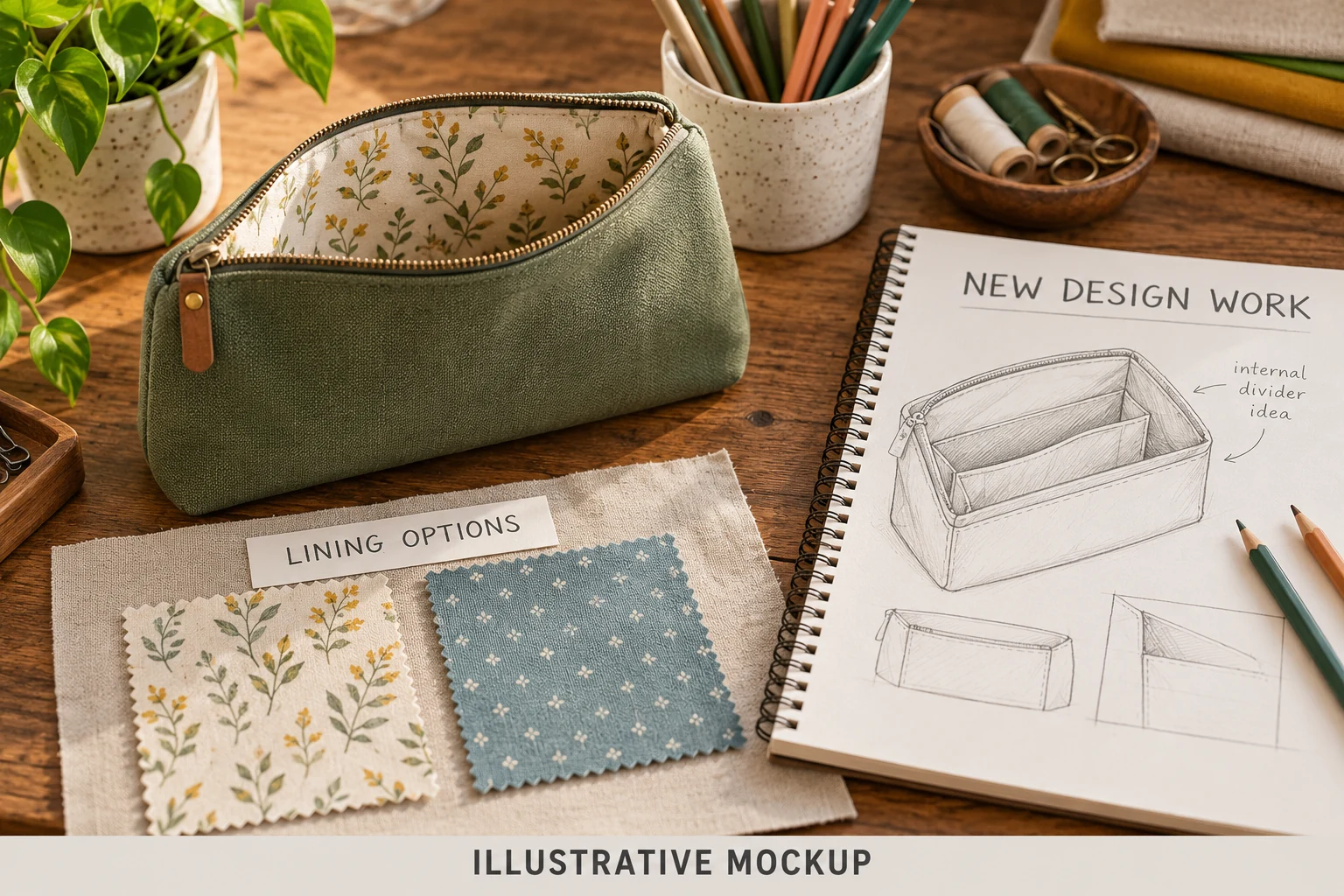
AI-generated illustrative mockup. The fictional distinction is between a supported variation and changed construction. No capacity, new design feasibility or customer commitment has been established.
Illustrative mockup by OpenAI image generation, editorial direction for this article. Created 2026-10-24.
Example: a lining choice and a divider are not the same extension
Imagine a fictional maker who produces one fabric pouch with two supported lining choices. A customer asks for one of those linings. The maker can assess the request using the existing pattern and making route, while still checking actual materials and workload.
Another customer asks for a new internal divider. Suppose the divider has not been designed or tried. Treating it as another dropdown option would disguise unresolved construction work as a standard variation.
The next step for that second request is an internal feasibility assessment, not an automatic acceptance. What pattern changes are needed? What trial would establish whether the construction works? What material or skill dependency remains unknown? If the maker cannot allocate that development without disturbing existing commitments, the proposed bespoke work can remain on hold or be declined before acceptance.
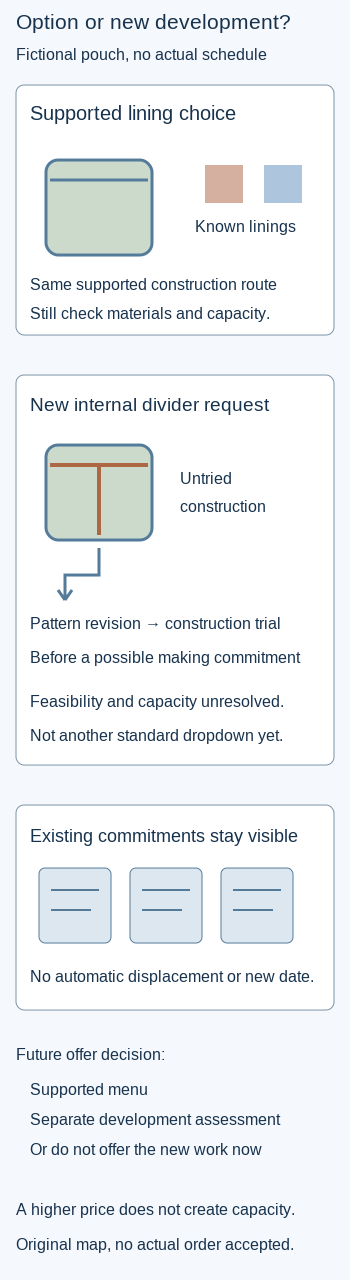
Original future-offer map, not a real order queue, tested construction method or delivery promise.
Original visual by the Superdirector editorial team. Creation date not recorded.
A higher charge might change the economics the owner is willing to assess. It would not make the untried divider proven or create hours that are already committed elsewhere.
Make the displacement visible
Before offering new bespoke development, compare its dependencies with the work already promised. Include design, sourcing, trials, making and the ordinary handling required to finish an order. Do not reserve only the final making step and assume everything before it fits between jobs.
The comparison does not require an invented universal buffer or a standard number of custom orders per week. Use the maker’s actual records and available capacity. Where those records do not exist, name that uncertainty instead of filling the gap with a confident date.
Etsy’s seller handbook recommends checking workload, logistics, materials and skills before committing to custom work. That is first-party editorial advice, not evidence that accepting more custom requests will grow a particular shop.
Keep existing commitments visible in the decision. The newest request does not become the highest priority simply because it is interesting or potentially valuable. Any change to an existing agreement requires its own appropriate handling; this article does not supply a cancellation, refund or deadline-change procedure.
Choose among three future offer boundaries
A bounded menu can be appropriate when the shop has repeatable designs and understood options. The important boundary is the supported making route, not the number of choices displayed. Even a short menu needs accurate availability and capacity checks.
Separately assessed bespoke development can be appropriate when the business deliberately offers new design work and can assess the necessary dependencies before accepting it. “Assessed separately” is not a hidden promise that every request will be accepted, nor does it establish a universal premium or turnaround.
No new bespoke work can also be a coherent current boundary. The owner may continue supported products or existing obligations without opening additional development work. That does not mean custom work is inherently bad, or that the boundary can never change.
Write the decision in terms of what the shop can support now. A provisional internal record might say: “The supported pouch menu remains the existing construction and listed lining options. New internal structures need separate feasibility work. We have not established capacity for that development alongside current commitments, so we will not add the divider as a standard option.” No customer promise has been made in this fictional record.
Example: an unfamiliar shape competes with committed pieces
Consider a fictional ceramic-tile maker with already committed standard work. A new inquiry requests an unfamiliar shape. The owner first needs to identify the design and trial work, the relevant materials and the making capacity. This is not a ceramic safety or technical-production guide.
If the necessary capacity is unavailable, possible prospective decisions include deferring the new bespoke offer, declining it, or pointing to an actual supported existing option when appropriate. None requires silently extending all existing promises.
Etsy’s processing guidance says processing for custom physical items includes their creation. It distinguishes readiness to ship from later delivery and notes that editing a processing profile affects linked listings and variations. A convenient field change is therefore not a substitute for assessing real work, and no setting changes are proposed here.
Learn from requests without promising speculative stock will sell
Repeated requests may suggest an option worth investigating. They do not establish that a newly developed item will sell, or that the original requester will buy a speculative version.
Keep the learning record separate from accepted work: what was requested, whether it fit the current route, what additional work it would introduce, and what evidence would justify revisiting the offer. If the owner chooses to explore a product idea independently, account for the resulting effort and inventory exposure rather than describing it as a risk-free alternative to a custom order.
A historical maker account about stopping custom work describes such a change, while replies describe different approaches, including a limited base design. A separate production-disruption question likewise receives contrasting responses. These are independent qualitative contexts, not proof that one model is universally more profitable or less stressful.
Make acquisition content match the boundary you chose
Once the future offer is established, the creative brief should distinguish supported options from work that is not currently offered or needs separate assessment. A short comparison of two real supported configurations can explain the menu. It should not imply that an untried construction is already available.
Avoid a broad “anything you imagine” promise if the actual business depends on a repeatable product design. Conversely, do not describe a genuine bespoke-development service as a quick standard selection. The creative should attract requests the business can assess and support, not merely maximize messages.
Classify one prospective request against the current making route and committed work. Decide whether it belongs in the supported menu, needs separate development assessment or should not be offered now. Base that decision on actual capacity and costs without changing existing commitments.