How-To Guide
Decide whether your technical app is ready for Show HN
A launch channel is useful when the people there can investigate something you need to learn. For a technical app, that might be whether another…
By the Superdirector editorial team.
A launch channel is useful when the people there can investigate something you need to learn. For a technical app, that might be whether another developer understands a parser's limitation or can reproduce an unexpected result. It is not automatically the same question as whether enough people will join a waitlist.
Before choosing Show HN, inspect the artifact, the audience, and the kind of conversation you can sustain. The deliverable in this guide is a private readiness worksheet, not a submission draft. There are no ready-to-paste Hacker News posts, titles, or comments here.
This is a channel-selection method for a technical maker's runnable product. Applying it to an ordinary consumer app requires a separate audience-fit judgment. No launch, public submission, account action, or product trial was performed for this article.
Start with what another maker can investigate
Write down a specific uncertainty about the work. A useful private objective might concern an input format, an architectural tradeoff, or a limitation that another practitioner can inspect. Avoid replacing that uncertainty with a signup quota.
In the June 2026 maker discussion, one web-app founder asked about first Show HN impressions. The thread shows a real readiness concern, not a measured demand estimate. An independent technical-tool founder's acquisition question asks which early-user channels are useful after several initial attempts. Its author describes a development/QA tool, which is relevant to audience selection but does not prove that Show HN will work.
A May 2025 B2C founder discussion provides older, adjacent acquisition context. It is not current evidence that technical forum readers represent your consumer buyers. The precise dates of some other retrieved operator statements are unavailable or inconsistent across views. None establishes search volume, a typical signup yield, or a conversion forecast.
Check the format before polishing the landing page
The current Show HN guidance concerns personally made work that visitors can try. Signup pages and landing pages are not substitutes for a runnable artifact. An early-stage project can fit; a polished appearance is not the main qualification. The guidance encourages reducing trial barriers and generally distinguishes substantial work from small updates.
That gives you a practical decision: is there enough real product available for the intended technical conversation? A beautifully edited walkthrough can explain a limitation, but it does not turn a non-runnable web app into a runnable one.
Do not remove necessary security or privacy protections to make the trial frictionless. Instead, identify the smallest safe inspection surface the product genuinely supports. That could be an owned sample, synthetic input, or another product-specific arrangement. If no suitable surface exists yet, improve the trial or select a different research route. Do not disguise the access burden.
Planning example one: a synthetic trace is inspectable
Imagine a fictional log-inspection app. The maker has included an invented trace with a malformed timestamp. The trial can load it without asking a visitor to upload confidential production logs.
The private feedback objective is narrow: can another developer distinguish an invalid input from an unsupported parser feature? Before choosing the channel, the maker inspects the same fixture in a fresh supported browser and records the actual result, the expected limitation, and any setup burden.
A useful readiness record would include the fixture version, how to open it, which controls exist, and where the limitation appears. It would not invent a successful test, a testimonial, or the number of people likely to respond. If the sample cannot run without the maker's hidden saved session, the artifact needs work first.
This is a fictional planning decision, not proposed HN wording or a claim about an existing product.
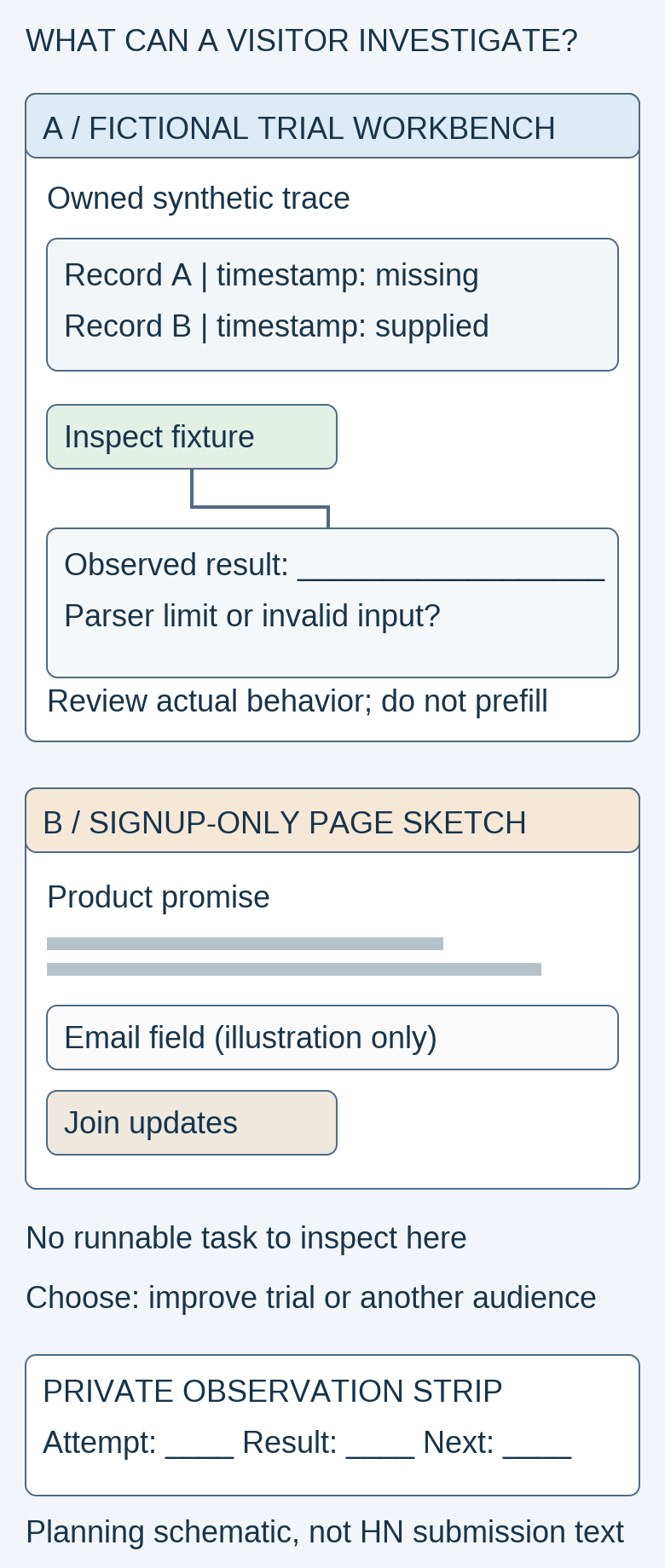
Original schematic, not a live app or HN interface. The runnable side exposes an input and an inspectable result area; the signup-only side cannot answer the technical question. No test outcome or public response is depicted.
Original visual by the Superdirector editorial team. Creation date not recorded.
Planning example two: the right decision is to wait
Now imagine a consumer planning app with an attractive page and an email form, but no available product experience. Its founder wants feedback about whether household planners find the workflow useful.
Two problems remain distinct. The artifact is not ready for the proposed Show HN format, and a broad technical audience may not represent the people whose behavior matters. A better next step is to finish an inspectable workflow and separately research a permitted way to learn from the intended planners.
That does not mean the app has failed or that every consumer app is unsuitable for a technical discussion. It means this particular plan has not connected an available artifact to a relevant question and audience. Keep the hold reason specific so it can be resolved.
Do not rename the email form a demo or judge product demand from a launch that never allowed anyone to investigate the product.
Prepare facts privately, but leave the conversation to the human
The current HN guidelines prohibit generated text in posts, automated posting, and generated or AI-edited comments. They also prohibit soliciting votes or comments. The founder must write their own contribution and replies; this guide must not be used as text to paste into HN.
A private preparation sheet can still organize factual evidence: the artifact's current version, implementation choices the maker can explain, known limitations, and questions they genuinely want to investigate. Keep it as a research record, not a disguised generated introduction awaiting a few edits.
Decide whether the maker can be present to discuss the work and acknowledge uncertainty. If a question needs investigation, record it and investigate rather than manufacture a confident explanation. Do not coordinate engagement, borrow testimonials, or treat a scheduled post as a substitute for participation.
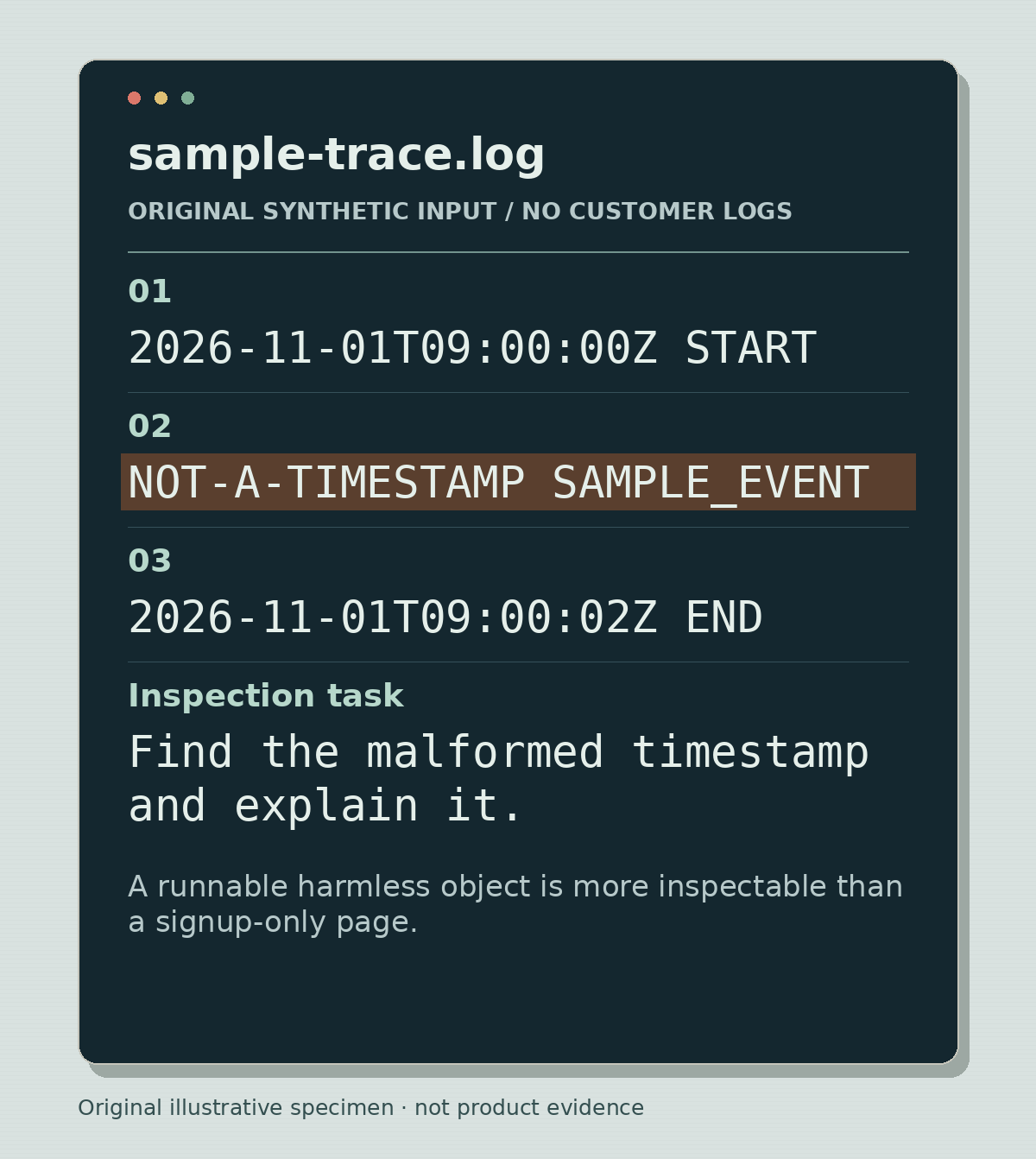
Original synthetic trace specimen with one intentionally malformed timestamp. It is not customer log data, a working product capture or proposed Show HN submission text.
Illustrative worked example by Editorial assistant, original text and raster artwork. Created 2026-10-24.
Use the feedback to make a decision, not a victory claim
After an authorized, human-written contribution, classify any available feedback into reproducible product issues, unclear explanations, audience mismatch, and unresolved questions. Preserve the original observation alongside the classification. These categories are an editorial proposal, not a proven growth model.
Keep page visits, trial attempts, usable results, follow-up participation, and payment separate when they can actually be observed. Missing attribution is unknown. A quiet thread cannot by itself distinguish limited exposure from poor fit or weak demand, and a lively discussion does not prove paying-customer interest.
The next decision should be small: proceed to human review of a suitable channel plan, repair the trial, or research a more relevant audience. Your aim is to make the product inspectable by the right people and learn something you can act on, not to turn one launch into an unsupported market verdict.