How-To Guide
Decide whether an App Store nomination should delay your launch
Your build is ready and you submitted an App Store featuring nomination, but no editorial decision has arrived. Should the launch wait for it?
Your build is ready. You submitted a featuring nomination. No editorial decision has arrived. Should the launch wait?
Do not use silence as a release status. Put the editorial process and the product release on separate tracks, then identify any actual agreement connecting them. A nomination receipt records a submission for consideration. It is neither a release command nor a promise of placement. Product readiness, release authorization and observed storefront availability need their own evidence.
This guide proposes a decision worksheet for a solo founder. It does not recommend changing a live release setting, contacting an editor or making a submission without the appropriate authorization.
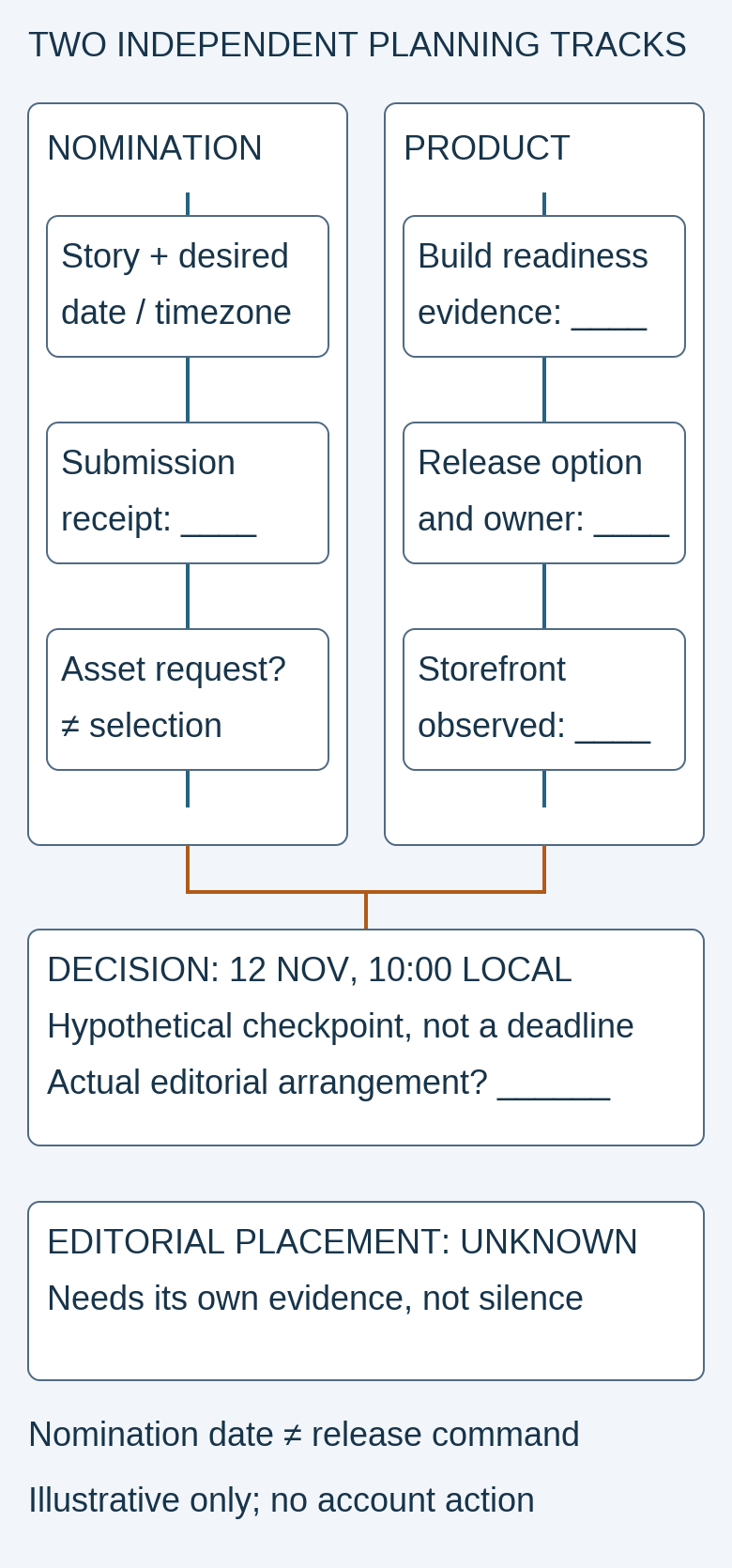
The diagram is an original illustration, not an App Store Connect screenshot or evidence of a submission.
 Superdirector
Make it work for your brand
Find it. Remake it. Post it. Superdirector turns the viral formats in your niche into your brand's carousels, X posts and video scripts, and keeps the calendar full.
The question founders are actually asking
One developer publicly describes being approved and ready to launch, but worries that waiting for editorial consideration could mean weeks without a decision. Later in the same discussion they say they understand the processes are separate. That is useful context, not an official ruling that every founder should always launch immediately.
A separately authored ASO discussion reports repeated nominations without placement and asks about timing and story angle. Both are self-reported experiences. Neither establishes selection odds or the effect of waiting longer. Relative dates and conflicting search labels limit exact dating; these discussions are not measured demand volume.
The useful decision is therefore not “How long until Apple accepts me?” It is “What evidence would make editorial timing a real dependency for this release?”
Build two tracks before deciding
On the editorial track, record the story, nomination state, desired date or range, submission receipt and any actual communication. On the product track, record the candidate version, readiness review, release owner, chosen release option and the evidence needed to confirm availability.
Apple documents manual release, automatic release after approval and automatic release no earlier than a specified date as version-release options. Its nomination documentation describes a separate desired-date field. Treating those as separate workflows is the supported distinction; entering a nomination date is not a substitute for inspecting release configuration. Pre-order and regional cases require their own account-specific checks.
Add a third field for a real editorial dependency. It might contain an explicit coordination request or agreed timing condition, if one exists. Otherwise write “No documented dependency found,” not “Apple approved the launch” and not “Apple rejected featuring.” The absence of a dependency is a planning observation, not permission to bypass your own launch gates.
Choose a true story, not a speculative feature claim
Prepare a short local story note: what actually changed, which user task benefits, what the current build demonstrates and what supporting material can be verified. Use the nomination category that matches that story rather than disguising a small update as a new launch.
The operational help page distinguishes new content, app enhancements and app launches. It also warns that an individual nomination can remain a draft, while the CSV route submits nominations rather than saving them as drafts. A live CSV import is therefore not a harmless private rehearsal. Keep an unsubmitted planning worksheet locally until the external action is authorized.
Do not attach a customer result, accessibility claim or localized experience merely because it sounds compelling. Link only material you have the right to share and can support. A beautiful demo still needs to show the actual candidate task rather than an imagined future feature.
The lead-time pages disagree
At this research check, Apple's getting-featured page asks for at least two weeks' notice and suggests up to three months for wider consideration. The operational nomination guide recommends a minimum of three weeks. Keep that discrepancy visible in your plan rather than presenting one universal deadline.
A conservative internal schedule can allow for the longer recommendation when feasible, but label that as your planning choice. Neither page provides a guaranteed response time or a quantified increase in selection probability. Do not tell the team that waiting three weeks, or three months, will produce a decision.
The nomination guide also says its selected date uses the device's local timezone. Record the timezone beside any planning date so a copied screenshot does not silently change meaning. This is a reason to check the record, not to alter the account settings during research.
Example one: approved build, unanswered nomination
In the fictional PocketIndex example, the founder has a candidate marked approved in their planning scenario, a nomination receipt and a planned internal release decision on 12 November at 10:00 local time. No actual account or release is being described.
At that decision point, the founder asks three separate questions: have the product gates passed, has the release owner authorized the next action, and is there an actual editorial timing arrangement? The nomination's unanswered state remains unknown. It does not automatically turn a ready product into a failed release, or an unready product into a safe one.
If the founder chooses to wait, record why and what evidence will end that wait. If the authorized decision is to proceed, retain the editorial record and verify the actual storefront separately before changing customer-facing calls to action. The purpose is a deliberate decision, not an indefinite delay driven by an imagined approval requirement.
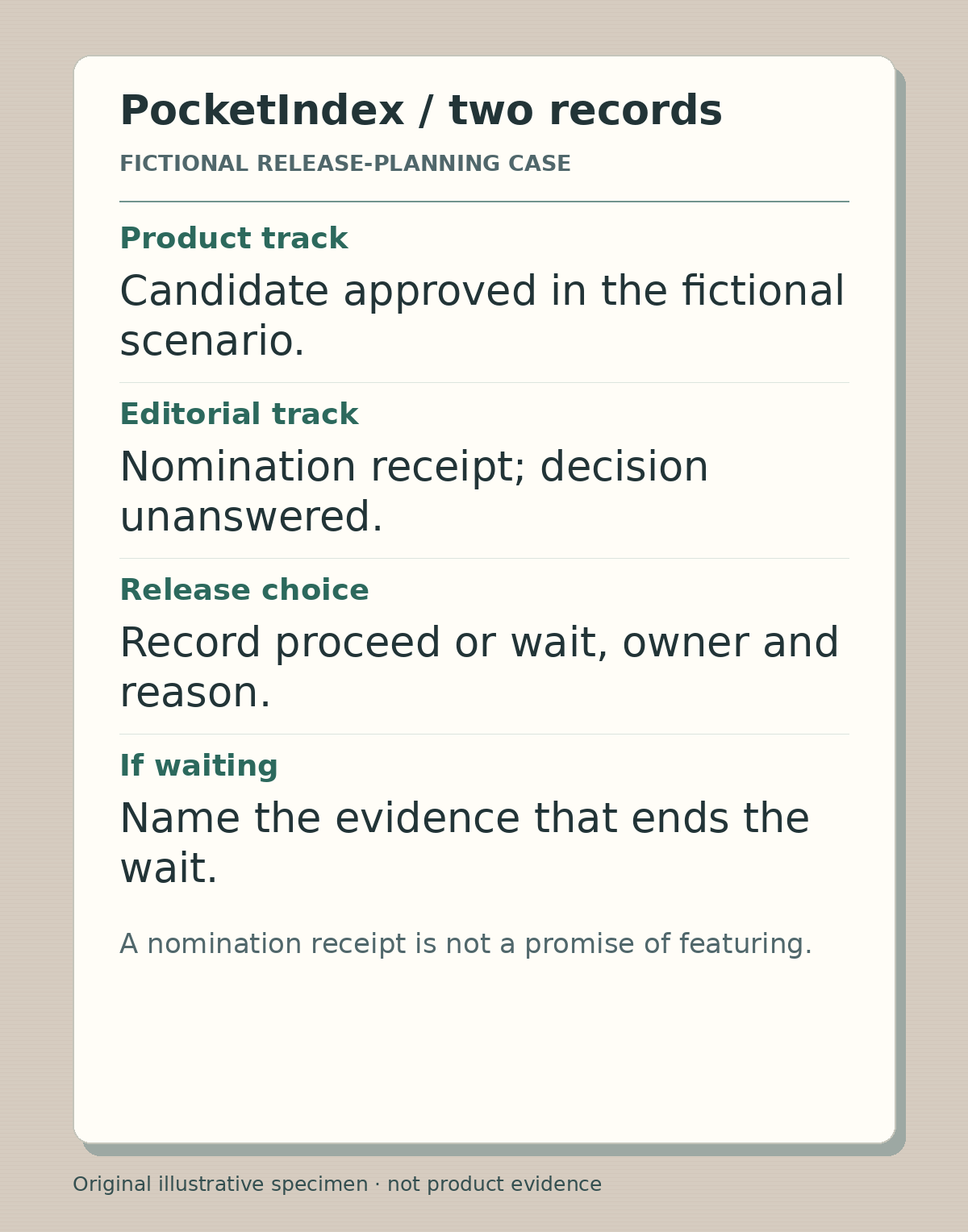
Original fictional PocketIndex planning record. No App Store account, nomination result, release date or featuring decision is represented.
Example two: an artwork request arrives
An existing note utility proposes a substantive offline-search update. In this fictional example, a request for promotional material arrives. The founder records the sender, exact requested assets, deadline and what sharing is authorized, then checks that the materials match the current build.
Apple says promotional assets may be requested while an app is being considered. That is not selection evidence. Keep the status as consideration unless stronger evidence arrives. Do not add a featured badge to a launch video because someone asked for artwork.
Apple describes notifications for selected Today placements. It does not promise a universal rejection notice. If a placement is later reported, record the exact placement, storefront, date and available verification. An old or region-specific placement should not become an undated claim of worldwide featuring.
Use the blank decision worksheet to record receipts and unknowns without inventing a dependency.
Close the planning loop
Before the next launch decision, compare the nomination story with the actual build and timetable. If plans changed, identify which records need an authorized update. Do not assume correcting a nomination changes version release, or that changing a release date automatically corrects every editorial statement.
Review your public copy separately. “Submitted for consideration,” “requested materials” and “featured in this verified placement” describe different states. Keep the first two out of wording that implies editorial endorsement.
Your next small action is to fill both tracks and name the evidence that would justify waiting. That produces a useful release decision even when the editorial outcome remains unknown.
References and limits
- Apple: nominate an app for featuring.
- Apple: getting featured.
- Apple: version release options.
- Developer question about nomination timing and launch.
- ASO operator question about nomination results.
No nomination, release, placement, traffic improvement or probability estimate was produced by this research.