How-To Guide
Choose who will print, inspect and ship your first art-print offer
“Print on demand or buy a printer?” hides several decisions inside one question. Who produces the print? Who holds finished stock? Who sees each item…
By the Superdirector editorial team.
“Print on demand or buy a printer?” hides several decisions inside one question. Who produces the print? Who holds finished stock? Who sees each item before dispatch? Who packs and sends it? A route can answer one of those questions well and still fail the promise you intend to sell.
Begin with the exact original artwork, physical print and customer-facing promise. Then trace its route. Do not buy equipment or commit to a batch because someone else’s comparison calls one method more profitable.
This is a planning method for an original-art seller with uncertain demand. The examples are fictional, not provider recommendations, actual cost comparisons or print-quality tests. Sources were reviewed October 24, 2026.
Separate production from fulfillment
Three possible arrangements illustrate the differences:
- A provider prints after an order and sends directly to the buyer. The seller does not personally handle that outgoing unit.
- A provider sends finished prints to the seller, who holds them, inspects or adds the promised personal step, then packs and ships customer orders.
- The seller produces the prints and handles inspection, packing and shipping.
These are responsibility maps, not quality rankings. An outsourced print can still pass through the artist’s hands. A seller-owned printer can be used after orders rather than to build a large finished-stock pile. The label “on demand” alone does not tell you who inspects or ships the item.
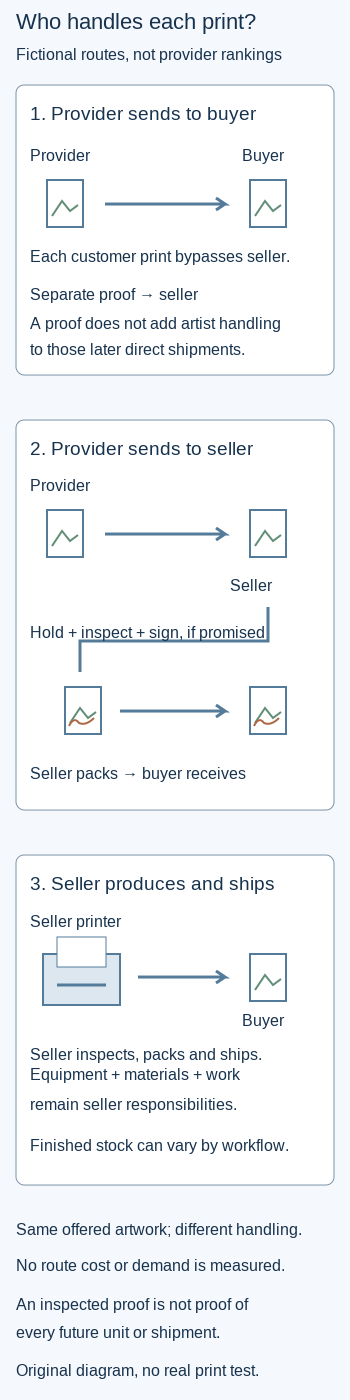
Original responsibility map. No measured cost, print quality or actual fulfillment is represented.
Original visual by the Superdirector editorial team. Creation date not recorded.
Let the promised personal step rule out an unsuitable route
Suppose a fictional illustrator promises to hand-sign each physical print. A provider-to-buyer route that never passes through the artist cannot include that personal step as described. Receiving a proof at the artist’s address does not cause every later direct shipment to be signed.
The illustrator could investigate a route through their hands or reconsider the offer before it is published. That does not mean buying a printer is necessary. Outsourced production followed by artist handling could also match the physical route, if its actual availability, costs and timing are workable.
Keep a reproduced signature distinct from a hand-applied one. Do not use a video of signing a proof to imply personal handling of orders that bypass the studio. The claim follows the route of each offered item, not the most attractive footage available.
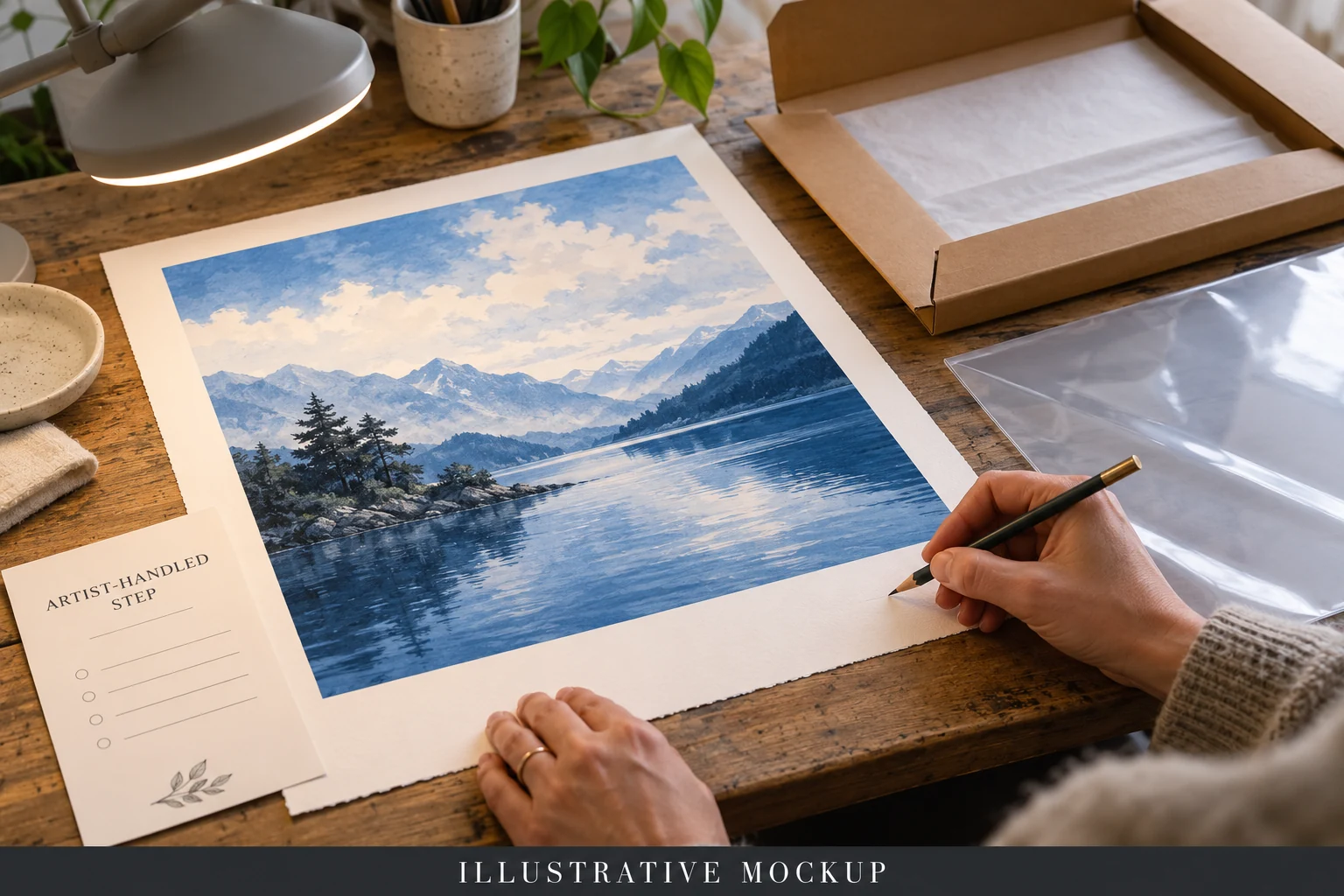
AI-generated illustrative mockup. This fictional scene shows why a promised hand-signing step needs an artist-handled route. It is not proof of a provider’s print quality, a completed order or production costs.
Illustrative mockup by OpenAI image generation, editorial direction for this article. Created 2026-10-24.
Unknown demand does not choose the route for you
Consider another fictional artist with an original landscape print and no observed order mix. Holding finished stock would expose the artist to unsold inventory and require storage. Direct fulfillment could avoid holding those finished units, but would remove the artist’s opportunity to inspect every outgoing print personally. Producing in-house would move the printing work and equipment responsibility to the artist.
None of those tradeoffs establishes the best route without the real constraints. The immediate decision might be which product proof and route information to investigate, rather than which equipment to purchase. Keep demand unknown instead of entering a hoped-for monthly volume into a calculation and treating the result as a forecast.
Record the desired print size, substrate, finish and handling promise. Then identify which missing fact could eliminate a route. For the signed offer, physical handling is decisive. For a seller with no packing capacity, a route that leaves all packing to the seller needs a feasible capacity plan before it becomes an offer.
Choose evidence that can answer the print question
A screen preview and a physical proof answer different questions. CatPrint’s proof guide distinguishes screen checks such as layout and cut lines from physical inspection of color, paper and finishing. Its current FAQ states that a hard-copy proof is associated with a paid order and requires payment before processing.
Do not describe that as an uncommitted free custom sample. A paper-stock sample also does not show how your own artwork prints. Check the exact current order and proof conditions before any commitment; none has been placed for this article.
Printful’s sample-order guidance has account eligibility and product restrictions, and says samples are not intended for resale. A generic sample-program description therefore does not prove that a particular account can obtain the exact offered product as a sample.
For any proposed physical review, identify the actual product configuration and the question to inspect. Do not turn one satisfactory sample into proof of every future unit, production run or shipment. Keep later output and issue handling as separate observations.
Keep provider payment separate from customer payment
A customer’s retail purchase and a fulfillment provider’s charge are not necessarily one transaction. Printful’s payment guide explicitly describes money received through the store’s payment provider separately from payment to Printful. It identifies product, shipping and possible additional costs.
This is a provider-specific example of why “no finished inventory” does not mean “no cost” or automatically convenient payment timing. Do not copy the guide’s suggested markup as a universal margin. Use the actual proposed product, destination and arrangement, and leave unknown charges unresolved.
For a route comparison, record printing, incoming shipment if relevant, storage, individual handling, packaging, outgoing shipment and the work needed to prepare acceptable files or resolve defects. Avoid counting the same fulfillment charge twice under different labels. Separate one-time preparation from per-order work, and do not assume that an equipment purchase will pay for itself.
This article does not calculate tax, recommend financing or authorize any sample order, subscription or equipment purchase.
Write the decision in terms of the promise you can support
A useful provisional record for the signed-print example might read: “Direct-to-buyer fulfillment does not include our required hand-signing step. We will investigate an artist-handled route and its actual proof, packing and shipment costs before deciding whether the offer is feasible.”
For the unknown-demand example, it might instead read: “We have not chosen between direct fulfillment and held stock. We need evidence for the exact print, the handling capacity and the applicable route costs. We will not rank options using assumed demand or borrowed quality scores.”
Those records do not select a provider. They identify the next evidence needed and the condition that would change the decision. Deferring the launch can be appropriate when a necessary promise has no workable route; it is not a reason to invent a guarantee.
Make the launch demonstration match the route
Once the owner chooses a supported arrangement, give the editor that responsibility map. Show real printing, inspection or signing only where it actually occurs and can be represented accurately. If the artist never sees individual direct shipments, a studio unboxing should be labeled as the reviewed sample, not the routine journey of every order.
A short visual explanation can distinguish the artist’s design work from provider production without making one sound inherently better. The aim is an understandable, supportable offer, not a claim that outsourced or in-house production always has superior quality.
What the research establishes
An artist’s own-printing-versus-ordering question and a separate new seller’s fulfillment question show independent operator interest in this decision. Their accounts and replies are historical, not current popularity measurements. One extensive comparison reply identifies its author as a prospective competing print-service provider; its rankings and numbers are not adopted here.
No sample, customer order, shipping result or real economics has been validated. The next useful action is to draw one exact product’s physical route and identify the first promise that the route cannot yet support.