How-To Guide
Choose the first app market you can learn from and support
The number of translated store listings is not the number of markets you are ready to serve. For a small consumer-app team, the first useful market…
By the Superdirector editorial team.
The number of translated store listings is not the number of markets you are ready to serve. For a small consumer-app team, the first useful market decision is where you can learn about one real customer task while maintaining a credible product and support experience.
That does not mean every app should launch in the United States, in its founder's home country, or in English. Choose a specific audience and learning priority from evidence rather than ranking countries by assumed willingness to pay. Use one decision sheet to compare the candidates.
Decide what “first market” means
Separate distribution availability from acquisition focus. A product can be available in several storefronts while the team concentrates research and launch effort on one task-defined audience. Choosing where to focus does not automatically require removing the app elsewhere.
Apple's availability guide describes country and region availability as an explicit configuration, with the customer's Apple Account region determining the store from which they purchase. Selecting all regions also includes future regions under the documented option. Those settings are not a substitute for a business decision about support capacity or product fit.
Keep existing customers out of an initial-market experiment. Do not casually deselect a market to simplify a spreadsheet. Apple also distinguishes removal from the store from continuing updates and eligible redownloads for previous customers. Existing obligations do not disappear when the team changes its acquisition focus.
Define the candidate audience more precisely than a country
A useful candidate has four parts: the customer task, the language experience needed to complete it, the route through which you can reach relevant people, and the actual eligibility to use the product. Record geography where it changes the task or distribution, not as a proxy for a person's language or interests.
For a fictional shared-household planning app, “people coordinating a weekly shopping list with another household member” is a task. “Everyone in a large country” is not. The candidate still needs an explicit interface and support language, a reachable audience and a verified product path. A translated headline alone fills none of those gaps.
A productivity-app founder's question asks whether a broad multilingual launch is worth spreading attention across many markets. The fear of poor translation and the assumed search advantage are the author's hypotheses, not measured effects. A different founder describes the maintenance burden of strings, ingredient search and narration before gaining users. These are two independent questions, not a market-demand ranking.
Compare what you know with what you would have to maintain
For each candidate audience, write down the actual task evidence. A specific problem conversation is different from a page view. Neither is a paid buyer, but the conversation may reveal what the product must do. Retain the source, date and limits rather than converting a few observations into a population estimate.
Then list the work required to serve the next user and maintain the next release. Consider the actual task language, errors, instructions, content updates and support responses. Name the person who can review changes and the capacity they can genuinely offer. Do not invent a response-time commitment or assume machine-translated text removes the need for review.
Apple's localization guidance recommends considering product fit and market needs, checking localized layouts, and obtaining native-speaker feedback on machine translation. Those are preparation requirements, not a promise of growth. A complete string catalog still may not cover a confusing invitation error or a support question about shared access.
Use unknowns as work items. “Support owner not identified” is more actionable than a low numerical market score with no explanation. A candidate can remain promising while being unready for concentrated acquisition.

Original AI-generated editorial illustration. A supportable first market depends on product and support work, not just the number of translated listings. This is not a product capture, customer scene or completed test.
Original visual by OpenAI image generation directed by the editorial assistant. Created 2026-10-24.
Example one: a smaller supported audience versus broader translated reach
In this fictional planning case, HouseholdList has a verified English shared-list task. The founder can review English support responses and has identified relevant household-coordination conversations to inspect. No actual audience count or conversion result is supplied here.
A second candidate has translated store text and reported page interest, but its invitation-error messages and help responses have not been reviewed. The team cannot yet explain how it would resolve a failed household invite in that language.
The provisional choice is to prepare a bounded learning plan for the supported task audience, while assigning the unresolved invitation and support work to the other candidate. This is not a finding that English is better, that the other market lacks demand, or that the first audience is more profitable. The choice follows what the team can currently learn and support.
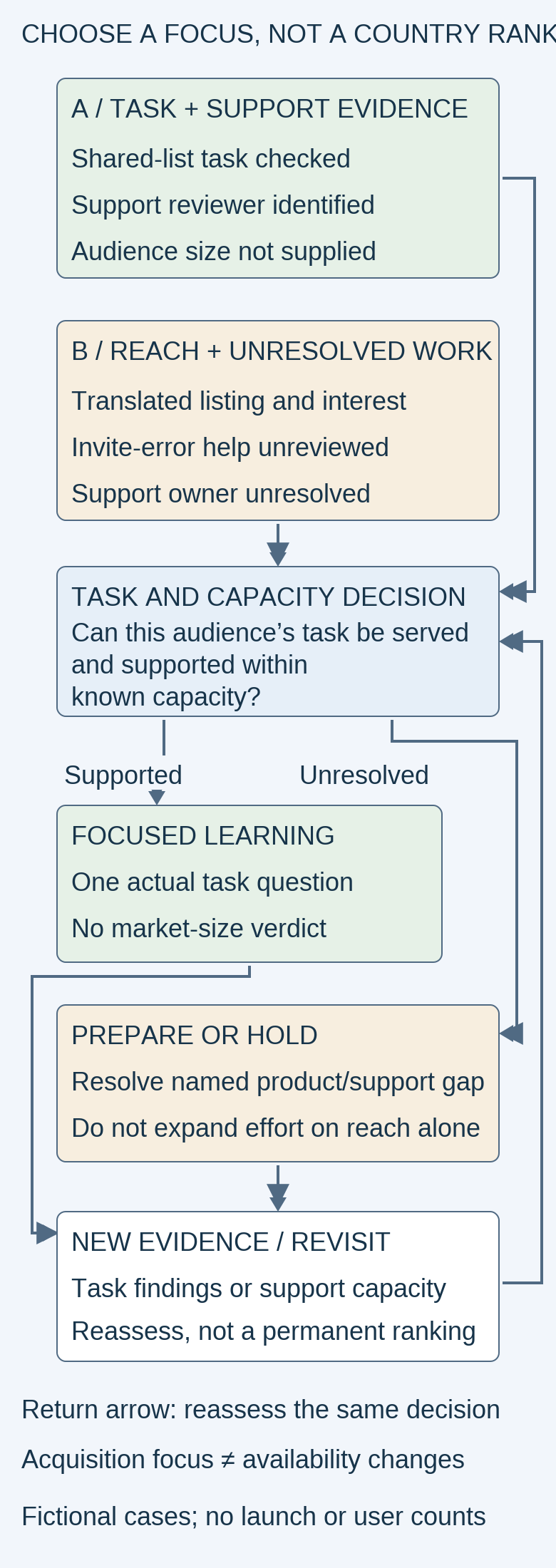
Original resource-allocation board. No real audience size, support promise, launch or market result is represented.
Original visual by the Superdirector editorial team. Creation date not recorded.
Example two: new task evidence changes the priority
Now suppose a different candidate audience raises a concrete shared-household coordination problem. The relevant product task has been verified in its language, but the founder has limited review and support capacity. Meanwhile, a broad English-speaking audience generates more impressions without revealing a specific task the product solves.
Do not let the larger impression total decide automatically. Prepare a narrower learning proposal for the concrete task, with an explicit support owner and limited scope. If that capacity cannot be provided, hold the proposal rather than pretending that language support alone makes it ready.
The new evidence may change the priority without proving a universal market winner. Record what changed: a clearer task, a reviewed workflow, or newly available support capacity. Do not rewrite the earlier decision as a mistake merely because it was made before those facts existed.
Read regional analytics within their coverage
For an app already available in several territories, Apple describes territory-filtered product-page, download, sales and usage information as possible inputs to localization decisions. Its guidance cautions that usage measures such as active devices, sessions and retention include only people who opted to share diagnostics and usage information. Keep that coverage limitation with the observation. Apple market-research guidance
Do not treat a low regional retention reading as proof that translation is the cause. The product task, offer, acquisition source, release timing and measurement coverage may differ. A region with little exposure is not necessarily a rejected market. Preserve the report period and the date you inspected it, and avoid comparing an established cohort with yesterday's new arrivals as if they had equal time to use the app.
Before launch, those analytics may not exist at all. Record “not available” rather than inventing a baseline. Public questions and a prototype review can inform a provisional plan, but they cannot substitute for observed use or sales.
Make one focused decision, with a reason to revisit it
Use the market-learning worksheet to select a candidate, name the learning question, record the support and maintenance work, and identify the evidence that could change the priority. Keep the next action small: inspect one actual task with the appropriate reviewer, resolve one support gap, or prepare one bounded audience-research plan subject to authorization.
All worked cases are fictional. A market-learning plan does not establish legal or regulatory readiness for a country, and it is not evidence of local demand or commercial performance.
A useful first-market choice is not “we translated the most languages.” It is “we know which customer task we are trying to learn about, why this audience is a reasonable starting point, and what we can honestly support while learning.”