How-To Guide
Choose invite-only or open-access affiliate distribution for a low-repeat product
A wall-art customer may finish one room and have no reason to buy again soon. That does not make an affiliate offer impossible.
By the Superdirector editorial team.
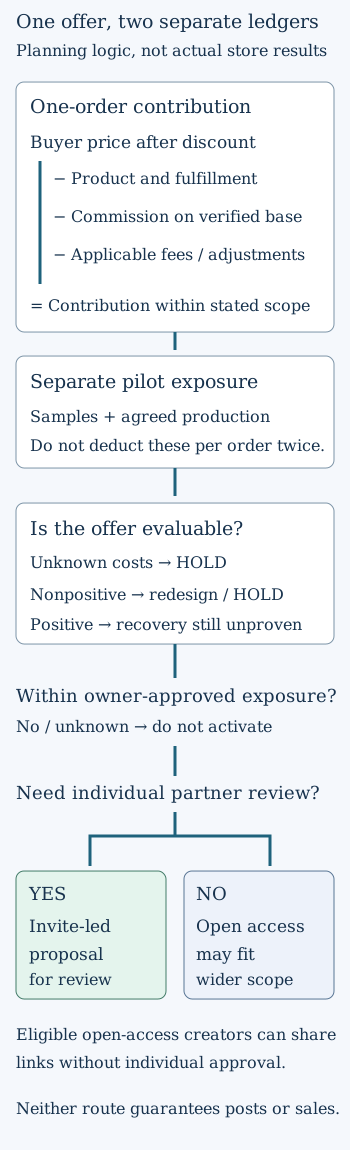
This diagram describes a proposed decision process. It is not a native platform screen, a spending limit enforced by Shopify or evidence that any program is active.
 Superdirector
Make it work for your brand
Find it. Remake it. Post it. Superdirector turns the viral formats in your niche into your brand's carousels, X posts and video scripts, and keeps the calendar full.
A wall-art customer may finish one room and have no reason to buy again soon. That does not make an affiliate offer impossible. It does make “we will recover the cost through repeat purchases” an assumption that needs evidence, not a shortcut around an unattractive first order.
For a small DTC seller moving from informal gifting to affiliate distribution, the immediate decision is not which commission percentage sounds competitive. It is whether a defined offer can support a useful learning exercise, and whether that exercise needs individual partner selection or can tolerate open access.
The method below is an original planning framework, not a profitability forecast or a recommended rate. Shopify documentation was checked on October 24, 2026. No merchant account, product economics, creator agreement or campaign was tested.
Specify the decision that a pilot should inform
Write a question narrow enough to change your next action. For example: “Can creators who explain small-room installations show the actual mounting requirements clearly, and does the resulting distribution produce orders whose observed contribution justifies another bounded trial?”
This fictional question has two parts. Useful product explanation is a content outcome. Orders and their costs are commercial outcomes. Neither can be inferred from the other, and a creator connection proves neither.
Decide which part matters most before selecting access. If you need to examine a creator's demonstration style and audience questions before association with the offer, individual review is part of the experiment. A broad discovery program is not a substitute for that review.
Separate four things that can appear in one offer
Use distinct lines for a sample, a customer discount, a sales commission and commissioned production. A sample consumes product and fulfillment resources. A customer discount changes the amount charged to the buyer. A commission is compensation under the applicable sales terms. A separately purchased video has its own agreed scope and cost.
Shopify's program documentation separates creator commission from customer discount. Its recruitment guide treats a gift and a program as separate welcome-offer components. A creator gift can itself be a product or discount; do not confuse a discount offered to the creator with the customer-facing discount.
The commercial arrangement still needs clear agreement. A no-obligation gift does not purchase a video or guarantee a post. If production is essential to the learning question, obtain an agreed deliverable rather than disguising that requirement as gifting.
Include material-connection disclosure in the creator brief. For endorsements reaching US consumers, FTC guidance calls for a clear disclosure of payments, affiliate relationships and free or discounted products. A no-obligation gift can still need disclosure if the creator later endorses the product. Keep the disclosure with the endorsement, including in the video where applicable, and check the rules for other intended markets.
Build one-order cases without imaginary repeat revenue
Start with an actual eligible SKU and the intended customer offer. Record the source and date of each input, including unresolved values:
- Product revenue after the applicable customer discount, using a consistent treatment of tax and shipping.
- Actual product cost, packaging and order fulfillment costs within the calculation's scope.
- Commission calculated on the verified commission base, not automatically the displayed list price.
- Applicable payment, platform and commission-processing fees.
- Relevant return, refund or other adjustments, kept explicit rather than assumed away.
Shopify's payment guide documents a commission-processing fee and payment conditions. Use current applicable billing evidence rather than copying a forum's percentage. Check whether a cost is already included elsewhere so it is not deducted twice.
The resulting amount is an order-level contribution under the stated assumptions, not total company profit. Fixed overhead, creative production and one-time samples are not magically covered because this number is positive. Record those separately. If shipping collected from the buyer is included as revenue, include the corresponding expense consistently; do not count one side alone.
Now make three cases. With positive contribution, the offer may leave something toward recovering pilot costs, but the number of future orders is still unknown. With zero or negative contribution, additional identical orders do not solve the recovery problem under that case. With an unknown cost, the answer is unknown, not provisionally profitable.
For the fictional wall-art seller, this means holding or redesigning an incomplete offer instead of adding guessed repeat purchases. Possible changes for owner review include a different eligible product, a different offer or a smaller production scope. None is a recommendation to change live terms without authorization.
Choose access according to the control you actually need
Shopify's current program guide distinguishes invited creators from open access. Eligible creators can discover open-access products and generate affiliate links without individual merchant approval. If prior vetting is required, its documented alternative is an invite program.
As checked on October 24, 2026, the guide makes open access available to all merchants but limits eligible open-access creators to the US, UK and Canada. Recheck current eligibility before action; this is not a claim that invite programs share the same geographic restriction.
That difference changes the learning design. In an invite-led pilot, the seller can deliberately select installation-focused creators whose existing work addresses the intended buying question. In open access, link availability can expand beyond a handpicked group. It does not promise suitable distribution, content production or sales.
A second fictional seller has complete cost records but only enough review capacity to inspect a small set of product demonstrations. Their reason to prefer an invite-led proposal is control over that learning scope, not a claim that invited creators universally convert better. A seller prepared for wider participation could consider open access separately, after checking eligibility, support capacity and the actual offer.
Set a review boundary before an invitation or shipment
The accountable owner should define authorized sample and production exposure, available stock, review capacity, an observation period and the decision expected afterward. Do not invent a platform-wide cap or assume that a planning worksheet automatically stops spending.
Prepare a short decision record: offer revision, eligible product, known and unknown costs, desired learning, access choice and reason, owner authorization, review date, and conditions that stop expansion. Hold if necessary costs are unknown or the proposed commitment exceeds the owner's allocation.
Stop expanding a trial for review if committed costs reach that allocation, required product claims cannot be verified, or fulfillment and support cannot sustain the promise. Any actual pause, cancellation or change to accepted terms must follow the applicable agreement and owner authority. A missing post from a no-obligation gift recipient is not a breach to punish.
For audience fit, examine actual relevant work and questions rather than treating total followers as likely buyers. An Instagram installation walkthrough or a professional YouTube tutorial may answer the product question better than a large but unrelated audience. The channel label alone establishes neither fit nor demand.

AI-generated illustrative mockup. The scene is a planning example, not an affiliate program launch or creator arrangement. Distribution access and content review capacity do not establish commercial results.
Decide from observed work, not available links
At the review date, distinguish connections, accepted gifts, actual expenditure, any agreed usable deliverables, observed distribution, attributed orders and order-level contribution. Mark missing information unavailable. Do not turn a lifetime total into the pilot's result or assume an attributed order was incremental.
If distribution did not occur, the trial has not tested audience response simply because a link existed. If content explains the product well but commercial evidence is insufficient, the next decision may be another bounded observation, not automatic expansion. If the economics do not fit the owner's constraints, a popular creator does not repair them.
A home-decor merchant's low-repeat acquisition question and a separate gifting-versus-discount question illustrate the planning problem. Forum rate suggestions are not benchmarks, and neither discussion establishes that this method improves sales.
The next useful action is to complete one real offer's cost record and write why prior partner review is or is not necessary. For a new, not-yet-approved program, do not activate access until the owner approves the actual offer and its bounded learning plan. This is not an instruction to pause an existing live program.