How-To Guide
Choose a browser-game distribution route before uploading the same build everywhere
A successful upload answers none of those completely.
Your own website, an itch.io project page and a curated browser-game portal can all lead to a playable game. They do not necessarily give you the same discovery opportunity, hosting arrangement, account experience or distribution freedom.
Before treating them as interchangeable destinations, separate four questions: where players find the game, where its files run, how players enter and return, and what permission governs distribution. A successful upload answers none of those completely.
The purpose of this comparison is to choose the next route worth investigating. It is not a recommendation to sign a particular agreement, a prediction of portal revenue or permission to submit a game.
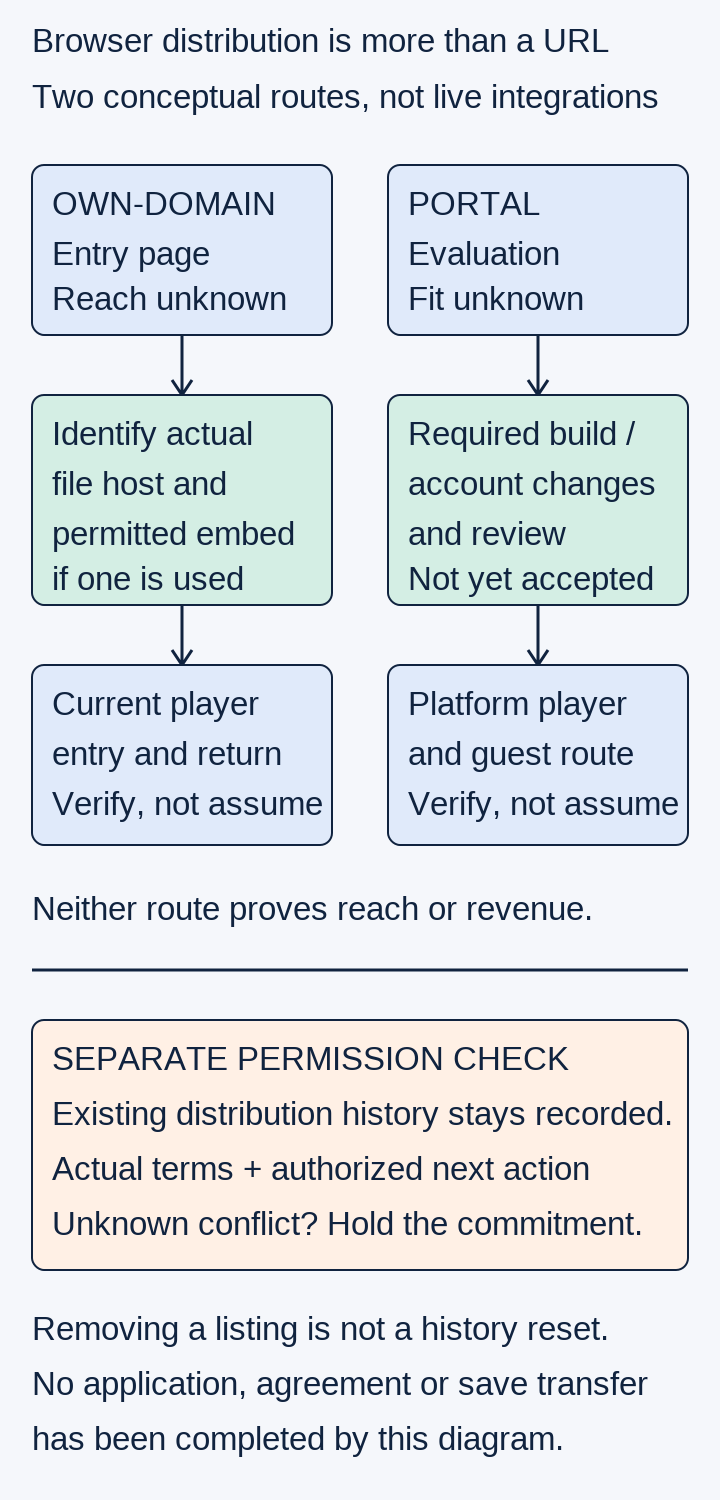
Original route model. No portal application, accepted agreement, live integration or migration is represented.
 Superdirector
Make it work for your brand
Find it. Remake it. Post it. Superdirector turns the viral formats in your niche into your brand's carousels, X posts and video scripts, and keeps the calendar full.
Name the acquisition job before choosing the host
A small studio might want a durable destination for several related games and its existing community. Another might want to see how unfamiliar portal players respond to one self-contained game. Both may use browser technology, but their immediate business questions differ.
For the first studio, keeping a recognizable destination and a coherent return journey matters. For the second, the relevant question may be whether the game fits a portal's audience and operational requirements. Neither a custom domain nor a large portal audience establishes that the intended people will discover, understand or return to the game.
Write down the job in one sentence and identify the evidence needed. “Find new players” is too vague. “Investigate whether this short puzzle game can support a guest-first portal experience without relying on our existing account onboarding” produces a specific comparison.
A current developer discussion about publishing older games to portals asks how those sites acquire games and what happens to rights. It establishes a real distribution question, but the replies' historical payments and copyright assurances do not determine the terms of a new arrangement. Read the operator's question and follow-up.
Draw the actual route, not just the logo
For each candidate, name the discovery page, the game-file host, the account system and the person or organization responsible for changes. Keep an unknown blank rather than filling it from the platform's reputation.
For example, itch.io's HTML5 documentation describes uploaded game files hosted by itch.io and displayed through an iframe on the project page. That is a particular hosting arrangement, not the same thing as putting a link to your independently hosted game on another site. Read the HTML5 hosting explanation.
Likewise, placing an embedded player on your own page does not, by itself, make every underlying file or service yours to control. Inspect the actual source and permission for the embed. Your domain can be the visible entry while another provider still operates the playable content.
For a fictional studio, the route record might say: own-domain entry; game files on its existing authorized host; current account service; studio-controlled release process. A portal candidate would need a separate row. Do not assume that the same URL, build or login flow will be accepted unchanged.
Treat portal evaluation as a selection process
CrazyGames describes Basic Launch as a temporary limited-audience phase with monetization disabled. Full Launch requires selection, fuller implementation and QA. Its public process is therefore not “upload once and receive global distribution.” Read the platform's launch-stage description.
That distinction changes the preparation decision. A team can investigate the work required for a trial without promising the trial will advance or produce income. The portal's overall audience size is not the expected audience for this game, and an available submission route is not acceptance.
Before relying on the route in a launch plan, identify what is merely documented, what the team has prepared and what the platform has actually confirmed. If there is no confirmation, leave the campaign dependency unresolved. Do not manufacture a launch date from a typical process description.
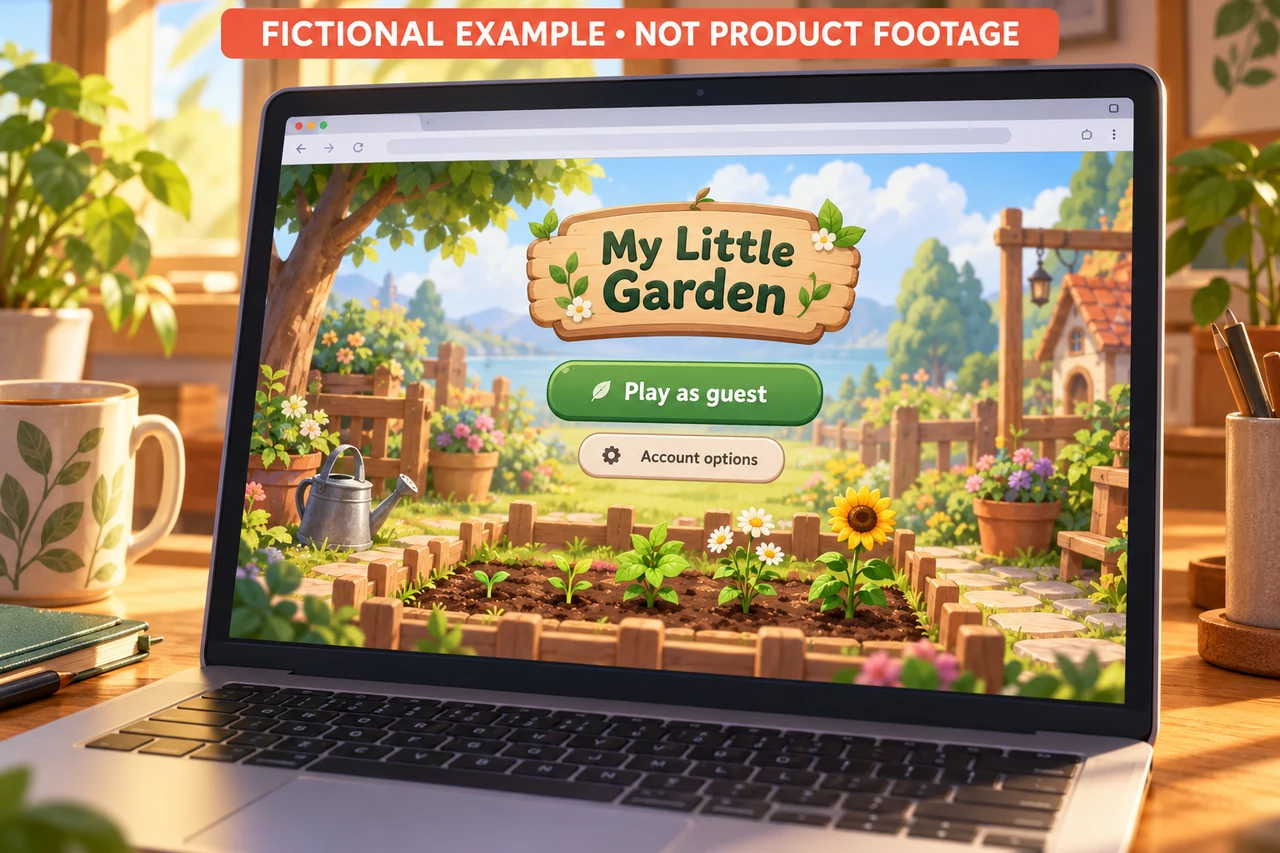
A fictional guest-first entry sketch makes the product question concrete before evaluating a browser-game distribution route. No platform integration is shown. Original AI-generated editorial illustration.
Check whether account behavior fits the product
An own-backend game is not automatically a drop-in portal game. CrazyGames' account requirements distinguish basic and full integration. In the relevant basic scenario, players enter as guests and external login options are disabled; full integration uses the platform's user and guest flow and still restricts external login. These are scoped platform requirements, not a universal rule for browser games. Read the account-integration scenarios.
Suppose a fictional idle-game collection currently starts with the studio's account screen because players move among its titles. The next question is not whether a portal can display its canvas. It is whether the team can support the required guest-first journey and account behavior without making unsupported continuity promises.
Record that adaptation as work to assess. Do not silently remove authentication, migrate progress or change a live service to make a submission appear ready. If existing players would experience a different route, that difference needs its own product review. A technical option in documentation does not prove that your implementation preserves their progress.
Preserve distribution history before considering exclusivity
Poki's public guidance describes web-exclusive and non-exclusive arrangements. Its stated web scope includes browser distribution, Discord and YouTube Playables, while identifying Steam, mobile app stores and consoles separately. It explicitly calls its default term and commercial details indicative: the actual agreement determines them. A described non-exclusive option is not an offer to every already-published game. Read Poki's partnership overview.
Use that information to identify questions, not to make a legal determination about an agreement you have not seen. Record where the game or demo has been distributed, which version was involved and what permissions already apply. Keep previous publication visible when evaluating a new route.
One developer reported difficulty removing a short portal demo while considering another platform. That is an unverified account of their situation, not evidence that removal is impossible or that the platform currently refuses it. Their inference that average session length proved universal completion is also unsupported without actual completion observations. Read the reported distribution problem.
Do not treat removal, renaming or different artwork as a reset of distribution history. If a real offer creates a conflict or uncertainty, obtain appropriate review of the actual terms before committing. This article does not establish a removal period, exclusive eligibility or rights to redistribute someone else's assets.
Make the next decision small and reversible
Finish the comparison with one of three outcomes: investigate a documented fit, retain the current route while resolving a specific gap, or hold a consequential commitment whose terms or implementation are unknown.
For the fictional account-based studio, the next useful artifact could be a guest-first journey sketch and an estimate grounded in its actual code owner’s assessment. For a self-contained puzzle game, it could be a distribution-history record and a list of unanswered questions about a prospective arrangement. Neither requires uploading, contacting a platform or accepting terms automatically.
If a route is later authorized and launched, measure what happened on that route: exposure where available, actual playable sessions, return behavior and revenue as separate observations. Do not equate an iframe load with a player, average playtime with completion, or a portal listing with profitable acquisition.
The useful choice is the one whose audience job, operational dependencies and permissions you can explain honestly. Publishing on more surfaces is not a substitute for understanding what each surface changes.