How-To Guide
Check publisher fit before making your demo plan depend on a deal
This is preparation guidance, not a recommendation to accept a deal or a forecast of funding.
An indie team can have a good playable slice and still be unclear about what it needs from a publisher. Development funding, production help, porting, marketing and distribution are different requests. A public demo can generate useful evidence, but it does not answer all of them, and a publisher’s submission form is not a promise that resources will arrive in time for launch.
Before deciding to wait for traction or wait for replies, build a publisher-specific fit record and a separate product dependency record. The goal is to know which work can proceed with resources and permissions already available, and which work genuinely depends on an agreement that does not yet exist.
This is preparation guidance, not a recommendation to accept a deal or a forecast of funding. No pitch, build upload or commercial commitment follows automatically from completing the worksheet.
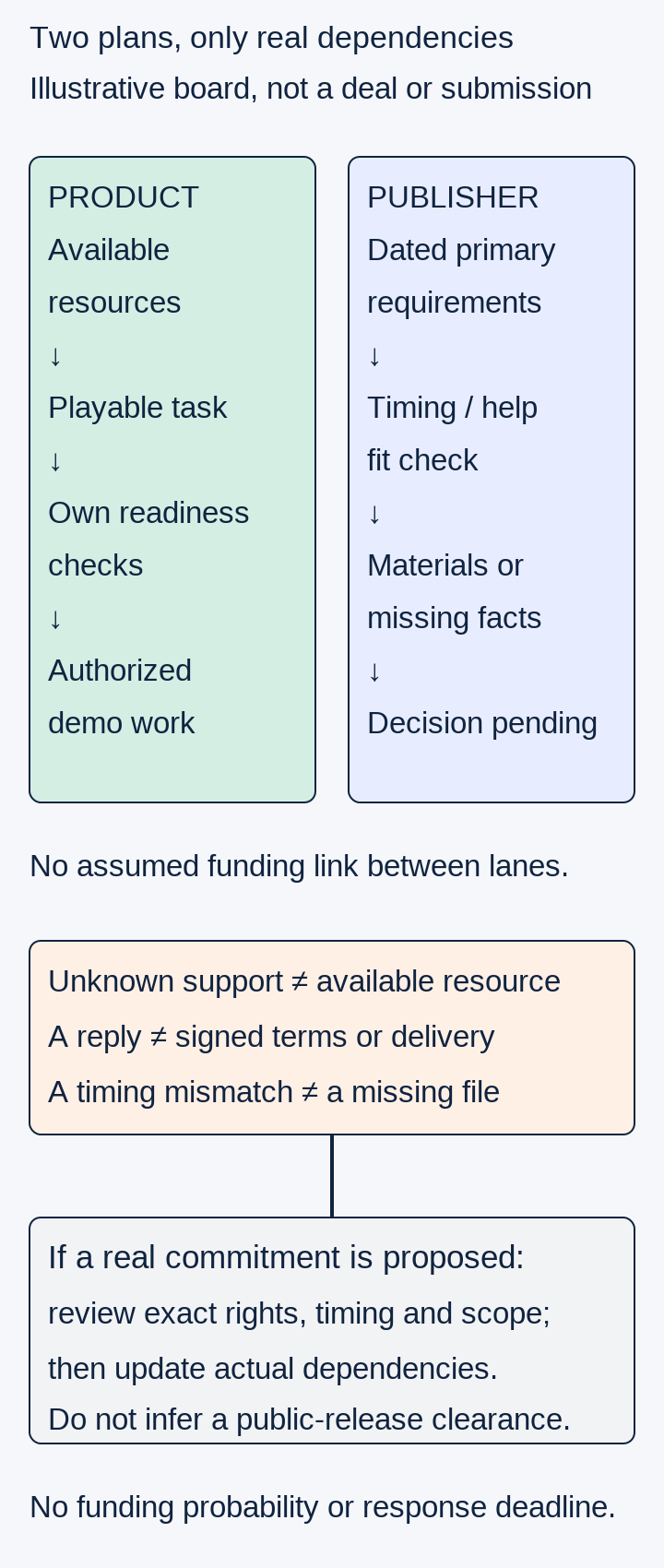
Original dependency illustration. No publisher partnership, submitted pitch, funding probability or release date is represented.
 Superdirector
Make it work for your brand
Find it. Remake it. Post it. Superdirector turns the viral formats in your niche into your brand's carousels, X posts and video scripts, and keeps the calendar full.
State the missing help in operational terms
Replace “we need a publisher” with the work or resource that is missing. Is the unfinished work in the game itself? Is the playable experience ready but the team cannot support a particular platform? Is the main gap a credible production plan, localization, launch execution or something else?
Write what is already done, what remains and why the missing capability matters. Do not turn every hoped-for service into a budget number. Estimates should come from the team’s actual plan, with assumptions visible, not from copying another studio’s pitch or a forum’s suggested amount.
A first-time studio asked whether to pitch a polished private demo before public traction, then clarified that it needed resources to continue development. That clarification materially changes the question: publicity and finishing production are not interchangeable needs. The post’s figures and expected creator coverage remain self-reported, not a benchmark for another team. Read the studio’s question and clarification.
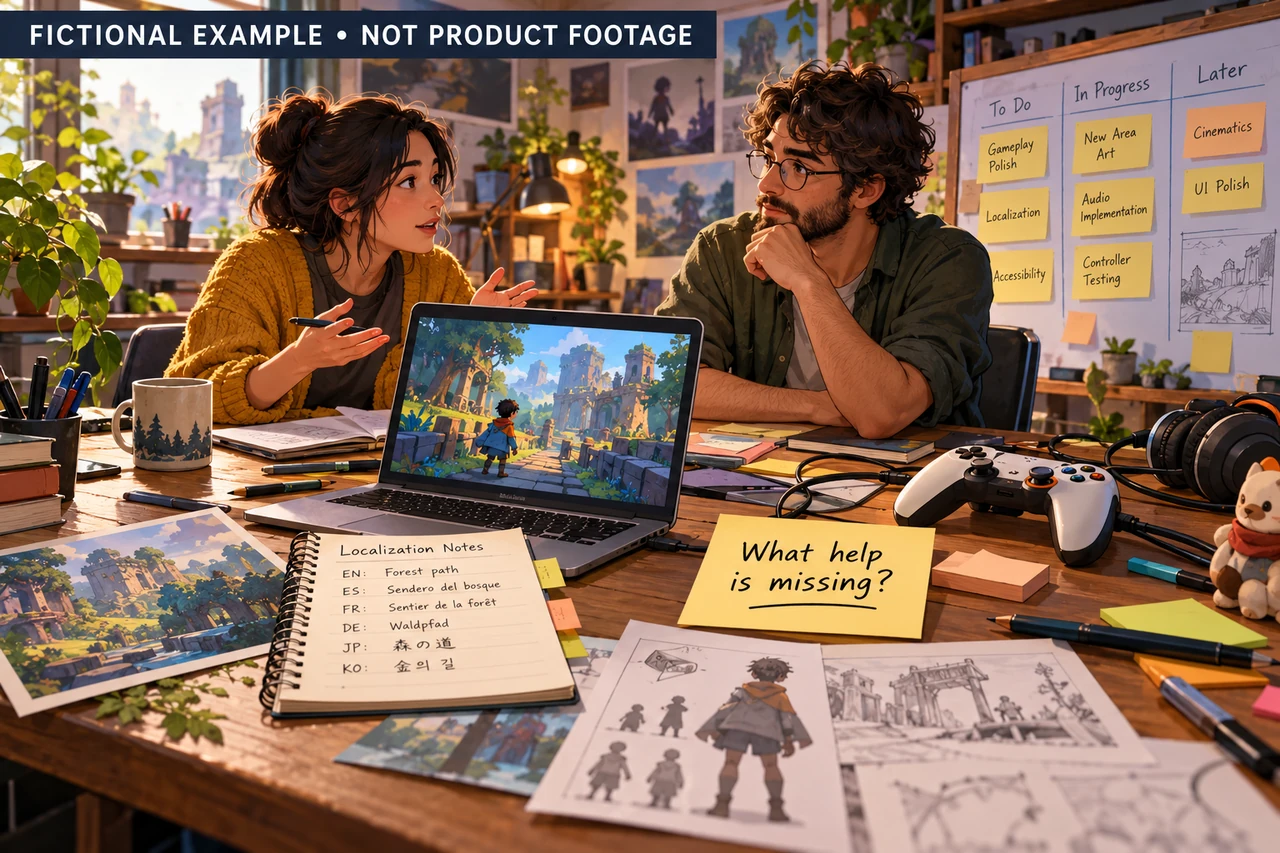
A fictional team starts with missing operational help rather than assuming a publisher agreement. No negotiation, offer or signed deal is represented. Original AI-generated editorial illustration.
Read the constraint before building a long list
A list of well-known publishers is not yet a useful shortlist. Inspect each publisher’s current submission surface and identify any condition that can rule out the route before you spend time tailoring materials.
At the time of this review, Devolver’s form says it considers pitches targeting “next year and beyond.” It requests gameplay and a deck with demo, financial-plan and requested-contribution context. Preserve the relative wording and observation date; do not silently turn it into a permanent calendar rule. Recheck the live form before any authorized submission. View the current Devolver submission surface.
For a fictional team planning a near-term release, that stated window is a timing mismatch to investigate, not a reason to quietly move the game’s release. The team can research another relevant route or reconsider its schedule for real product reasons. A more polished deck does not remove incompatible timing.
Raw Fury’s contact page, by contrast, lists the playable, project materials, approximate launch window and development estimate it wants to evaluate. It separately identifies game pitches and creator/press routes. Sending material to a channel for coverage would not substitute for following the publisher’s game-pitch process. Read Raw Fury’s contact guidance.
Separate advertised capabilities from an actual offer
Team17’s pitch page describes broad genre/platform scope and services spanning development and go-to-market work. That establishes what the company advertises, not what it would offer this project, at what cost or on what schedule. Read Team17’s publisher page.
Use three labels in the fit record: stated capability, project-specific evidence and unresolved question. For example, “localization listed on publisher site” belongs in the first category. “Localization resources committed to our game” would require different evidence. Do not let the first sentence turn into the second when a teammate summarizes the sheet.
A useful fit row contains the dated primary source, requested help, platform and product fit, release-window fit, required materials, missing facts and the next reversible preparation action. Keep a mismatch distinct from an unknown. A clear mismatch can remove a candidate from the current plan; an unknown calls for research or a later authorized question, not a guessed answer.
Make the playable evidence fit this evaluation
Raw Fury’s linked explanation focuses on a build that conveys the project’s intended experience rather than a universal length or polish formula. It also distinguishes the requested PC-development-cost estimate from marketing and service budgets in its own process. That guidance is publisher-specific; its older authorship and current link should not be confused with a new contract or a promise to pay particular costs. Read the linked Raw Fury explanation.
For a fictional team needing help completing a tactical game, the useful preparation step might be to show one implemented decision and its consequence, describe what remains unfinished, and reconcile the development estimate with the actual remaining work. A polished cinematic cannot establish that the mechanic works. Conversely, a representative playable does not prove that every production risk is resolved.
Keep the public-demo job separate. A publisher evaluation build and a public demo may share work, but they do not automatically have the same audience, explanatory needs or release readiness. The public version should not imply that a feature exists merely because it is described in a future production plan.
Do not schedule around an unanswered inbox
Another small developer team asked whether publisher replies and a signed arrangement could fit a planned release sequence. The discussion contains incompatible estimates of how long that might take. It establishes uncertainty, not a dependable turnaround time. Read the original timing question.
Keep the states distinct: materials prepared; submission authorized and sent; receipt confirmed; substantive response received; terms evaluated; agreement completed; resources actually available. No state guarantees the next. A reply is not a funding date, and a submitted form is not a reason to describe the project as publisher-backed.
On the product side, record which tasks have resources and permission today. Continue only that bounded work when its own readiness gates permit. If the demo itself cannot be supported without additional resources, mark that real dependency rather than pretending it can proceed. If it can be prepared independently, an unconfirmed publisher relationship need not become an invented blocker.
When a real proposed commitment would change publicity, timing, rights or responsibilities, stop and assess that specific change with the appropriate commercial and legal review. This worksheet does not resolve contract terms or authorize disclosure of confidential builds and plans.
Finish with a decision you can verify
For each candidate, choose one next step: reject a documented mismatch for this cycle; verify a missing public requirement; prepare one publisher-specific piece of evidence; or hold a consequential action pending authorization and review. Avoid treating “send more pitches” as the default answer to an unclear request for help.
Then inspect the product plan for unsupported dependencies. Can the owner point to a real reason a task waits? Is a desired service being recorded as if it were promised? Are the release window and development estimate consistent across the documents?
After new evidence arrives, update the relevant row and repeat the comparison. A useful outcome might be that one candidate is not a timing fit, one requires a clearer playable explanation, and the next authorized demo test can proceed independently. That is concrete business progress without inventing a deal, a wishlist threshold or a funding forecast.