How-To Guide
Can two visitors evaluate your public demo without changing each other’s experience?
Persistence describes whether work remains available afterward.
A public demo can look convincing when its creator is the only person using it. The harder question is what happens when two visitors arrive together: does one person’s edit change the other person’s task, does a scheduled refresh interrupt active work, and does a simulated action look like a real external result?
Before directing acquisition traffic to an interactive example, prepare a concurrent-visitor rehearsal. Its purpose is to preserve a meaningful product evaluation, not to claim that a demo is secure or to supply a destructive reset recipe. Use synthetic objects and an authorized test environment, not real customer accounts.
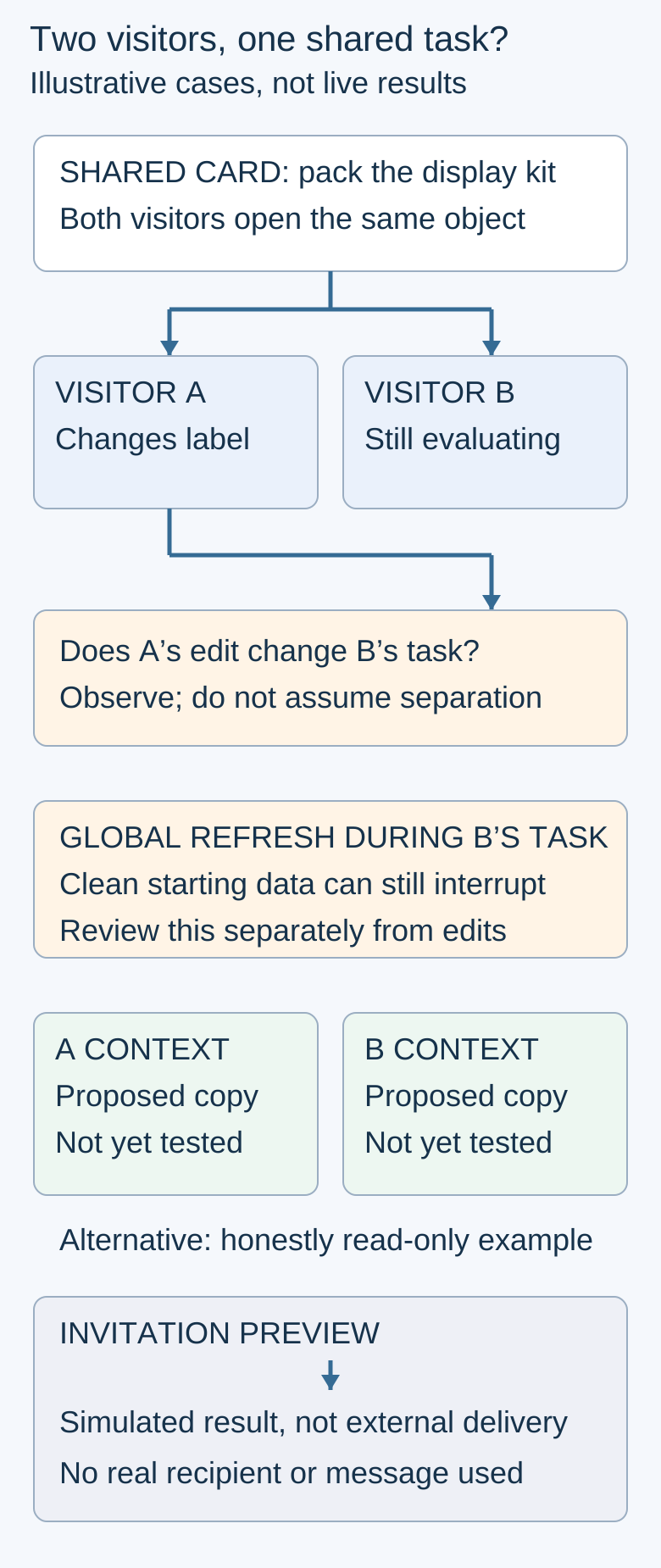
Original rehearsal diagram. No visitor data, reset, account or external action was executed.
 Superdirector
Make it work for your brand
Find it. Remake it. Post it. Superdirector turns the viral formats in your niche into your brand's carousels, X posts and video scripts, and keeps the calendar full.
Separate a clean start from an independent experience
Three promises are often bundled into the word “demo.” A clean start means the example begins in a known state. Visitor separation means one person’s permitted activity does not unexpectedly alter another person’s evaluation. Persistence describes whether work remains available afterward.
A periodic refresh may restore the starting material without providing visitor separation between refreshes. It can also interrupt someone who is halfway through the task. A visible warning about temporary data is useful, but it does not establish that the underlying design supports the experience being advertised.
A historical developer question asks whether a demo should be read-only or periodically restored. One reply describes a planned reset, then clarifies that it was not implemented. Preserve that distinction: an intended cleanup process is not an observed capability.
A separate builder discussion raises the possibility that everyone can modify the same example. An independent commenter describes a separate-demo design but explicitly says its effectiveness is not yet known. The thread’s claimed conversion and churn benefits are not adopted here. These historical reports establish practical questions, not current demand volume or a proven growth tactic.
Worked example: overlapping visitors change the task
Consider the fictional planner TaskHarbor. Its public demonstration begins with a synthetic card titled “Pack the display kit.” Visitor A opens the example, while visitor B begins evaluating how a task is organized. A then changes the card’s label.
The planned rehearsal asks what B sees next. Does the original task remain available in B’s context? Does the label change unexpectedly? Does an error or refresh appear? Record the actual observation when authorized testing occurs, not the behavior the team hoped it built.
Now consider a scheduled global refresh while B is still working. This is a separate case from starting a fresh visit. If the refresh changes the active task, the visitor may attribute the interruption to the ordinary product rather than to the demonstration environment.
The diagram below illustrates those possible interference paths. It is not a report that TaskHarbor exists or that any test has failed.
Choose the interaction the demo can honestly support
One candidate is a read-only example. It can help someone inspect information and navigate supported views without inviting edits it cannot preserve. Its limitation must be clear: inspecting a prepared result is not experiencing the full creation workflow.
Another candidate is independently mutable visitor context. It may allow an authentic editing task, but the actual separation must be established by the implementation and tested under overlapping use. Naming a context “private demo” does not prove its records are separated.
Samuel Casey’s developer retrospective describes changing an initial shared-account plan after recognizing concurrent-user problems. It is a useful account of a failed assumption, not an audit of current software or a universal architecture recommendation. The useful question is which shared resources can affect the task, not which framework another developer used.
Do not adopt either candidate merely because it creates fewer signup steps. The appropriate choice depends on what a prospective user must actually evaluate and what the team can verify. If the supported demo cannot show the essential action, pair it with an accurately labeled explanation or retain a different evaluation route rather than simulating full functionality without disclosure.
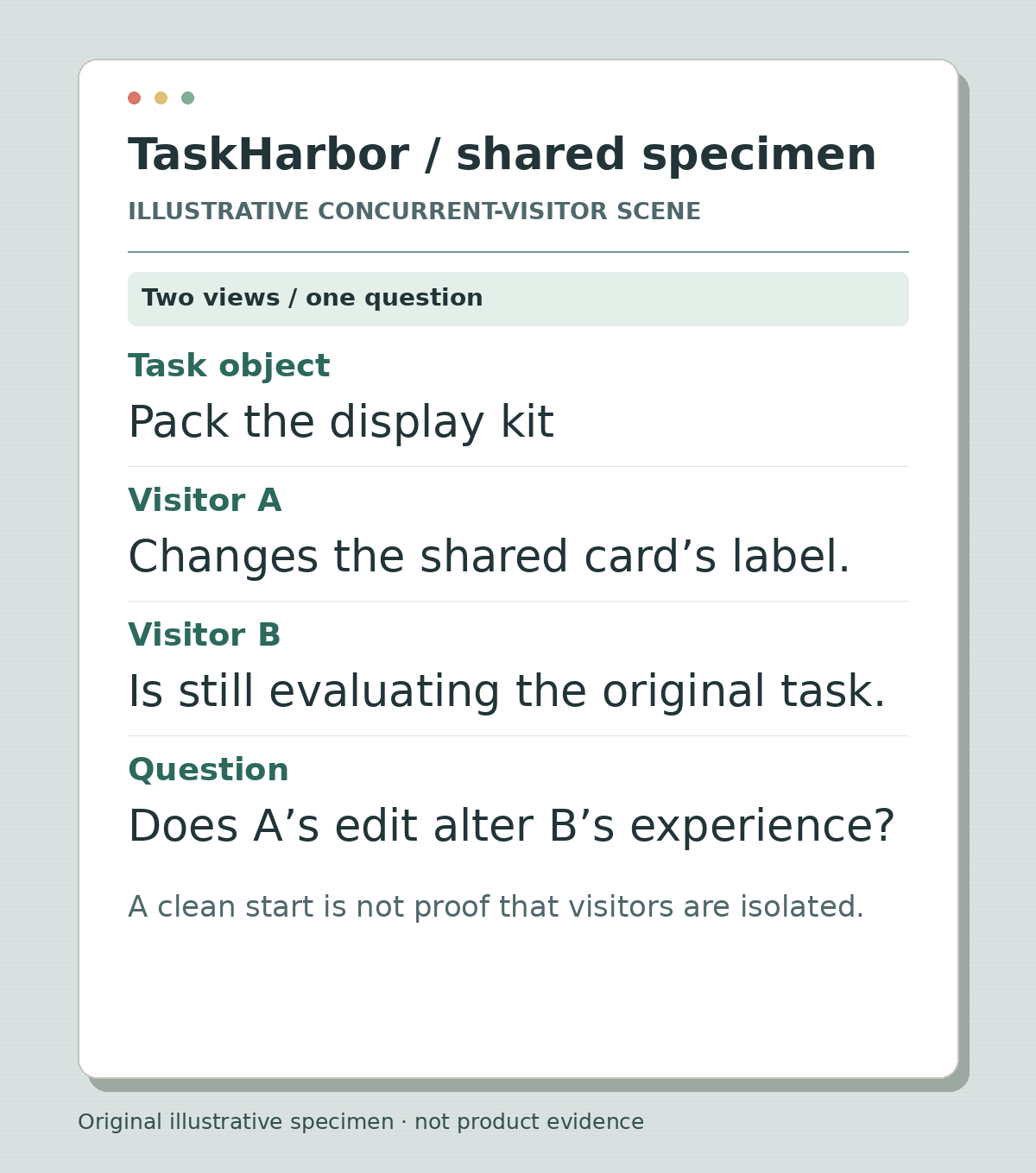
Original TaskHarbor demo concept. The two visitors and task are fictional; the scene asks an isolation question and does not report a completed concurrency or security test.
Browser storage is not a complete isolation claim
MDN’s sessionStorage documentation describes storage partitioned by origin and browser tab, surviving reloads within that page session. It also notes that an opened page may initially receive a copy of its opener’s storage. Those browser properties do not themselves establish separation of a shared server record.
Treat “we use session storage” as the beginning of an implementation question. Ask which objects are browser-local, which requests address shared records, and which operations can change another context. The developer should evaluate the actual design through authorized review. This article does not provide token handling, security configuration or a shortcut around authentication.
Use synthetic session labels in the rehearsal record rather than credentials or identifiers belonging to real customers. Never place private data into a public demonstration to make it feel realistic.
Worked example: an invitation that is only simulated
TaskHarbor’s second illustrative task lets a visitor inspect an invitation flow. The demonstration can show selecting a fictional recipient and reviewing the proposed invitation. If no message leaves the demo, the result must be labeled as a simulation rather than “invitation delivered.”
Explain the boundary near the action. The real product may require an authorized account, recipient selection and actual delivery infrastructure. A demo animation cannot establish that those steps work. Conversely, a public demo should not send real invitations just to make the example feel complete.
Holded’s documented testing environment provides a useful contrast: it identifies the test context, provides fictitious sample records and restricts external effects, including specified email and integration capabilities. Those are Holded-specific rules for its authenticated environment, not evidence that any public app demo has the same protections.
A simulated invitation does not verify actual delivery. Keep a separate, authorized end-to-end test for the real communication path.
Rehearse interference before measuring conversion
Use the blank visitor-overlap worksheet to define two synthetic contexts, their overlapping task steps and the objects each can affect. Include an ordinary edit, a return to the task and any documented expiration behavior. Do not execute a destructive reset against live data as part of the worksheet.
Record each observation with the candidate build and environment. A clean initial screen, independent editing and persistence after a return are different findings. If one fails, retain that failure rather than replacing it with a successful recording from another session.
Explain what visitors may keep, what is temporary and how they reach their own supported workspace if that route exists. Do not promise that demonstration work transfers into a real account unless the actual product provides that behavior and it has been checked.
Keep demo interactions separate from real activation in later reporting. Opening a prepared example is not a customer completing their own task. A simulated invitation is not an external delivery, and a click toward signup is not a payment. The immediate next action is to identify one object that both demo visitors could affect, then review that overlap before increasing traffic.