How-To Guide
Build a rain-alert proof record without claiming forecast accuracy
A weather widget can show rain while the phone stays silent. An alert can arrive without establishing that the forecast was right. If your…
By the Superdirector editorial team.
A weather widget can show rain while the phone stays silent. An alert can arrive without establishing that the forecast was right. If your first-release video promises useful rain alerts, keep those two questions separate: what reached the user, and what happened at the forecast location during its stated window?
Build the demonstration around one linked record, not an impressive-looking notification. Record the forecast identifier, issue time, valid window and location, then attach the rule configuration, any observed delivery and any independent later weather observation. An empty field stays empty. This is a proposed production method, not a report that a particular app passed it.
Start with the user's distinction
One iPhone user reports receiving rain-stopping notifications but not rain-starting ones despite enabling next-hour precipitation. Another, separately authored Android discussion asks for one app with useful rain alerts and says a precipitation widget alone is not enough. These are concrete user questions, not a measurement of market size or a verified diagnosis of either product. Their pages show relative dates, so exact publication dates remain unconfirmed.
The lesson for a launch demonstration is narrow: a visible forecast, an enabled switch and a delivered notification are not interchangeable artifacts. Do not explain a missing alert by guessing that the provider, phone or user must be at fault.
Give the forecast a stable identity
Before recording, choose one ordinary, non-emergency precipitation use case. Use your own supported product behavior, not an assumed copy of Apple Weather. Record:
- A forecast or test-fixture identifier.
- The provider and data product actually used.
- The location represented by that record.
- When the forecast was issued or retrieved, labeled accurately.
- The interval for which the forecast applies, including timezone.
- Whether the relevant data was available, unavailable or not checked.
A retrieval timestamp is not automatically the provider's issue timestamp. If the source does not expose issue time, record that limitation rather than substituting the phone's clock. Similarly, a current-conditions response is not proof that a minute-by-minute forecast product was available.
Apple's WeatherKit documentation explicitly describes location-specific availability and says weather-alert or minute-forecast data can be temporarily unavailable or unsupported in some regions. Apple's consumer Weather support page separately lists regional coverage for particular features. These references show why a feature-specific availability check matters; they do not establish the coverage of your app or a different provider.
Record configuration without calling it delivery
Next, attach the rule the demonstration is meant to exercise. Record the selected location, alert type and the configuration visible in the actual build. Distinguish a saved place from a moving current-location context. For example, Apple's Weather instructions treat current-location and saved-location notification controls separately. Your product may work differently, so inspect it instead of copying that menu path into your claim.
Record permission and relevant device settings as observed. Do not silently change location permissions to make a video succeed. A user may reasonably choose not to grant a permission. If that prevents the selected feature, explain the actual dependency and any supported alternative without promising one exists.
The completed configuration row means only that those settings were observed. It does not prove a notification was generated, delivered, displayed or noticed.
Example one: forecast available, delivery unknown
Use synthetic fixture F1 at location L1. Its forecast window is T1–T2, with an issue-time field T0. The fixture marks minute data available and a rain-start rule enabled. Leave the delivery field blank.
The permissible explanation is: “This example shows the forecast record and configured rule. Delivery has not been demonstrated.” Do not add a notification graphic and present it as a receipt. If you need a designed overlay to explain the intended interface, label it as an illustration throughout.
In a real recording, preserve the source capture and actual timestamp evidence. If the app does not expose enough information to join the forecast and alert, the next action is to identify that evidence gap, not invent a connection in editing. A generic test push may help inspect a notification layout, but it does not establish a rain forecast, provider coverage or an event-triggering rule.
Example two: alert observed, weather outcome unmeasured
Synthetic fixture F2 includes an alert receipt associated with its location and valid window. There is no independent weather-observation record. The delivery lane is populated; the outcome lane remains unknown.
That distinction matters even after a real test. A recording of an alert can support the statement that the alert appeared under those recorded conditions. It cannot, by itself, support “accurate rain prediction.” The screen is showing what the system said, not independent evidence of the weather.
If a later observation becomes available, record its source, location, observation time and relevant limitations separately. Confirm that it refers to the same forecast window and place before comparing. An observation from another town or a different hour is not a matching outcome simply because both mention rain. Do not collect private location information from customers for a launch demonstration without the necessary permission.
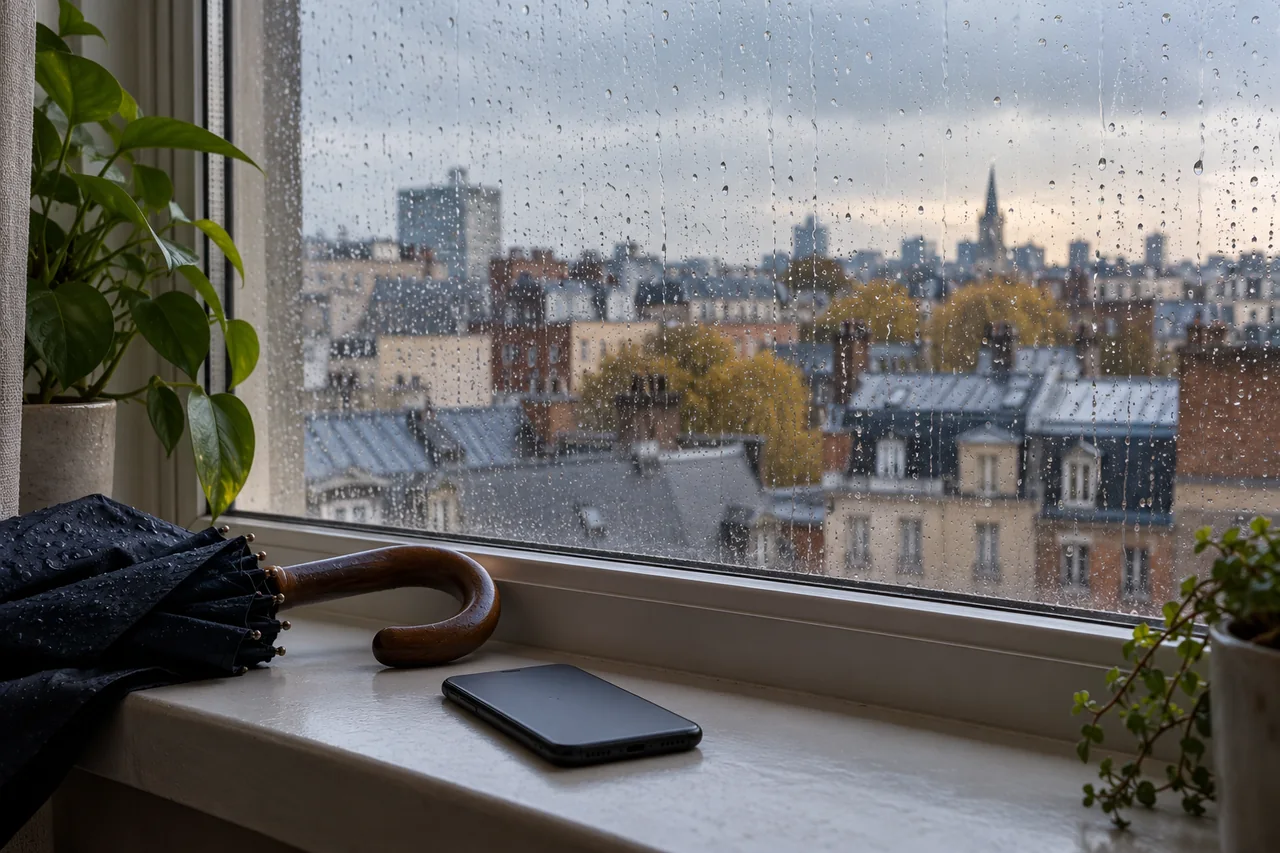
Original AI-generated editorial illustration. A weather observation, a forecast and delivery of an alert remain separate records. This is not a product capture, customer scene or completed test.
Original visual by OpenAI image generation directed by the editorial assistant. Created 2026-10-24.
One matched event is still not a general accuracy result
Even if a forecast and later observation agree, retain the scope: one recorded example. It does not establish a reliable percentage, typical lead time, superiority to another provider or behavior in all locations. Those claims need a separately designed evaluation with defined coverage, repeated observations and an honest account of misses and uncertainty.
This article does not assess emergency-warning reliability. Do not use a launch demo as a reason to replace official weather warnings or promise that an outdoor activity will be safe. Keep the CTA about the demonstrated product task and its verified availability.
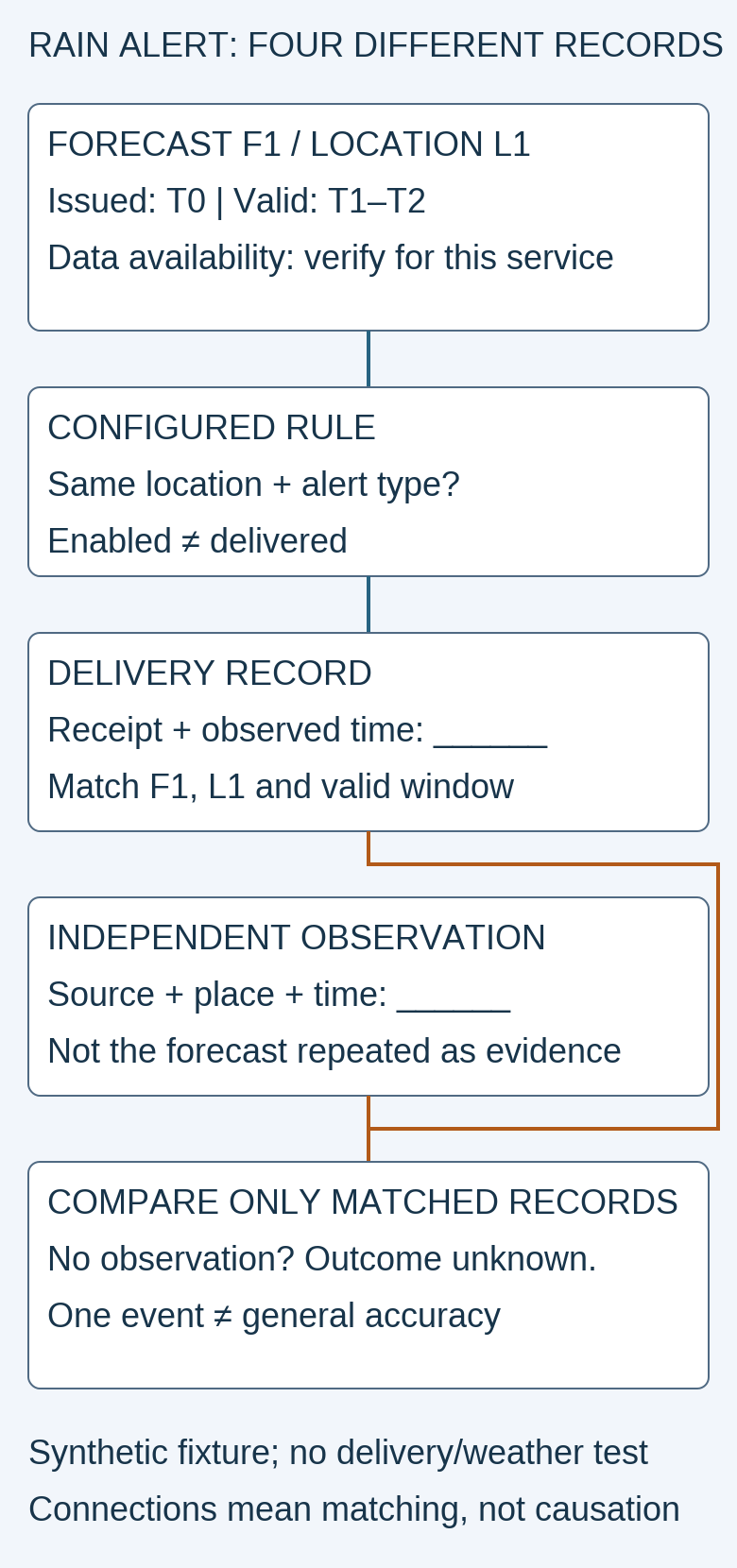
The diagram is an original planning aid, not a screenshot or a completed weather experiment.
Original visual by the Superdirector editorial team. Creation date not recorded.
Use the blank proof worksheet to keep the four evidence types separate.
Review the export against the record
Watch the finished candidate without narration. Can a viewer tell which screens are actual captures and which are synthetic? Are location and time context readable without exposing private information? Then listen without looking: does the voiceover claim accuracy, reliability or advance warning that the record does not support?
Finally, check the product destination. A convincing internal build is not public availability. Your next small action is to fill one forecast identity row and list the missing joins. Record a bounded real demonstration only when the required evidence and permissions exist. Leave the rest explicitly unmeasured.
References and scope
- Apple: manage Weather notifications, read for current versus saved-location configuration, not third-party behavior.
- Apple: Weather feature availability and sources, read for feature-specific coverage, not a universal provider map.
- Apple: WeatherAvailability, for feature-specific data availability limits.
- User report: missing rain-starting alerts, self-report only.
- User question: one app with rain alerts and a widget, buyer vocabulary, not verified comparative results.
No product test, weather observation, popularity measurement or conversion improvement is claimed here.