How-To Guide
Before putting a Steam review score in launch creative, check which reviews it describes
A founder counts the comments on a Steam page.
A founder counts the comments on a Steam page. A designer sees a different count beside the score. An analyst supplies a spreadsheet containing only positive English-language reviews. Each person may be looking at something real, but those observations do not support the same claim.
The useful editorial question is not “Which number looks strongest?” It is “What exactly does this number describe, and can a viewer recover that context?” A score-bearing asset needs a traceable source, a defined population and an observation date. If those are missing, show the game’s actual value instead of constructing a rating from mismatched records.
This is a workflow for preparing evidence-backed creative. It is not a method for soliciting reviews, changing a score or promising a visibility boost.
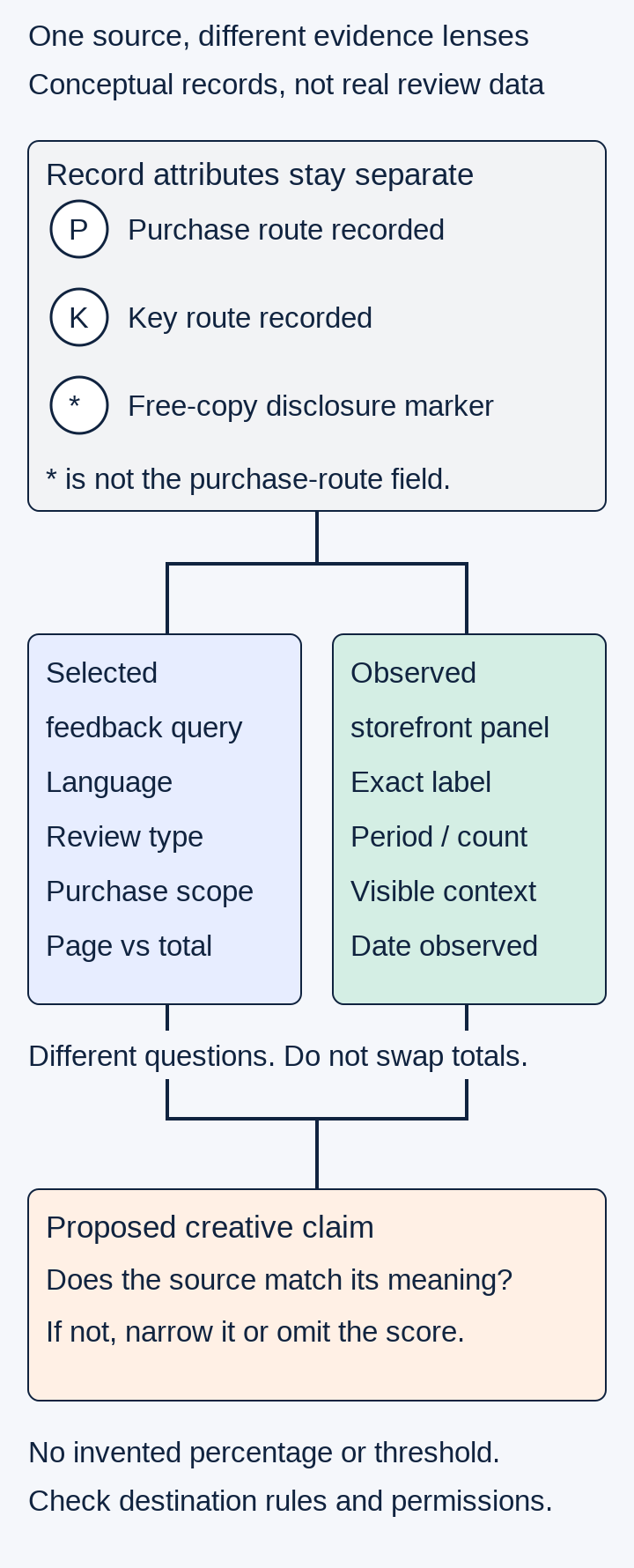
Original conceptual illustration. The records are teaching examples, not measured users, real reviews or a reconstruction of Steam’s interface. The two lenses answer different questions; no percentage is calculated.
 Superdirector
Make it work for your brand
Find it. Remake it. Post it. Superdirector turns the viral formats in your niche into your brand's carousels, X posts and video scripts, and keeps the calendar full.
Start with the sentence, not the screenshot
Write the proposed claim in the review brief before opening the design tool. Leave blanks rather than guessing: product, displayed score label, associated count, period, language or filter context, source URL and observation time. Also name the intended destination, such as a company landing page or a particular store asset.
Then ask another person to identify what a reader would reasonably think that claim means. “Players recommend our latest update” is stronger than “This is the lifetime review label observed on this date.” A lifetime panel alone does not establish reception of a specific update. A selected set of comments does not establish a worldwide recommendation rate.
Treat that meaning check as an editorial decision, not a formatting exercise. If the evidence supports only a narrower statement, narrow the statement before polishing its appearance.
Readable feedback and score inclusion are different
Valve documents separate recent and lifetime scores and says purchases made by the reviewing account, rather than key activations, contribute to the score. The documentation also describes free-copy disclosure. These distinctions do not mean a key-holder’s account of a confusing tutorial is useless. They mean that useful feedback and the population behind a score are different things. See Valve’s user-review documentation.
Consider a fictional studio with twelve readable comments and a smaller qualifying purchase population beside the displayed score. The designer should not divide all positive comments by twelve and label the result “Steam score.” The right next action is to preserve the actual panel context or omit the proposed score asset until it can be supported. The fictional numbers illustrate the mistake; they are not a platform threshold or an observed game’s results.
An operator discussing the launch of Once Before Us described surprise at the distinction between key-holder feedback and counted reviews. A prospective player in the same conversation also questioned the differing counts. That is a useful example of real confusion, not proof of how common it is or of any resulting sales effect. Read the original developer discussion.
Do not let an export silently become the public denominator
An export may be excellent for a particular research question and unsuitable for a public score claim. Imagine an analyst selects English-language positive reviews to study what people enjoyed. The resulting document is a positive-feedback sample by design. It cannot establish the proportion of all reviewers who were positive.
The current IUserReviewsService documentation separates language, purchase and review-type filters. It also distinguishes reviews returned on one page from totals matching a query. The purchase field and the reviewer’s free-copy disclosure are separate fields, not interchangeable labels. Valve now documents GetAppReviews as the replacement for the older appreviews interface. These are documentation observations, not results of an API run for your game. Read the current interface definitions.
For the editor, the practical safeguard is simple: require the person supplying a figure to explain its inclusion rule. “This is what the first response contained” is not an explanation of the entire population. “This was filtered to positive comments” immediately disqualifies it as an overall recommendation-rate denominator.
Preserve the context through the design handoff
Create one evidence card for each proposed claim. It should contain the exact intended wording, the unedited source context, the URL, observation date and the scope that must remain visible. Keep the original capture separate from a cropped working image. A crop that removes the period or associated count can change the meaning even when the remaining words are accurate.
Use a deliberate approval question: “Can someone looking only at the finished asset tell what this claim applies to?” If the answer depends on a hidden spreadsheet, revise the asset. A footnote too small to read on the intended mobile placement does not solve the problem.
A hypothetical handoff might read: “Use only the label recorded in this evidence card; retain its period and count context; recheck before release; do not turn it into an update-specific endorsement.” This is an instruction for the editor, not ready-to-publish copy about an actual game.
The evidence card should also record why an attractive option was rejected. For example: “Positive-only research export; not usable for an overall score claim.” That prevents the same unsupported statistic from returning in a later video revision.
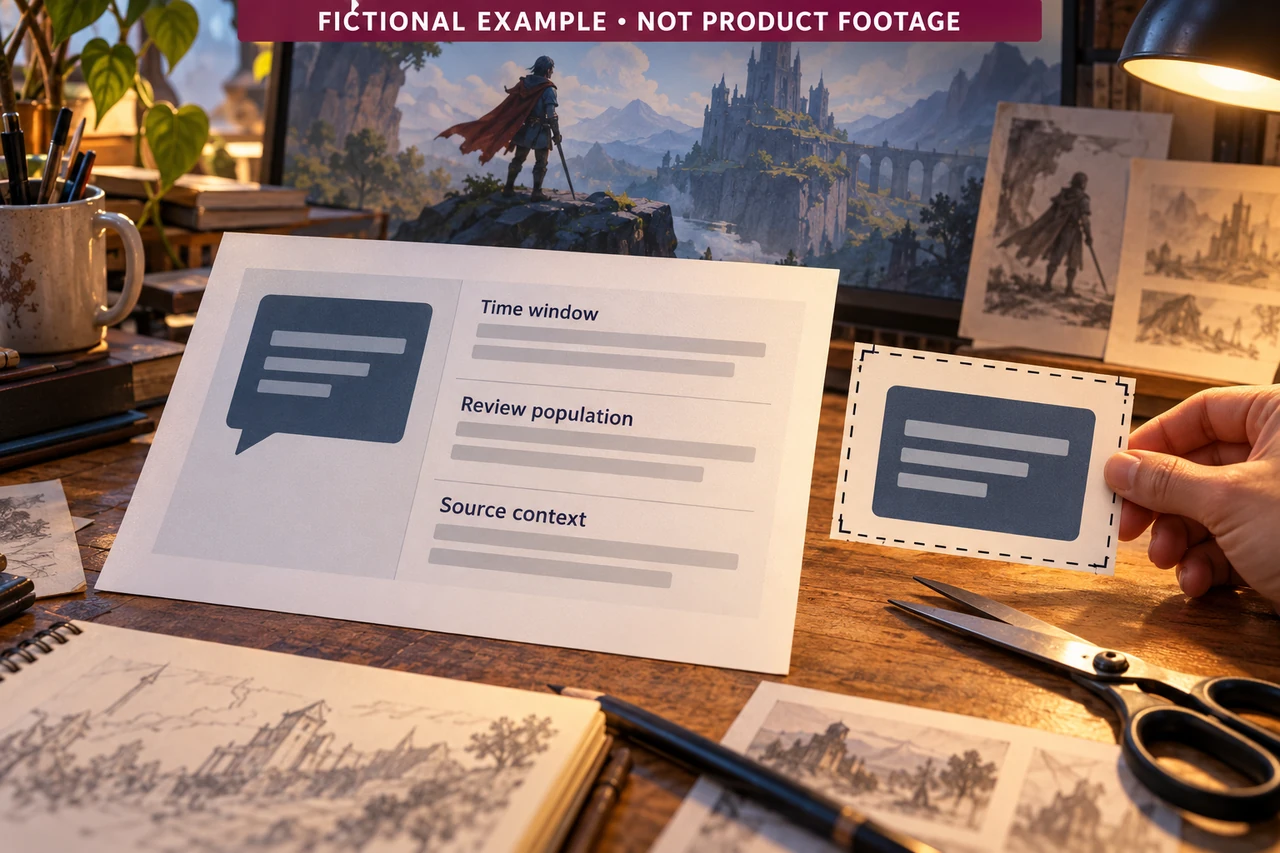
A fictional handoff contrasts a cropped review excerpt with its time window, review population and source context. Keep that context with any published claim. No live Steam score, denominator or rating is reproduced. Original AI-generated editorial illustration.
A correct number does not clear every use
Before putting a score, screenshot or player quotation into a particular asset, check that destination’s current content rules and the permissions needed for the material being reused. A number being visible online does not by itself clear a player’s words, identity or image for a promotional placement. This article does not establish those permissions or approve an exact asset.
Do not respond to a weak or unavailable score by manufacturing the desired evidence. Valve prohibits manipulation, reward-based review solicitation and in-application review requests under its stated rules. A separate developer discussion about social-media requests contains conflicting interpretations; the replies are not permission to launch a campaign. Read the discussion in context.
When the claim cannot be substantiated or the placement is not cleared, leave the score out. An accurate gameplay demonstration, a clear explanation of the player’s task and a usable destination can carry the creative without an invented endorsement.
Close the loop on the claim, not on a promised ranking
Before release, have someone other than the asset’s author compare the final text and crop with the evidence card. Record whether they could identify the population, period and source without being coached. Recheck changing facts immediately before the approved publication step. After a later revision, compare the new asset again rather than assuming the old approval covers it.
Track concrete errors: a missing date, a positive-only sample presented as all feedback, a count detached from its scope, or an update-specific statement supported only by lifetime evidence. Fix those defects and repeat the check. Do not call the process a conversion improvement without an appropriate measurement, and do not claim it changes Steam’s discovery behavior.
The finished outcome is modest but useful: the creative says only what the underlying evidence supports, and another person can verify why.