How-To Guide
Before posting a Steam update, decide what existing players should do next
A developer has improved the game and wants the community to notice. The next step seems obvious: write an announcement. But “notice” hides several…
By the Superdirector editorial team.
A developer has improved the game and wants the community to notice. The next step seems obvious: write an announcement. But “notice” hides several different jobs. A reader might need to understand a change, return to try a changed interaction, or join a session that happens at a particular time. Those jobs need different evidence and different invitations.
Choose the player action before choosing the post category. This is a small editorial planning method for an existing Steam community, not a promise that an announcement will increase retention or bring new buyers.
Start with one changed player task
Write one sentence containing the audience, the actual change and the next useful action. For example: “Owners who stopped at the puzzle tutorial can try the revised hint interaction in the released build.” This is a fictional planning example. It is more useful than “tell everyone about our exciting update” because someone can inspect whether the promised interaction exists and whether the audience can reach it.
Then ask whether communication is the main problem. If the hint remains unintelligible inside the game, another post may only send people back to the same frustration. Repair or test the interaction first. If nothing meaningful changed, do not invent a milestone to fill a calendar.
A historical solo-developer discussion illustrates the capacity problem: the author wanted a place for progress reports without producing a full devlog. It is an authentic question about communications work, not evidence that weekly posting is the right cadence for your game. Read the original developer question.
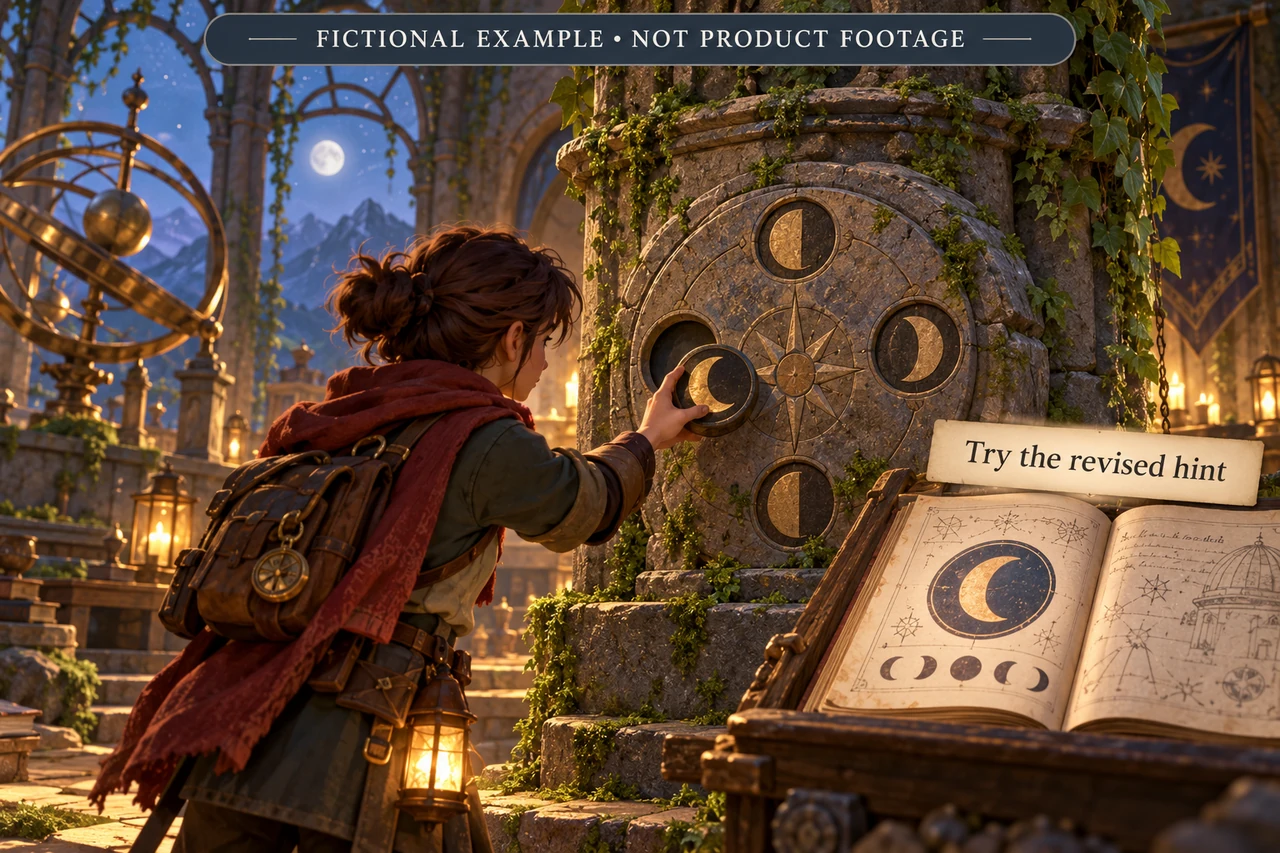
A fictional revised hint gives a returning player a specific interaction to try, rather than a generic invitation to read an update. Original AI-generated editorial illustration.
Original visual by Original editorial illustration generated with OpenAI’s built-in image tool. Created 2026-10-24.
Compare three useful invitations
Understand a change asynchronously. The reader can learn what changed whenever they arrive. This may be appropriate for a concise development explanation or a factual update. The useful response might be fewer misunderstandings or a more precise question, not an immediate game launch. Do not give it a fictional appointment simply because a dated event looks more prominent.
Return to perform a changed task. An existing player needs a specific reason to reopen the game. Explain the prior friction, the implemented change and the shortest route to try it. Record which build contains the change and what remains unchanged. Avoid implying that one repaired interaction fixes every reason someone stopped playing.
Join a real time-bound session. Participation depends on actual availability: the relevant build, eligible players, a functioning entry route and someone able to handle problems. A cooperative community session might need this route. A development diary does not become a live session merely by adding a countdown.
These are editorial choices, not three official Steam categories. Steam uses one events-and-announcements system; choose its actual category to match the communication rather than treating the labels as a trick for reaching more people.
Match the invitation to the audience you can actually reach
A follower interested in development is not necessarily an owner able to launch the paid game. A current owner may not know your Discord exists. A newcomer on the store page may need an explanation of the basic offer before a detailed change log makes sense.
Valve documents follower activity-feed and News Hub distribution. That does not establish email or push delivery, attention, ownership or a completed player action. Steam follower behavior.
Valve also describes category-dependent visibility and requires unrelated-product announcements to use Cross Promotion. Choose the truthful category and inspect its available surfaces. Do not relabel a small patch or a sequel advertisement to imitate a major update. Events and announcements guidance.
A player discussion provides a useful counterexample: the original author filtered for game updates but objected to unrelated new-game advertising appearing there. This is one consumer conversation, not a representative survey or evidence that cross-promotion always fails. It does show why “more exposure” is not an adequate reason to ignore the audience’s expected context. Read the player’s complaint and clarification.
Work through the decision before producing the artwork
For the fictional puzzle update, write a compact plan:
- Audience: owners who encountered the old hint interaction.
- Change: the exact implemented hint behavior, verified in the intended released build.
- Action: reopen the relevant tutorial and try that interaction.
- Explanation needed: how to reach it, what changed and what did not.
- Blocking issue: the destination still opens an older build, or the revised hint is still confusing.
- Evidence afterward: actual observations of that task and the questions players ask, if available.
A different fictional team is arranging a cooperative community session. Its useful invitation identifies who can join and when participation is actually possible. The team checks the entry route and assigns a support owner before preparing the invitation. If that support capacity is unavailable, it can choose an asynchronous update instead of promising a session it cannot operate.
In both examples, the decision includes an option not to post yet. That is not inactivity. It prevents communication work from concealing a missing product or operational prerequisite.
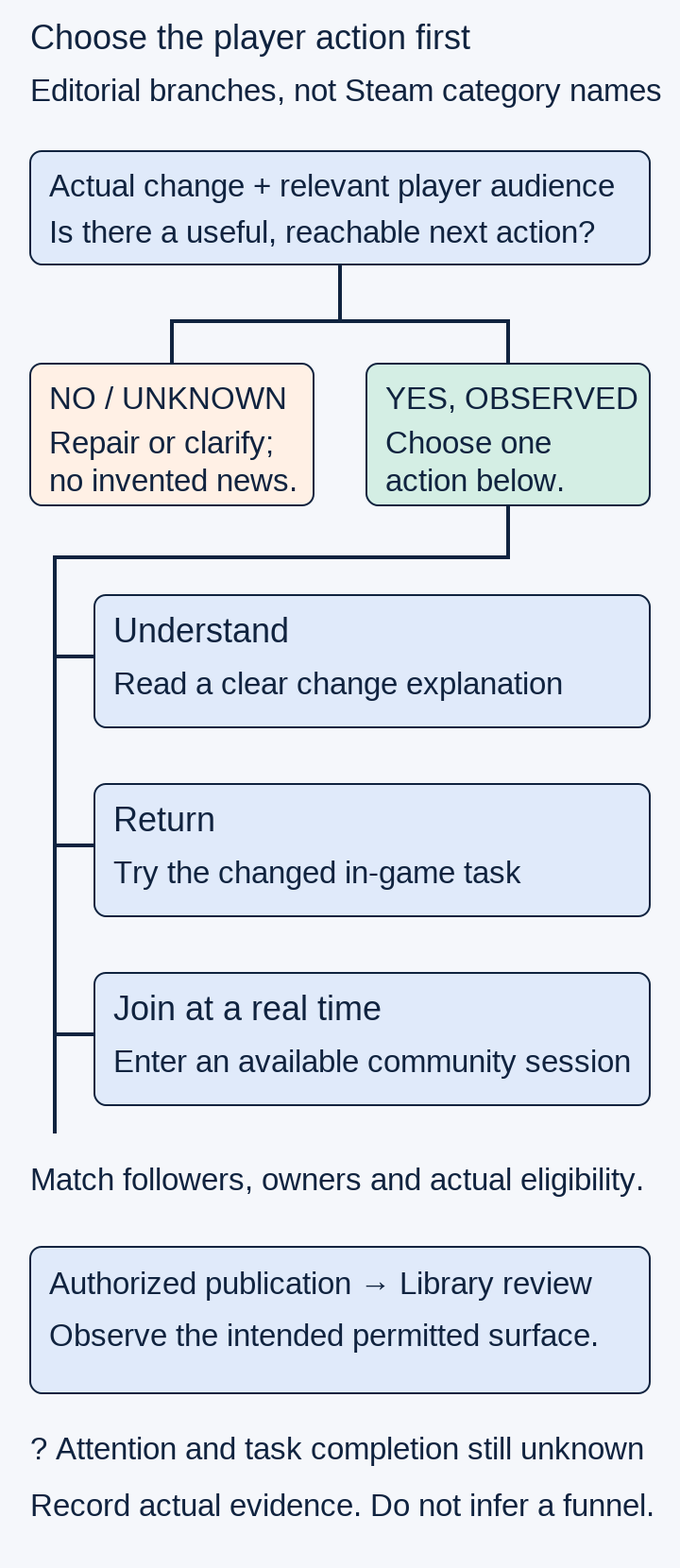
Original decision map. The branches are editorial examples, not official category names, an actual campaign or a guaranteed conversion path.
Original visual by the Superdirector editorial team. Creation date not recorded.
Separate publication from visibility, reading and useful action
Keep a short observation record rather than one “announcement done” checkbox. Record the prepared revision, authorized publication state, the intended surface and observation time, and the player action you are trying to support.
Steam’s moderation guidance says new or edited posts enter review and are not visible in the Library until confirmed. A published post is therefore not sufficient evidence that its Library placement is already available. Treat documented typical review timing as an expectation, not a deadline guarantee. Library review step.
The visibility report has its own boundaries. It counts unique signed-in users, excludes anonymous browsing and records first locations. Direct external visits can produce reads without a corresponding on-Steam impression. Some event types, including patch notes and cross-promotions, are excluded from the store page’s recent-items section. These details prevent a universal placement assumption or an improvised funnel made by dividing unrelated totals. Event reporting definitions.
An event read does not show that a player completed the revised tutorial. If you have no reliable task-level observation, leave that outcome unknown. If play increases during an update, record concurrent changes and other promotion rather than assigning the entire increase to the announcement.
Finish with one reversible next step
Choose one real change and write its audience-to-action sentence. Have a reviewer check the build, the destination and the proposed invitation without relying on your explanation. If they cannot tell what to do or cannot perform it, improve that boundary first.
After any authorized publication, compare actual confusing responses and available task observations with the plan. Revise the explanation when it is unclear; reconsider the product when the task still fails. A useful community loop ends with a better player experience, not merely another item in the news feed.