How-To Guide
Before porting an app, check whether the second platform delivers the same promised task
A request for an Android or iOS version is interest in something. Before treating it as a reason to port the app, identify what that something is.
A request for an Android or iOS version is interest in something. Before treating it as a reason to port the app, identify what that something is. The person may want the same saved result, an integration with their existing library, or simply a way to use a familiar workflow on their phone. Those are not interchangeable requirements.
A shared codebase can make a second build possible without establishing that it delivers the same product. The useful decision is whether to investigate a same-task port, research a clearly different offer, or hold while an essential dependency remains unknown. This article does not choose a platform winner or estimate the revenue from a launch.
Original planning illustration. No platform restriction, actual prototype, permission grant or completed export is claimed.
 Superdirector
Make it work for your brand
Find it. Remake it. Post it. Superdirector turns the viral formats in your niche into your brand's carousels, X posts and video scripts, and keeps the calendar full.
Read the platform request as a task request
An iOS founder using a cross-platform codebase asks whether Android is worth the additional work. The original question names sharing, notifications, billing and device testing rather than assuming compilation is the entire job. In the same conversation, another maker says their product works with Apple Photos, so moving platforms would require understanding a different environment.
That specific dependency matters more than a generic list of porting chores. If the product's value depends on operating on a person's existing photo collection, opening a similar screen elsewhere is not enough. The new version needs an appropriately supported route to the intended outcome, or a different promise that people can evaluate honestly.
A separate Android founder reports requests for an iOS version and later clarifies that the Flutter build already compiles for iOS. The author expresses growing intention to proceed. That is not evidence of a completed launch, paid demand or equivalent task behavior. Crossposts of the same question are not additional independent customers.
Neither discussion establishes that one platform earns more, that all requests become buyers, or that a particular fee is the whole cost. Keep those assumptions out of the decision.
Identify the outcome that must survive the port
Write the current product promise as a task with an observable result. “Manage my existing album” differs from “make a contact sheet from selected images.” “Send a file into another app” differs from “save a copy inside this app.” Two interfaces can look nearly identical while performing different jobs.
Then identify the dependencies that are essential to that result. For a media utility, they may include the source collection, how the user selects content, whether the app changes the original collection or creates separate copies, and where the result remains usable. Do not map every decorative feature. Focus on the boundary that could change why the customer wanted the product.
React Native's platform-specific code documentation explicitly accommodates platform-specific components and files. That supports investigating differences; it does not measure the effort for your app or establish that a cross-platform framework automatically supplies equivalent native behavior.
The decision record should distinguish an existing verified behavior, a proposed target behavior and a behavior not yet investigated. “The build runs” belongs in a technical observation, not in the cell for a completed customer task.

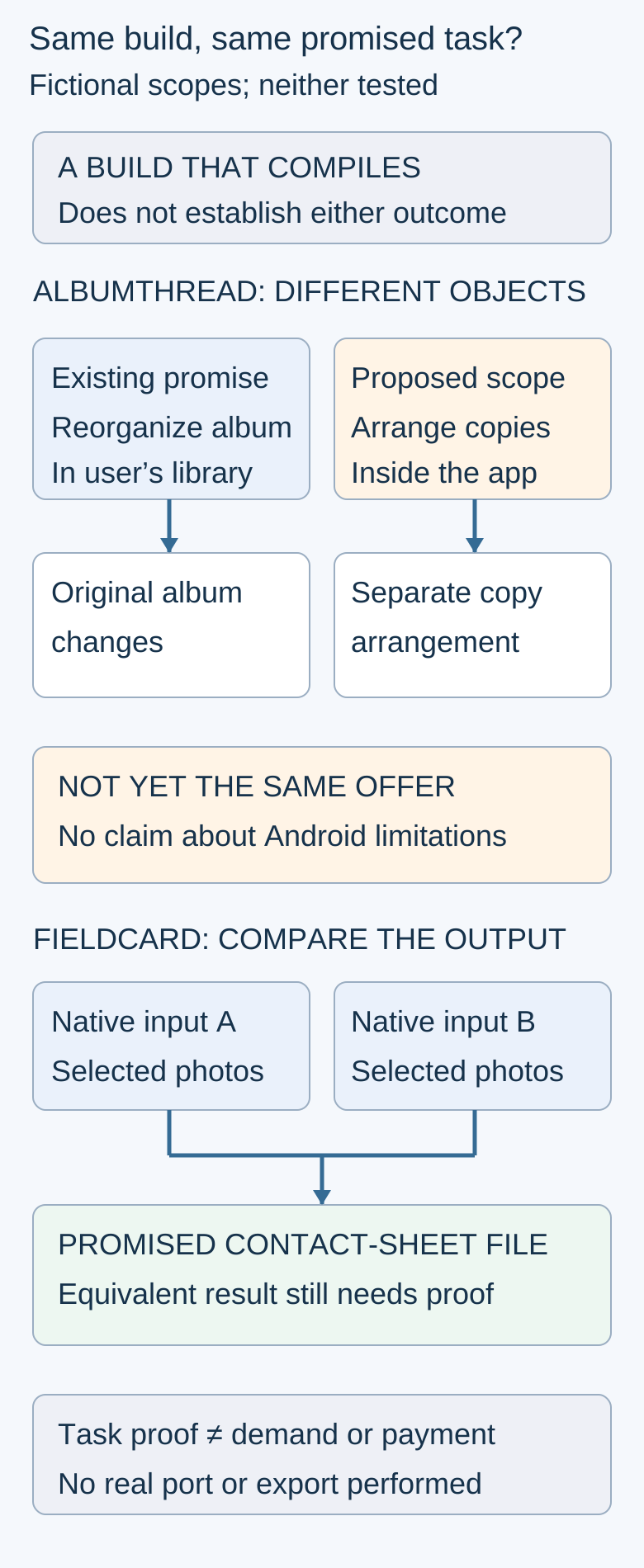
Original AI-generated editorial illustration. The same photo task can involve different input routes, permissions and library behavior on another platform. This is not a product capture, customer scene or completed test.
Worked case: an album operation becomes an imported-copy workflow
Imagine AlbumThread, a fictional iOS utility whose intended promise is reorganizing an existing photo album. A proposed Android prototype instead lets someone select images, import copies and arrange those copies within the app. No actual build or outcome is represented here.
The imported-copy workflow might be useful. It is not automatically equivalent to changing the person's existing album. If the original request was about that album, an attractive arrangement of copies may leave the important job untouched.
The next artifact is a narrow task-equivalence investigation using synthetic media and the actual proposed implementation. What source object does the operation use? What object changes? Where can the person observe the result afterward? Does it remain available through the route the product promises? Do not quietly change the success definition from an existing-library action to an in-app copy because the latter is easier to demonstrate.
If the intended new audience actually wants a shareable collage instead, record that as a different task hypothesis. It needs its own evidence. A request for the original app is not proof of willingness to adopt the substitute.
This example does not say Android cannot manage albums. It describes an intentionally limited hypothetical prototype. The existence or absence of another implementation must be investigated rather than inferred from the example.
Use platform documentation without making it a verdict on your product
Apple describes PhotoKit as working with assets managed by Photos, including collection-related capabilities through its constituent frameworks. That is a starting point for identifying an existing dependency, not proof that a particular app implements every capability.
Android's photo picker guidance describes access to selected media rather than the entire library. It also distinguishes device availability, fallback behavior and access lifetime. A picker example is not a complete account of Android's media APIs. It cannot establish that a selected-image prototype is the only possible design, that it can manage an existing album, or that its saved result survives every later state.
Have the technical owner establish the relevant implementation scope before making a product-equivalence claim. This guide supplies no permission changes, native code or migration recipe. It asks which capability must be understood before deciding whether the proposed port is still the same offer.
Worked case: different input routes can still lead to a comparable output
Consider a second fictional utility, FieldCard. Its intended task is to turn deliberately selected photos into an exported contact sheet. The user does not expect the app to reorganize the original library.
Here, different native selection routes might still support the same promised output. The next proposed proof is one complete selection-to-export task on each relevant candidate, using the same rights-owned synthetic inputs and an explicit output requirement. The comparison should inspect the actual export, not merely the preview or the fact that the picker opened.
If one candidate produces a usable file and the other only displays a temporary composition, equivalence remains unproven. If both produce the intended result, that supports the bounded task claim, not universal feature parity, accessibility, reliability or commercial success.
The distinction from AlbumThread is the promised outcome. A copy-based workflow is not inherently inferior. It is unsuitable when presented as a different operation that it has not performed.
Make the port decision before borrowing the original marketing
Use the task-equivalence worksheet to select one next investigation. If the essential outcome is feasible but untested, prepare the bounded proof. If the proposed behavior changes the offer, prepare a separate task-research question. If the dependency is still unknown, hold the same-product claim.
Only then examine the ongoing work needed to serve the second platform. Existing customer care remains protected, but a generic maintenance checklist is not the answer to whether the new build delivers the requested job. Likewise, changing store screenshots cannot repair a missing native capability.
Do not reuse the original listing's feature promises by default. Explain supported scope only after it has been established on the target candidate. A narrower version may be a legitimate product, but it should not be marketed as identical while an essential outcome differs.
For later authorized learning, keep requested availability, completed task proof, actual adoption, payment and repeated useful work separate. A person asking for another platform has not agreed to buy a changed offer. A successful prototype has not established a profitable channel. No accounts, availability, purchases, permissions or user data were changed for this article.
Only one linked conversation identifies the specific photo-library dependency; the other concerns the broader compilation-versus-launch decision. Neither establishes another app's behavior. Validate the target task before reusing the original feature promise.