How-To Guide
Before joining a Steam bundle, check the player fit and who controls the offer
A collaborative bundle can put related games beside one another, but a shared store offer is not evidence of a shared audience.
A collaborative bundle can put related games beside one another, but a shared store offer is not evidence of a shared audience. It also does not give every participating developer equal control over how that offer is presented.
Before approaching another studio, make two decisions separately: whether the other game gives your players a useful next experience, and whether the proposed arrangement leaves the right people able to review and maintain the offer. A promising answer to the first question does not erase a problem with the second.
This is a research and evaluation workflow. It does not recommend a real partner, authorize outreach or establish that a bundle will produce additional sales.
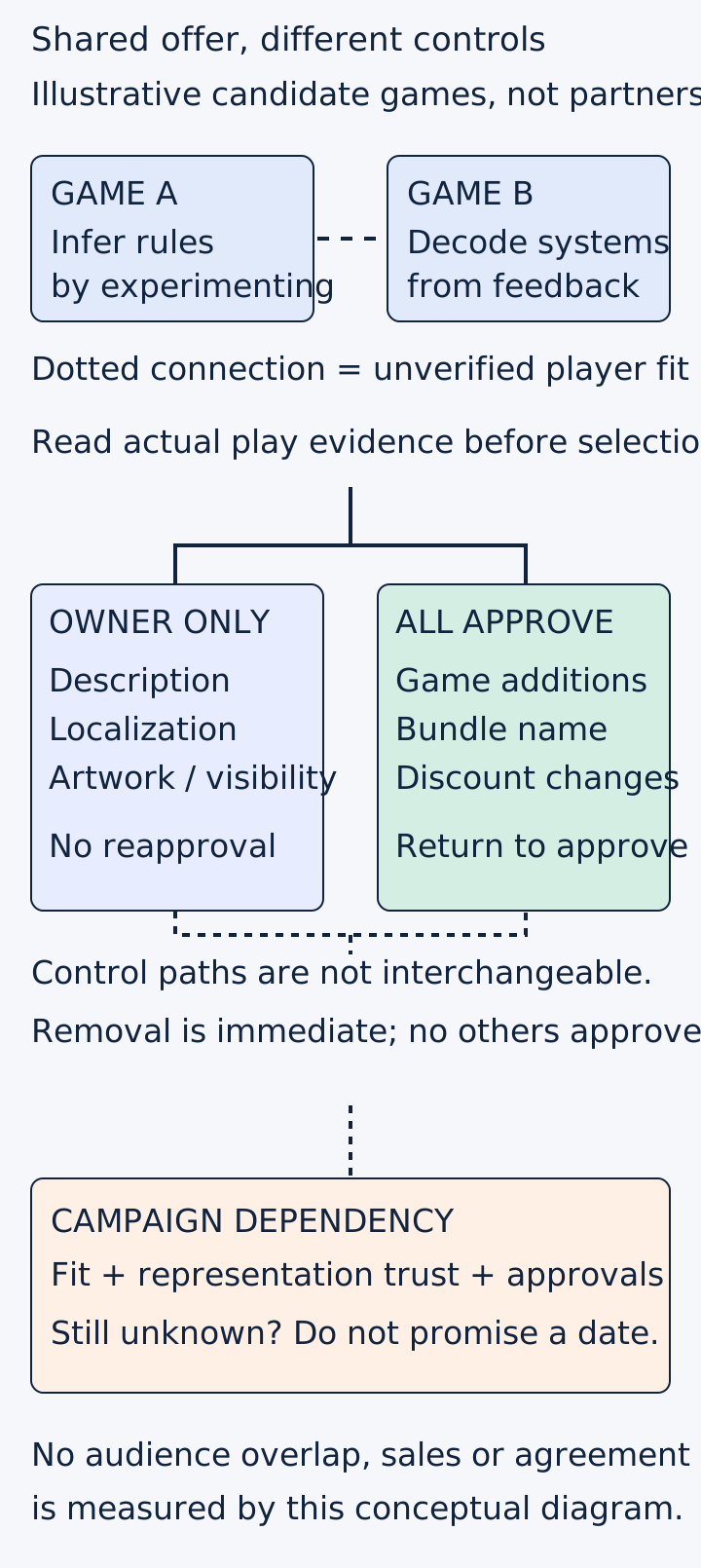
Original conceptual model. The games, relationship and campaign are illustrative; no partner agreement, measured audience overlap or live Steam configuration is shown.
 Superdirector
Make it work for your brand
Find it. Remake it. Post it. Superdirector turns the viral formats in your niche into your brand's carousels, X posts and video scripts, and keeps the calendar full.
Start with the player's next reason to play
Write a sentence connecting the actual player activity in your game to the activity in the possible partner's game. “Both are indie games” is too broad. A shared tag can help find candidates, but it does not establish that someone who enjoys one will want the other.
For a fictional pair, one puzzle game asks players to infer machine rules through short experiments; another asks them to decipher an unfamiliar system by observing consequences. The themes differ, but the activity gives the team something specific to investigate. Compare actual gameplay explanations, pacing, difficulty expectations and content boundaries before treating that connection as supported.
A second candidate might share the first game's visual theme while asking for a very different experience, such as fast competitive reactions. That is not automatically a poor game or an impossible partnership. It is a different audience hypothesis requiring evidence, not a matching capsule image that proves fit.
Record the source of each observation and the uncertainty that remains. A store description is the developer's claim. Gameplay you can inspect may support a narrower observation. Neither tells you how many relevant new customers will arrive through the bundle.
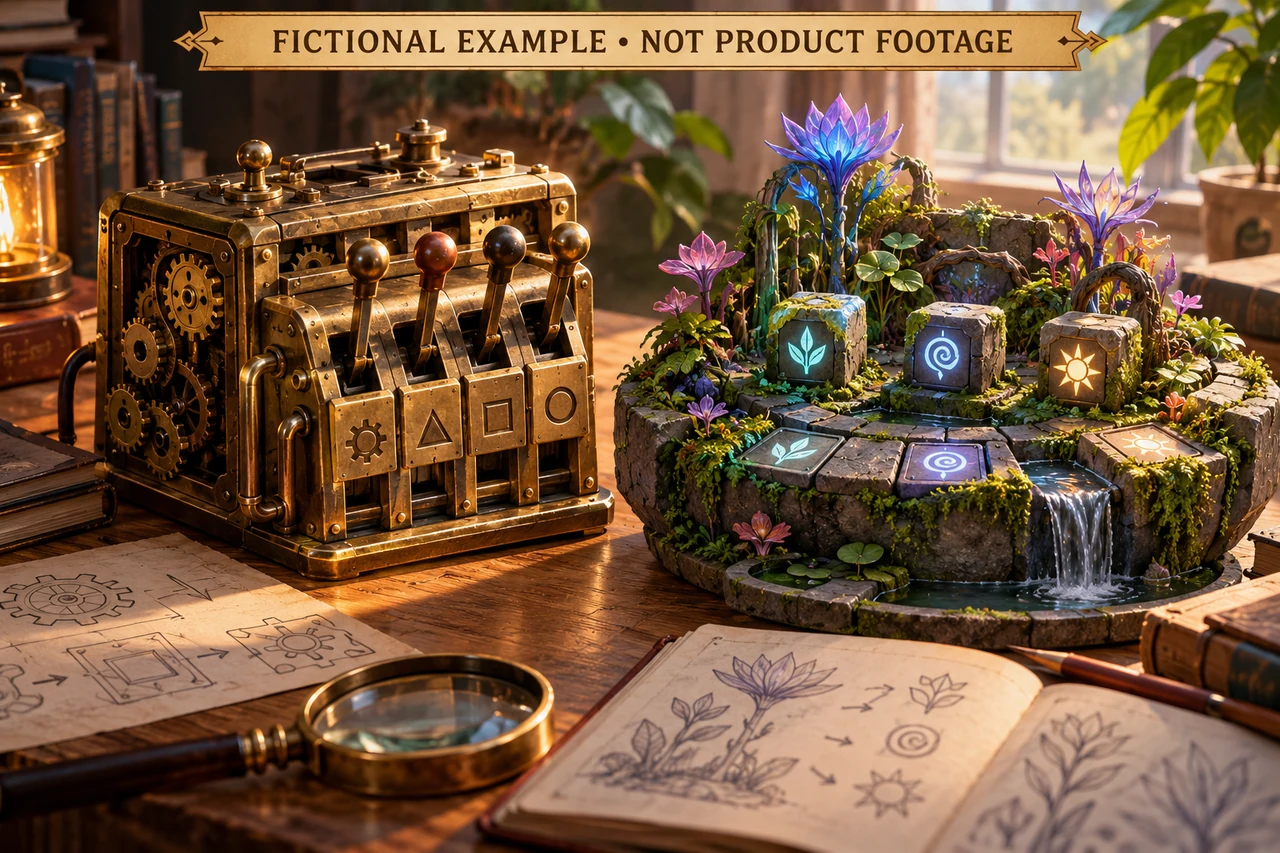
Two fictional puzzle settings share an observe-and-experiment activity despite different themes. That is a fit hypothesis, not measured audience overlap or a bundle agreement. Original AI-generated editorial illustration.
Understand the question developers are actually asking
A developer of a hacker-themed puzzle game asked where to find bundle partners around thematic events. The post establishes a concrete coordination problem, not proof of the traffic or sales they hoped to gain. Their self-reported figures are not a minimum size requirement for another studio. Read the original partner-finding question.
Another developer asked whether bundling early was worthwhile when participation also meant an ongoing discount. Replies reported both benefits and concerns, including existing customers receiving a discount through another game they already owned. Those accounts are useful competing considerations, not a controlled result or a universal discount recommendation. Read the timing and discount discussion.
The practical question is therefore not simply “How large is the other game's audience?” It is “Which purchase decision might this arrangement change, and what would we give up or need to maintain while testing that possibility?”
Separate incremental reach from an available discount
Steam's bundle documentation explains that the bundle percentage applies to the relevant current item prices, with ownership affecting what a Complete The Set customer purchases. Do not model the offer as a fixed total shared by every visitor or assume that every discounted purchase came from a new audience. Review the current bundle rules.
For evaluation, list the actual products proposed, the discount configuration under consideration and the customer states that matter. Use the team's authorized commercial assumptions rather than inventing a margin or copying a forum's percentage. A customer already planning to buy your game and a customer discovering it through another title are not the same outcome, even if both use the bundle.
You may not have the evidence to distinguish them. Mark incrementality as unknown rather than turning total bundle purchases into a claim of additional customers. The immediate decision can be to investigate the arrangement, not to declare it profitable.
Inspect the control asymmetry before committing creative
Valve distinguishes changes requiring participant approval from representation controlled by the bundle owner. Changes to the game list, bundle name or discount require approval; a bundle awaiting approval cannot publish. Removal is an important exception: a collaborator can remove its game immediately without other participants’ approval. The owner controls description, localization, store visibility and artwork without participant reapproval. Steam also says it does not send emails about bundle state or publishing, so the participants must coordinate themselves. Read Valve's collaborative-bundle guidance.
That is a substantive trust and maintenance question. Knowing that your team can approve a discount change does not mean it can prevent every later wording or artwork change through the same Steam approval flow.
For a fictional campaign with a fixed creative deadline, record who owns the bundle, who will check the representation and who can return for required approvals. If the necessary people or confirmations are unavailable, the campaign dependency remains unresolved. Do not put an unconfirmed bundle date into a finished trailer merely because the games seem complementary.
Keep the evaluation reversible
A useful candidate record includes: the specific player-task connection; evidence inspected; mismatches; discount exposure to examine; bundle owner; representation-review arrangement; required approval availability; and the next unresolved question.
Classify the candidate as investigate, mismatch for this campaign, or hold for missing evidence. Avoid converting that record into an invitation or commitment automatically. Sharing a collaborative invitation URL or changing the actual offer is a separate authorized operation, not part of reading public sources.
Do not pay for entry to a Steam bundle. Valve's advertising guidance permits cross-promotional activities but prohibits charging developers for bundle participation or access to Steam pages. A proposal framed as guaranteed paid placement should not be treated as ordinary partner coordination. Read Steam's cross-promotion rule.
This does not resolve rights to another game's artwork or branding. Use only materials whose intended use is authorized, and keep that permission separate from evidence that the bundle configuration was approved.
Evaluate the result without inventing the counterfactual
If a suitable arrangement is later authorized and implemented, retain the actual configuration and observation dates. Check that the visible description and included products still match the reviewed offer. Record changes, approvals and campaign timing so later analysis is not comparing different offers as if they were identical.
Keep observed bundle purchases, other purchases, concurrent discounts, events and external promotion separate where the available reporting permits. A sales change during a festival is not proof that the bundle caused it. If the available data cannot identify incremental buyers, report that limitation.
The first useful deliverable is a defensible decision about one candidate: a concrete reason the games belong together, the commercial uncertainty still to examine, and a clear understanding of who can change the offer. That is more valuable than a long partner list built only from tags or audience size.