How-To Guide
Before building a second app, account for the product you already maintain
A second app is not just another build. Once released, it can become another product with users, support questions, compatibility work and promises to maintain.
A second app is not just another build. Once released, it can become another product with users, support questions, compatibility work and promises to maintain. For a solo founder, the useful question is not whether marketing or coding deserves half the week. It is which next piece of evidence is worth producing while keeping existing customer work covered.
This guide compares continued learning about an existing app with a bounded prototype for another idea. It does not prescribe a time ratio, tell you to abandon customers or promise that more marketing will rescue a weak product. Its output is a private work-in-progress decision, not a new launch commitment.
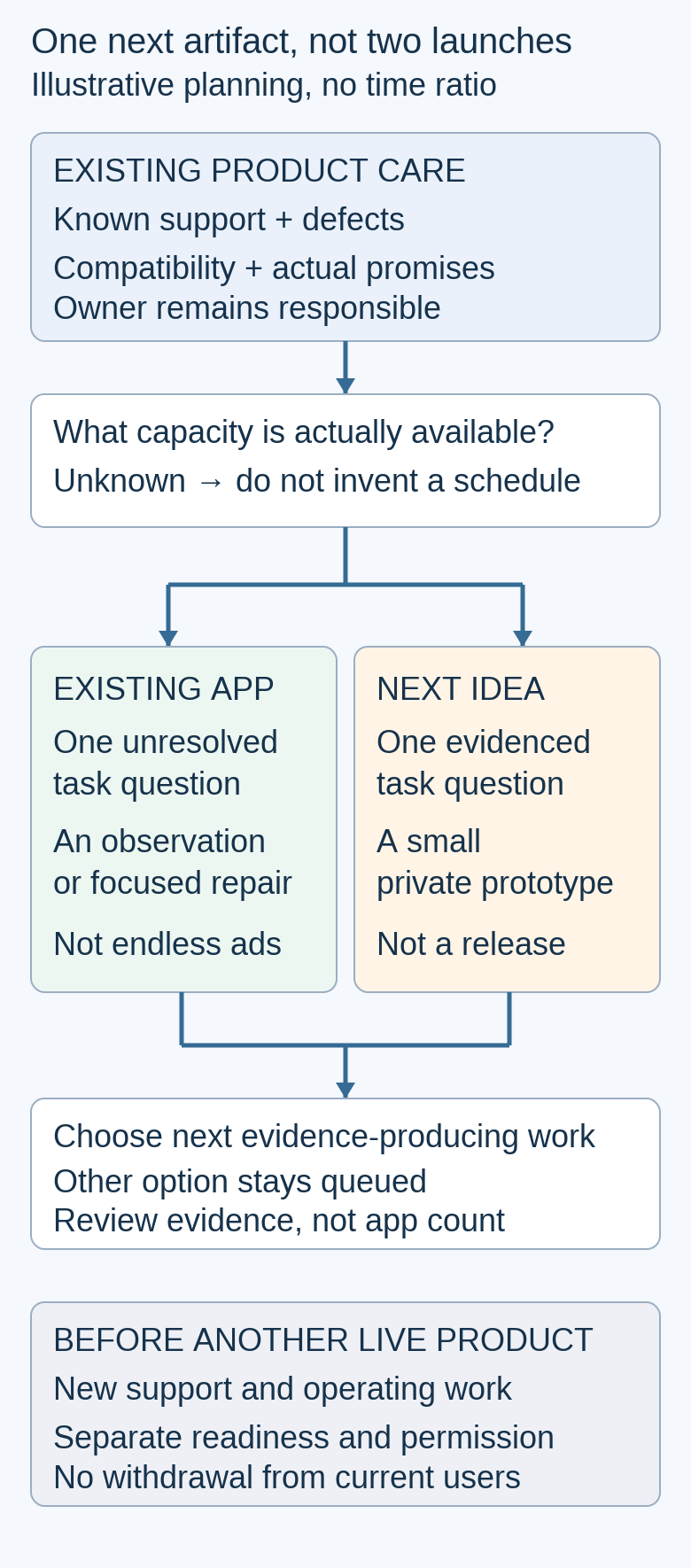
Original fictional planning diagram. No actual capacity allocation, product shutdown or commercial outcome is represented.
 Superdirector
Make it work for your brand
Find it. Remake it. Post it. Superdirector turns the viral formats in your niche into your brand's carousels, X posts and video scripts, and keeps the calendar full.
Separate work you owe from work you are choosing
List the live product's concrete obligations before calling the remaining time “free.” Include actual unresolved support issues, known defects, necessary compatibility work and commitments already made to users. Record the owner and current evidence. Do not invent a monthly maintenance quota or assume a simple interface means there is nothing to maintain.
Apple's App Review Guidelines require an accessible support contact and describe current-OS and completeness expectations. Apple's App Store Improvements guidance also describes ongoing evaluation of apps that no longer function as intended, are outdated or fail current guidelines. These are reasons to keep maintenance visible, not a prediction that your app faces removal.
The platform's specific removal procedures are not a grace period for ignoring a current defect. Conversely, maintenance does not require inventing new features every month. Use the actual product and applicable requirements to identify work, rather than treating every possible improvement as an obligation.
Keep this ongoing-care lane separate from discretionary growth and prototype work. If the known commitments already exceed available capacity, the next-app project remains queued. A planning sheet must not erase an unresolved customer issue to make a new idea fit.

Original AI-generated editorial illustration. Existing support obligations and a bounded new prototype are different commitments. This is not a product capture, customer scene or completed test.
Read the founder's actual choice, including the clarification
A first-app founder asks whether to spend postlaunch effort marketing the current app or building another one. In a later reply, the author clarifies that they are not planning to abandon it; they are asking about the attention split. They also acknowledge having no postlaunch evidence yet.
That distinction matters. The question is not answered by accusing the founder of giving up. Nor can a universal split be justified from a product that has not yet produced the relevant evidence. Their expectation of low maintenance is still an expectation.
A different multi-app operator describes launched products, a rejected submission and another unfinished idea. The author asks whether switching among apps is the right direction and later wonders whether earlier products were written off too quickly. The reported figures and completion percentages are not independently verified. A rejected submission is not guaranteed to become a release after a day of work.
These two questions support examining the commitment created by another product. They do not establish a profitable portfolio size, a correct advertising budget or a general rule to keep building.
Give the existing app a specific unanswered question
“Market it harder” is not an evidence-producing deliverable. Specify what is still unknown. Can a relevant person understand the task? Can the product deliver it? Has any suitable audience actually encountered the offer? Did an observed task fail? Different uncertainties require different work.
A handful of unrelated visits does not establish that the intended audience rejected the app. It also does not prove that promotion is the only missing ingredient. Keep inadequate exposure, unclear positioning, product problems and a weak underlying need as distinct possibilities until evidence differentiates them.
Choose the smallest appropriate next observation that could change the decision. It might be reviewing an existing permitted user session, inspecting a specific failed task or preparing a clearly bounded audience-learning plan. This article does not authorize contacting people or buying traffic.
Do not promise months of unlimited marketing because the first result was disappointing. Define the question and the point at which you will review the resulting evidence. An inconclusive observation may justify more research, a different approach or a hold. It is not automatically a command to keep spending.
Represent the next idea as a prototype, not a second live promise
Describe the second idea's task evidence separately from the excitement of building it. A specific independently reported problem is different from an attractive feature sketch. Neither guarantees demand, but the distinction changes what a small prototype should test.
Write down what the next artifact would answer. For example, a nonproduction prototype might test whether a person understands a proposed document-organizing interaction. It does not need to become a published app with subscriptions, accounts and support commitments before that question can be examined.
Keep the states explicit: idea, prototype, tested candidate, release-ready product and maintained live app. Moving between them adds work and obligations. A prototype does not establish store approval, and a nearly finished build does not establish a worthwhile reason to release it.
The purpose is not to prevent experimentation. It is to avoid treating another complete product as the default unit of learning.
Worked example: the first app has not had a relevant observation
Imagine the fictional utility ClipShelf. It is live, but the founder's only promotion was an unrelated personal announcement. The competing idea has an enthusiastic sketch and no actual task evidence. No traffic or revenue result is supplied in this example.
First, the founder records known ClipShelf support and compatibility work. With any genuinely available capacity, the proposed next action is one bounded observation about the current task's comprehension. The next idea stays in the queue rather than becoming a parallel full build.
This choice does not declare ClipShelf a winner. It recognizes that the current evidence cannot distinguish a weak offer from an offer that has not reached an appropriate person. The observation might reveal that the task is confusing, unsupported or unnecessary. That outcome would still help determine what to do next.
The founder does not change the other idea's status to “rejected.” It remains an untested possibility, preserved without another public promise.
Worked example: the new idea has a concrete question worth testing
Now imagine a different founder with a live utility and documented ongoing-care work. A separate prospective task has been raised in independent conversations. The new question is specific enough for a small nonproduction prototype, but its commercial value remains unknown.
The founder proposes that prototype as the next discretionary deliverable, while retaining ownership of current support and maintenance. If the available capacity cannot cover both, the prototype stays queued or its scope is reduced. Existing customers do not lose access or support because the new idea feels more interesting.
The result might justify further investigation, but it does not automatically justify another release. Before a new live product is proposed, the team must account for its own support path, operational dependencies and readiness checks. That later commitment is different from spending bounded effort learning about an interaction now.
Review the choice using evidence, not the number of apps
Use the blank maintained-product decision sheet. Record existing commitments, available capacity assumptions, each option's next artifact and the evidence that would change the priority. If capacity is unknown, keep the scheduling decision unresolved rather than inventing a ratio.
At the review point, distinguish work completed from results established. A prototype built is not a validated need. A promotion prepared is not qualified exposure. A qualified visit is not useful work or payment. A new payment is not a mature renewal, and a quiet interval does not identify its own cause.
The next action should produce one inspectable result without concealing the live product behind it. That is a more defensible choice than counting finished apps, splitting every day mechanically or assuming another launch will solve an unanswered question about the first one. No outreach, spending, account changes or withdrawal of customer service occurs here.