How-To Guide
Before an Amazon listing-creative experiment, decide what it can answer
For a small brand, the practical starting point is one unresolved purchase question.
Two polished images are not yet an experiment. You need a buyer question, a meaningful difference between the versions, an eligible testing route, and a decision you will make from the result. Otherwise, a dashboard can provide numbers without resolving the creative uncertainty that started the work.
For a small brand, the practical starting point is one unresolved purchase question. Perhaps buyers cannot judge a product's dimensions from the current imagery. You can prepare a clearer explanation and review it for comprehension before deciding whether a live listing experiment is appropriate.
This guide is a planning and interpretation workflow. It does not launch a test, authorize publication, or claim that any creative has improved sales. Current platform guidance was checked on October 24, 2026; the older reference is explicitly identified below.
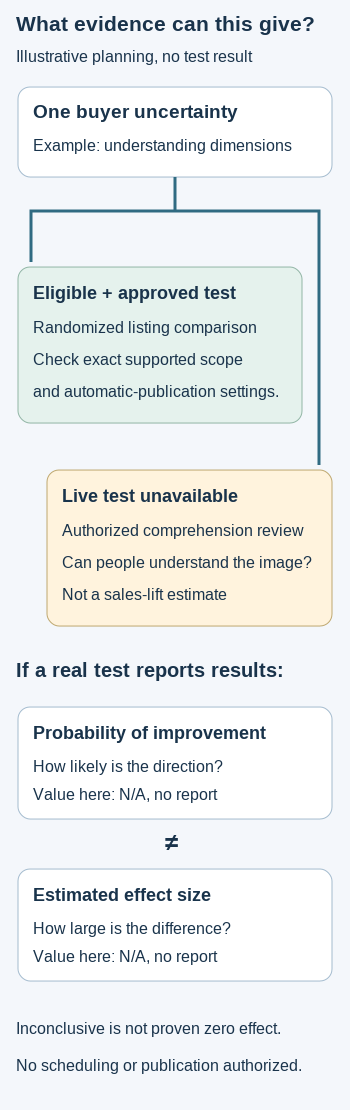
Original planning illustration. No experiment result, live account eligibility or publication authorization is represented.
 Superdirector
Make it work for your brand
Find it. Remake it. Post it. Superdirector turns the viral formats in your niche into your brand's carousels, X posts and video scripts, and keeps the calendar full.
Distinguish a randomized test from a before-and-after change
If you replace images, change the price, introduce a coupon and redirect advertising at the same time, the later sales total does not isolate the image's effect. The business may have improved, but that observation cannot identify which change caused it.
Amazon describes Manage Your Experiments as randomly assigning detail-page viewers to different content versions. Its current page requires a Professional selling account and the Brand Representative role for a brand enrolled in Brand Registry, and sufficient recent product traffic. The actual eligible products must be checked in the account; do not invent a universal minimum visit count. Current Manage Your Experiments guidance
A creator comparison or separately published social posts are different evidence. They may involve different audiences, timing and distribution. Keep those observations useful at their actual level instead of relabeling them as randomized listing tests.
Write the creative question in buyer terms
An illustrative hypothesis is: “A clearer dimensional explanation will help shoppers assess whether this organizer fits their intended space.” The creative comparison might contrast an existing lifestyle presentation with a measured explanation for the same product. These are fictional alternatives, not approved assets or a claim that a particular image placement is eligible.
The comprehension hypothesis and the commercial outcome are not interchangeable. A conversion improvement would not, by itself, prove that shoppers understood the dimensions or selected a correct fit. Use a separately labeled comprehension review to investigate that understanding.
Before choosing the tool configuration, specify the content type and placement actually supported for your account. Do not assume that a test of one image surface permits arbitrary replacement of every image in a gallery. Prepare the alternative for the supported scope and current content rules.
Keep a record of the buyer uncertainty, the meaningful creative difference, the outcome you intend to inspect and what the comparison will not establish. If the alternatives differ in several ways, describe the package of changes rather than attributing a result to one tiny element.
A one-question design is an editorial recommendation for interpretability, not a claim that the platform only supports single-attribute tests. A broader experiment can be legitimate when the decision concerns the broader content package.
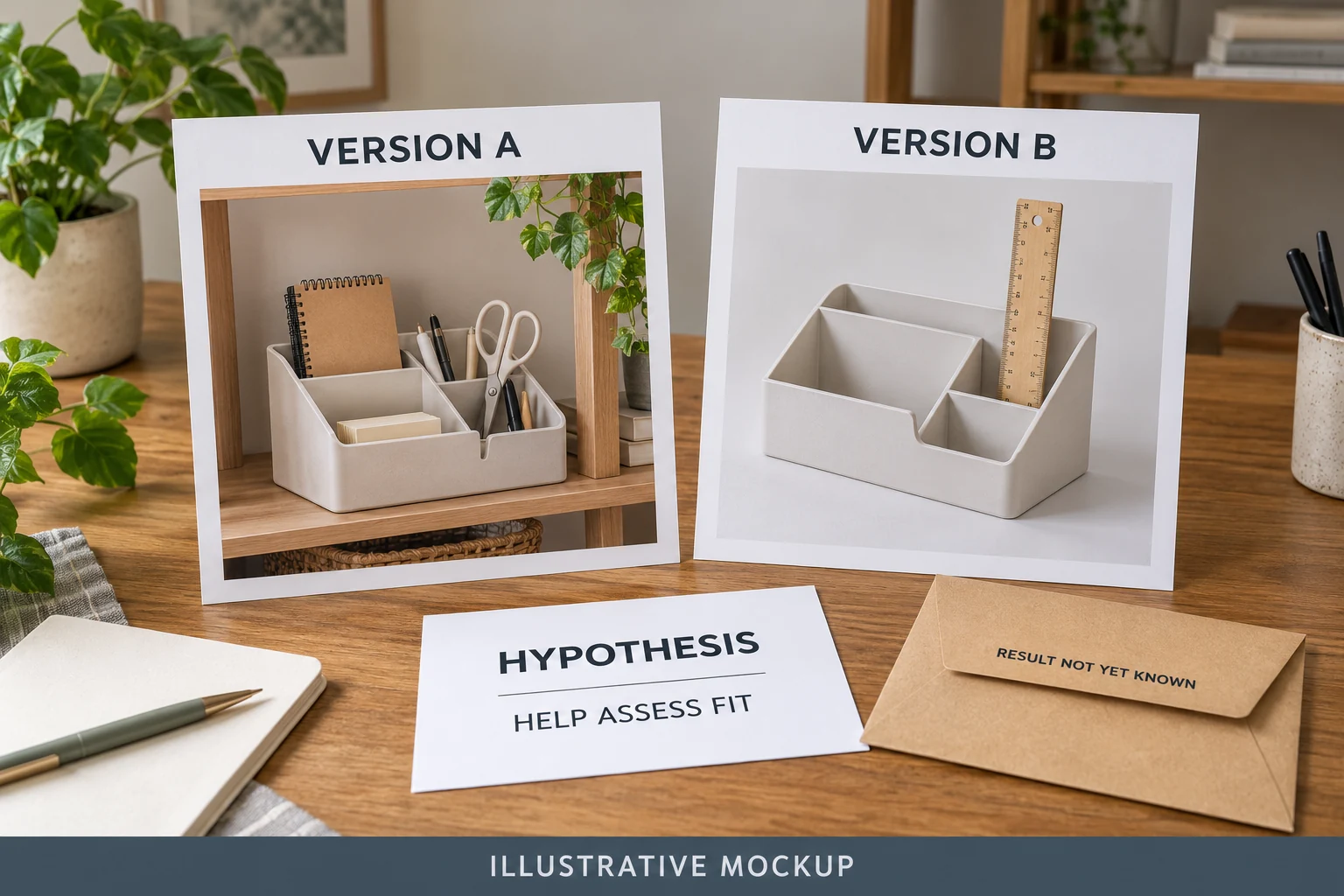
AI-generated illustrative mockup. The comparison expresses a fictional buyer-task hypothesis, not eligible or approved Amazon experiment assets, a launched test or an observed winner.
Check readiness before preparing a launch
Make a readiness sheet for the specific product and marketplace. Record eligibility, current content revision, proposed alternative, factual approval, rights clearance, intended duration, owner and publication settings. Unknown entries remain unknown.
The current platform page describes preselected settings that can begin an experiment after validation and automatically publish winning content. Treat scheduling as potentially consequential, not as a harmless preview. Inspect the actual settings and obtain the applicable approval before starting or enabling publication. This planning article does not provide that approval. Experiment settings
If the listing is ineligible or has insufficient evidence for a useful test, do not buy traffic merely to fill a worksheet. You can still ask a small number of suitable reviewers to interpret the proposed image, provided that research is authorized. Record what they understand and where they hesitate. That is comprehension evidence, not measured sales lift.
Keep the two versions recoverable
Save the original and alternative with stable revision identifiers. Keep source photographs, measurements, captions and the approved export together. A later filename change should not make it impossible to reconstruct what each group saw.
Review both versions for truthfulness before comparing performance. An attractive but misleading dimension graphic is not an acceptable alternative just because it might draw attention. A factual correction should not be withheld from customers solely to preserve a test of inaccurate content.
Record concurrent changes such as stock availability, price, promotion and traffic conditions. These notes help explain the context and limits of the completed result. They are not a license to retrofit a causal story after seeing which number is larger.
Follow the planned duration or the applicable platform stopping rule. Do not stop at whichever early reading favors the creative you already prefer. Record the completion basis before interpreting the final comparison. Current completion guidance
Read probability and magnitude separately
Amazon's October 2023 best-practice guide distinguishes the probability that a version performs better from the size of the difference. It also separates per-version metrics and sample information from projected annual impact. Use those conceptual distinctions, not the historical interface as a promise of today's exact report. Historical Amazon experiment guide
A probability percentage is not a sales-lift percentage. When reading a real report, write down the metric name, units, comparison, sample information, uncertainty shown and observation period. If any item is unavailable, mark it unavailable instead of substituting a zero.
A large-looking percentage without its definition is not enough to decide what to publish. Likewise, a modeled annual impact is not cash already earned. Keep observed results, estimated effects and business projections in separate sentences.
Allow an inconclusive result to remain inconclusive
An unresolved comparison does not prove that creative never matters or that the two versions are exactly equivalent. The difference may be small, the alternatives may answer the same question similarly, or the available information may be insufficient. Do not select the interpretation that best excuses a preferred design.
Return to the original buyer question. If reviewers still cannot understand the dimensions, improve that explanation on its merits before proposing another experiment. If the alternatives are both clear and no reliable commercial difference is established, keep the uncertainty rather than manufacturing a winner.
The next action can be a revision, another properly scoped test, or a decision not to invest further. It does not have to be more spending. The useful completion record states what was tested, what the evidence supports, what remains unknown and whether publication was separately approved and verified.