How-To Guide
Before a win-back discount, decide what would make returning worthwhile
A cancelled subscription tells you that renewal changed. It does not tell you that a discount would solve the person's problem.
A cancelled subscription tells you that renewal changed. It does not tell you that a discount would solve the person's problem. Before preparing a return offer, distinguish a reported obstacle, a verified product defect and a cause you simply do not know.
The useful output is a repair-versus-offer decision for an existing subscription product. This is not a guide to changing prices, obstructing cancellation or messaging everyone who turned off renewal. The examples use a fictional reading-notes app and leave actual customer circumstances, eligibility and results unknown.
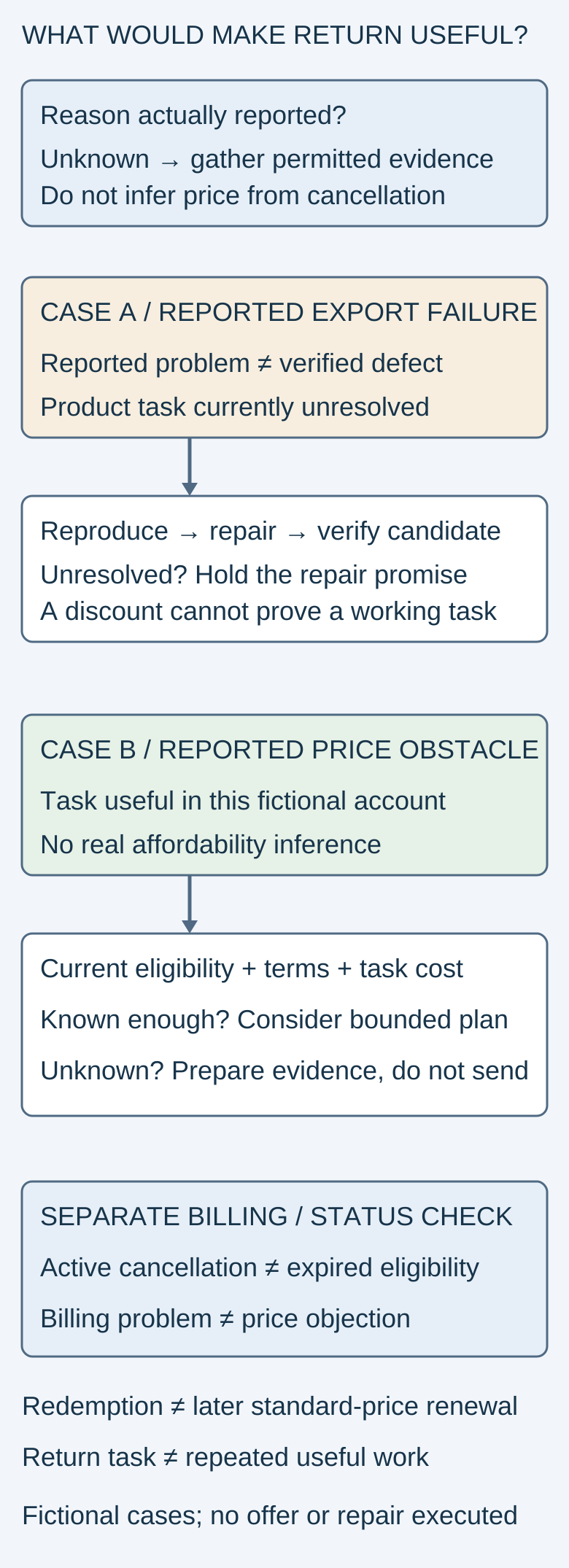
Original fictional decision map. No customer diagnosis, discount, product repair or return outcome is represented.
 Superdirector
Make it work for your brand
Find it. Remake it. Post it. Superdirector turns the viral formats in your niche into your brand's carousels, X posts and video scripts, and keeps the calendar full.
Ask what changed in the useful task
Start with the recurring job the customer expected the app to perform. In the fictional app MarginPath, that job is keeping reading notes usable across later reading sessions and exporting them through a supported route. A person may have completed their immediate project, encountered a defect, found the recurring task unnecessary, or decided against the price. Those are possible explanations, not facts inferred from a timestamp.
Use only feedback already supplied through an authorized process. Record its scope: one person's statement about one situation, on a particular date. Do not turn it into a diagnosis of every cancellation or infer someone's financial position from their account activity. If no reason is known, write “unknown” rather than assigning price as the convenient default.
A useful founder question is: what work would we need to complete before this person could reasonably evaluate returning? Sometimes the answer concerns the product. Sometimes it concerns whether the recurring offer fits a continuing need. Sometimes there is not enough evidence to choose.

Original AI-generated editorial illustration. A return offer should connect to a useful reading-notes task rather than assume a discount repairs the obstacle. This is not a product capture, customer scene or completed test.
A real operator question exposes a terminology trap
An iOS app operator asks about users cancelling shortly before a trial ends, including whether a “win-back” notification or email would help. The same post considers trial duration, pricing and earlier value. Its metrics are self-reported, and its explanation of why people cancel is not independently established.
The replies do not settle the question. One describes changing several things and reports a conversion lift; another explicitly distinguishes adding a trial from shortening an existing trial. Those are different comparisons. Neither justifies copying a duration or sending a last-minute message to your own customers.
The practical distinction is between a general desire to retain a person and a particular platform offer. Apple's StoreKit guidance defines its win-back offer around a subscription that has expired with automatic renewal off. A still-active trial with renewal disabled is not automatically that state. Current offer eligibility requires additional checks.
Worked example: the export task is still broken
Imagine a former MarginPath subscriber voluntarily reported that a supported export failed. The founder has not yet reproduced the issue. A return discount would lower a price, but it would not establish that the export now works.
The next internal action is to inspect the reported task with safe test material, establish the affected version and determine whether the behavior can be reproduced. If a repair is prepared, verify the actual candidate before describing it as fixed. Do not contact the former subscriber or promise compensation simply because the worksheet identifies this branch.
If the task remains broken, hold the return promotion that depends on it. If the issue cannot be reproduced, retain that uncertainty and identify the next legitimate product investigation. A complaint is useful evidence, but it is not automatically a confirmed defect; a code change is not automatically a completed repair.
This example allocates effort to the missing useful capability rather than using a discount to conceal uncertainty. It does not claim a repair would make the person subscribe again. The original need may have ended, and the person remains free not to return.
Worked example: the task was useful, but the offer needs examination
In a second fictional case, a former subscriber reported that the recurring task was useful but a temporary budget constraint contributed to leaving. This is an explicit invented statement for the example, not an inference about a real customer.
The founder can consider a bounded offer hypothesis, but the worksheet does not choose an amount or guarantee affordability. First identify the actual subscription product, current eligibility, applicable terms, supported return task and the cost of serving that task. Explain what happens after any offer period using the real terms, not a reassuring phrase such as “a small discount forever.”
Apple's configuration guide scopes win-back offers to subscription products. Eligibility is tied to the most recently lapsed product within a group, paid duration and time since expiry, with other configured constraints. A historical purchase alone does not establish that a specific offer applies today. The guide also calls for checking eligibility before sharing an offer link.
Those are constraints on a potential plan, not instructions to create or send an offer now. If the task's cost, terms or eligibility remain unknown, the decision stays “prepare evidence.” A technically eligible offer may still be a poor response to the actual reason someone left.
Keep billing problems out of the price-objection bucket
Apple's subscription guidance distinguishes voluntary cancellation from billing problems and describes separate support and status mechanisms. A failed renewal does not by itself establish dissatisfaction with the product or its price.
Ask the authorized owner for the applicable state, without collecting payment details in the editorial worksheet. Do not prescribe a fresh purchase, new account or offer as a substitute for the supported billing or entitlement process. Preserve existing access and terms while the team investigates. This article performs no account lookup, API action or billing recovery.
Likewise, cancellation timing does not prove the recurring job is unwanted. A person may disable renewal while retaining their current period of access. Keep the operational status separate from any volunteered reason and from the business decision about future work.
Do not borrow a win-back success story's causality
A separate operator report lists win-back offers alongside annual-plan promotion, notifications, store-page work and product improvements. The author explicitly distinguishes collected cash from monthly recurring revenue. This is adjacent qualitative context, not an isolated test of a return offer.
The appropriate lesson is to preserve separate records, not to reuse the reported growth figures. If several changes happen together, a revenue increase does not identify which change caused it. Annual payments can also make collected cash look different from recurring revenue. Neither observation establishes durable retention for another app.
Decide what evidence earns the next step
Use the blank return-decision worksheet. Its first fields concern the useful task and the reason actually reported. Only after those fields should it ask about a possible offer. This ordering prevents a configured discount from becoming the answer to every departure.
For a later authorized evaluation, keep the following outcomes separate: offer eligibility, actual exposure if observable, redemption, completed return task, later standard-price renewal and repeated useful work. A redemption is not a mature renewal. A returning user who cannot complete the task is not proof of successful retention. Missing observations remain unknown, and a small sample does not produce a causal winner.
Choose one next internal action: reproduce a reported problem, verify a prepared repair, examine a bounded offer's actual constraints, or hold because the reason is unknown. Do not add friction to cancellation to improve a dashboard. No offer, communication, price or access setting has changed here. The two source contexts do not establish popularity, reading-app demand or a guaranteed commercial result.