How-To Guide
After a quiet Product Hunt launch, decide whether a relaunch is worth the work
A quiet first launch can make another launch feel like the obvious repair. But a new launch campaign and a better product are different investments.
By the Superdirector editorial team.
A quiet first launch can make another launch feel like the obvious repair. But a new launch campaign and a better product are different investments. Before rebuilding the promotional package, identify what a user can now do that they could not do before, and whether another launch is the best way to learn about that change.
This guide produces a private change-and-effort decision sheet. It does not schedule a launch, delete a post, contact Product Hunt, or establish eligibility for a particular account. The examples are fictional and contain no measured adoption results.
First, establish what “quiet” actually means
A post can be live without appearing on the featured homepage. Product Hunt's homepage explanation distinguishes featured products from the All feed and says non-featured posts can remain available for interaction. Do not equate missing homepage placement with an unpublished product.
Inspect the existing post and its available evidence through the owner's authorized access. Keep publication, featuring, visits, comments, product trials, and useful work separate. If traffic or referral information is unavailable, record that limitation rather than assuming nobody saw the product.
One solo app maker asks whether to relaunch or move on after little apparent response. A separate productivity-app founder asks whether a redesign and new functionality justify an early relaunch. Their accounts motivate the decision, but their dates and results are not independently verified. Cached relative dates conflict with indexed dates, and neither discussion proves that a quiet launch means weak product demand.
Replace the feature list with a before-and-after task
Choose one meaningful user task. Record what the earlier version allowed, what the candidate version allows, and who benefits from the difference. A list of changed screens is not enough.
For example, “new colors, shorter labels, and a lower price” describes changes, but it does not establish a different use case. “A second authorized collaborator can now review and update a shared plan” describes a potentially different task. That task still needs actual product evidence.
Use an owned or synthetic fixture to compare the two versions. Keep the starting conditions and important constraints visible. If the old version cannot be inspected, retain dated evidence that actually exists and label the comparison incomplete. Do not manufacture an old failure to make the new version look impressive.
The purpose is not to score the release as a percentage improvement. It is to explain a concrete difference and decide whether it deserves the effort of another public launch.
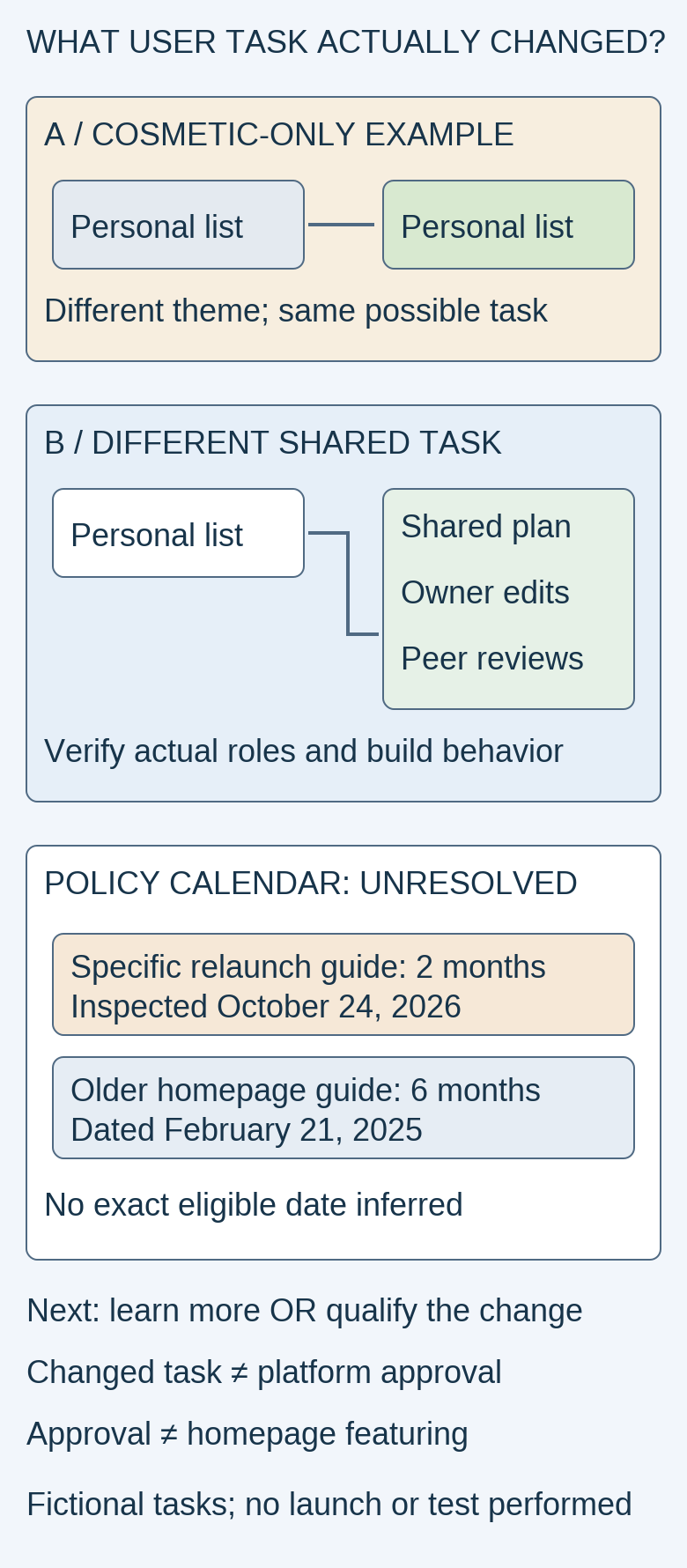
Fictional task surfaces and an unresolved policy calendar. No product test, platform approval, scheduled launch date, or adoption result is depicted.
Original visual by the Superdirector editorial team. Creation date not recorded.
Example one: improve the product learning instead
Imagine a utility app whose first launch attracted little discussion. The new candidate has a different color theme and a revised price, but the same single-person task is possible before and after the change.
The founder records that finding without dismissing the design work. Clearer presentation may matter, but the evidence does not yet establish a new use case. Rather than preparing another launch package immediately, the founder proposes a permitted observation of an intended user's task: where do they hesitate, stop, or fail to understand the result?
That observation has not happened merely because it is planned. The next deliverable is a small learning plan with an owner, a specific question, and an appropriate permission boundary. The original launch stays intact. Weak votes are not used as a reason to erase its history or call the product newly invented.
Example two: a changed workflow merits qualification, not a promised date
Imagine a productivity app that previously supported only a personal list. A new candidate supports a shared review workflow with distinct participant roles. The founder prepares an owned sample showing what the second person can actually do and where access remains limited.
The private packet links the old task, the new task, the relevant user, and the supporting build evidence. If collaboration is only a prototype, that fact belongs beside the comparison, not in a hidden note.
This may justify investigating a relaunch, but it does not grant platform eligibility. The next action is to verify the applicable current requirements before committing a date or substantial production effort. A meaningful product change and a permitted submission are separate decisions.
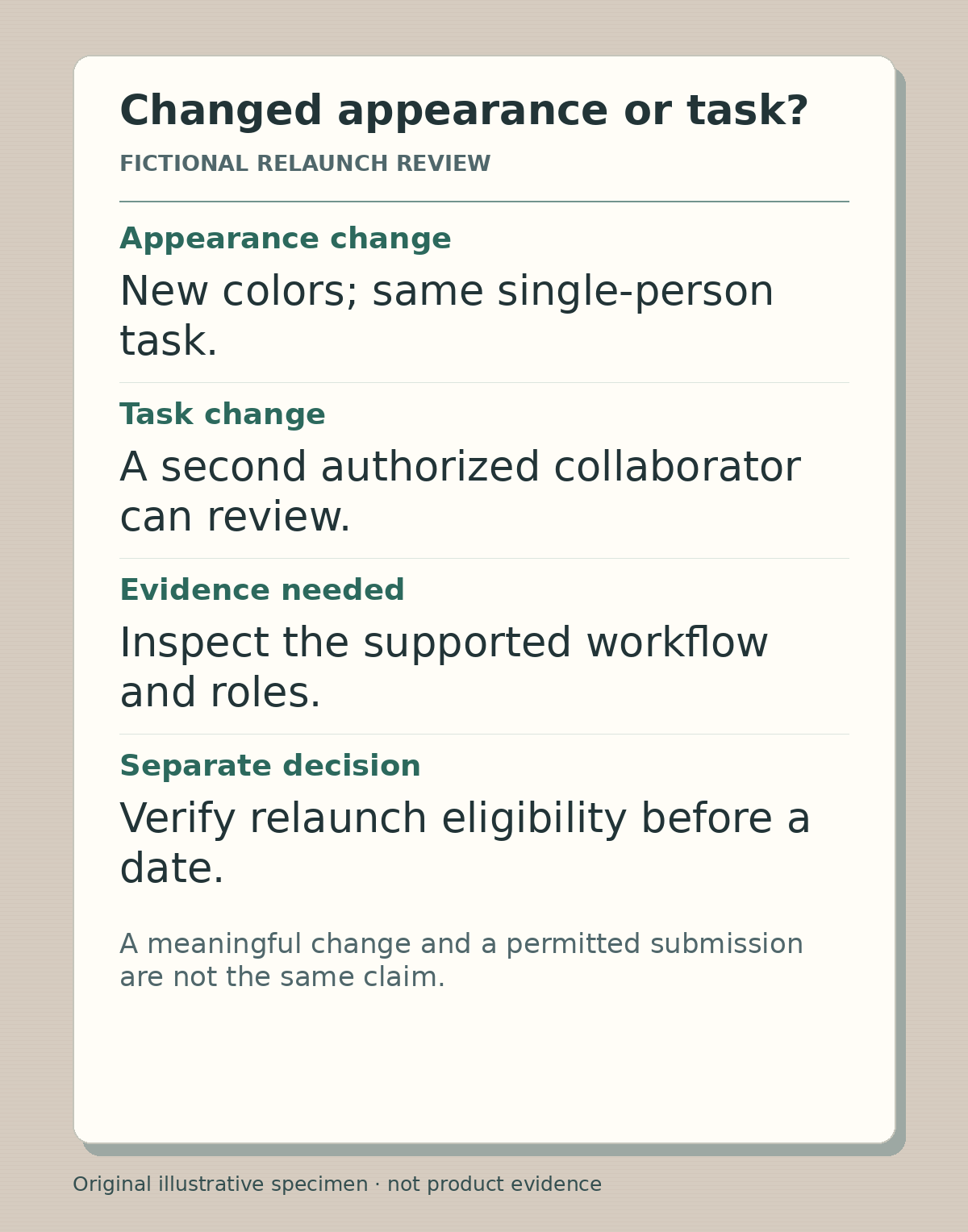
Original fictional change-review specimen. The collaboration example is a task to substantiate, not a released feature or proof of Product Hunt relaunch eligibility.
Illustrative worked example by Editorial assistant, original text and raster artwork. Created 2026-10-24.
Keep the documented timing conflict visible
As inspected on October 24, 2026, Product Hunt's specific relaunch guide states a two-month interval, requires a significant update, and applies related restrictions to the same company and root domain. It describes review for earlier requests. Cosmetic UI or price changes alone do not meet its stated significance test, and relaunch approval does not guarantee homepage featuring.
However, the older general homepage guide, dated February 21, 2025, says products can be resubmitted after six months with changes based on feedback. These pages conflict on the interval. Do not silently select the shorter one or calculate an exact eligible date from this article.
Record both sources, the prior submission history, and the unresolved question. Obtain current platform clarification through the appropriate authorized route before acting. Renaming the product or changing its presentation is not a reliable way to reset company or domain history.
Compare the effort you would commit with the question you need answered
A relaunch requires more than a new announcement. Estimate the actual work for the task demonstration, accurate release information, review, and discussion availability. Use your own capacity estimate, not a universal launch-hours benchmark.
Then compare that work with a smaller learning activity. If the most important uncertainty is whether anyone can complete the shared task, direct product observation may be more useful than another exposure event. If the task is already demonstrated and the unresolved question concerns reaching a relevant audience, a relaunch may be worth qualifying. Neither choice guarantees growth.
Write down what would change your decision. Examples include discovering that the new task is not actually available, obtaining a clear eligibility answer, or learning that the intended users cannot understand the difference. A decision rule prevents disappointment from becoming the sole reason for repeated launches.
Plan genuine discussion, not a voting operation
Product Hunt's sharing guidance distinguishes organic sharing from mass upvote requests, rewards for votes, and coordinated voting. It also says a Hunter's followers are not emailed about the post; maker-follower email notifications depend on homepage featuring. Do not buy a supposed guaranteed notification effect or organize reciprocal votes.
If a launch is later authorized, prepare to answer genuine product questions and acknowledge limitations. Do not promise rankings, homepage placement, backlinks, or a predictable number of customers. Sharing permission for one audience also does not authorize messaging unrelated people.
Finish with a decision you can defend
Use the blank relaunch decision worksheet to record the existing launch, the old and new tasks, actual supporting evidence, policy uncertainty, effort estimate, and next learning question.
Choose one of three outcomes: keep learning without a relaunch, prepare a substantive change packet for qualification, or hold while a specific requirement remains unresolved. Those are operational decisions, not grades for the founder or verdicts on the market.
After any authorized launch, compare relevant visits and useful work with clearly dated observations. Keep repeated use and payment separate from votes and comments. A busier second launch may generate useful questions, but it does not by itself establish a causal improvement in acquisition or retention.