How-To Guide
A small Steam download can still mean substantial update work
The client may still need to reconstruct local files before the update is ready.
“It's only a small patch” can describe the network transfer while misleading a player about everything that follows. The client may still need to reconstruct local files before the update is ready. An installed-size figure answers another question again: how much space the resulting files occupy, not necessarily how much data crossed the network or how much free space was needed during the operation.
For an indie team preparing a demo page or patch announcement, the useful task is to match each claim to the operation actually observed. Do not use the project folder, packaged build, store storage requirement and client download display as interchangeable measurements.
This guide proposes an evidence sheet and two fictional examples. It does not report a tested build, an installation benchmark or a universal free-space requirement.
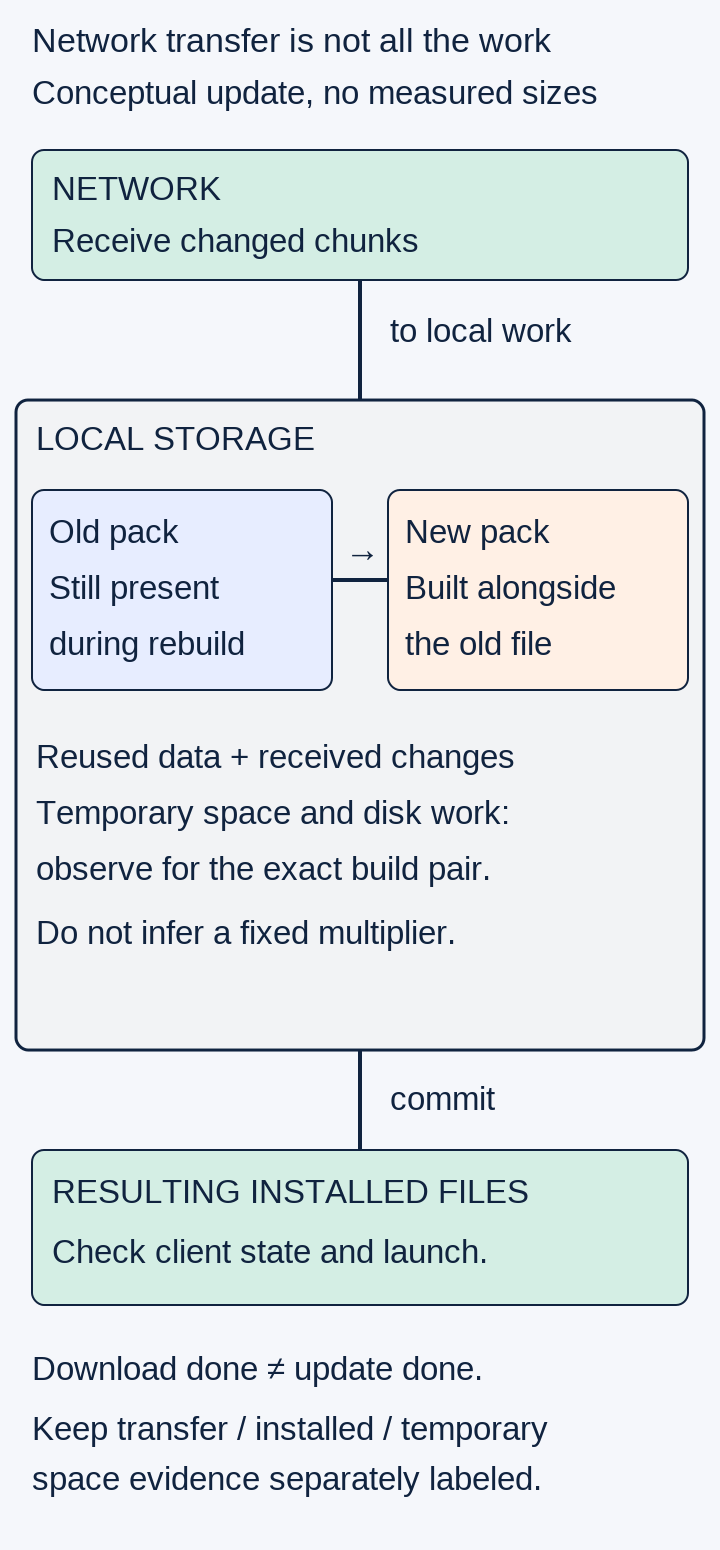
Original conceptual mechanism diagram, not a Steam interface or measured size comparison. Transfer, temporary local work and final installed files are separate observations.
 Superdirector
Make it work for your brand
Find it. Remake it. Post it. Superdirector turns the viral formats in your niche into your brand's carousels, X posts and video scripts, and keeps the calendar full.
Start with the build pair, not the headline number
A clean installation and an update from an older build are different cases. Before recording sizes, identify the app and branch, destination build, operating system, language and selected optional content. For an update, also record the starting build. If you cannot establish the starting state, label the observation accordingly rather than calling it a repeatable patch measurement.
A useful evidence sheet has separate entries for:
- Network transfer observed for that operation.
- Installed files after the operation completes.
- Free-space requirements or temporary-space behavior actually established by the test.
- The client's observed completion state and whether the resulting build launches.
Record the units and where each value came from. An advertised storage requirement is not the same as a measured installed footprint. Likewise, a final footprint does not by itself establish the highest temporary space needed while updating.
If a field is unmeasured, keep it pending. A neat table with an assumed value is less useful than an incomplete table that makes the next test obvious.

A fictional asset-package cutaway shows why one small sound edit can involve more local work than the edit itself suggests. It is not a size or duration benchmark. Original AI-generated editorial illustration.
Why transfer and local work can diverge
Valve's SteamPipe documentation explains that content is divided into chunks, compressed for delivery and expanded on the client. During updates, matching chunks can be reused while changed chunks are downloaded. Pack-file organization affects how efficiently changes can be represented.
The same documentation describes a separate local operation: a new version of a pack file is built alongside the old version, then the update is committed. That can involve substantial disk work even when the network transfer is small. It does not establish a universal time estimate or a fixed temporary-space multiplier for your game.
Imagine a fictional demo update that changes one sound inside a larger asset pack. The edit is small from the designer's perspective. That fact alone tells you neither the downloaded bytes nor how much local reconstruction the package requires. Inspect the actual build pair rather than promising that one changed sound means an instant update.
Do not confuse an oversized demo question with a measured download
A developer preparing a UE5 horror demo for Steam Next Fest asks how to reduce its packaged size without losing visual quality. That is a genuine operator concern, but the packaged-build figure in the question does not independently establish the final Steam network transfer. The discussion's engine-setting suggestions also should not be pasted into an unrelated project without checking its version and packaging setup.
A separate first-party launch account describes reducing a Steam game's build size and explicitly distinguishes listed storage from exact download size. Its broader claim about why players did not launch the game is an interpretation, not a controlled result. You can learn from the measurement distinction without adopting its causal headline, reported conversion figures or download-time estimates.
These examples support asking a more precise production question: which size are we trying to reduce or explain, and how will we observe the result? They do not establish a target size for every indie demo.
Test a clean install separately from an existing player's update
For the fictional demo, prepare two authorized test cases rather than one number copied into both contexts.
The clean-install case records the selected content and the completed installation. The update case begins from a documented prior build and records what happens when moving to the new build. Keep the device, storage setup and relevant client conditions with each observation so later comparisons do not silently combine unlike situations.
Use an existing permitted test environment and preserve user data. Do not delete saves, clear unrelated folders or alter a live user's installation merely to create a clean-looking measurement. If the available setup cannot establish temporary-space behavior safely, leave that requirement unverified and ask the release owner to supply a suitable test receipt.
A reported download completion is not the final acceptance condition. Check whether the client still reports installation or update work, then verify the intended build can start through the normal route. A successful launch is useful evidence for that setup, not a guarantee for every storage device or every historical update path.
Write the patch note to fit the evidence
Suppose a team has measured network transfer for one old-to-new build pair but has not established completion time across player devices. Its announcement can distinguish the measured transfer from the remaining local work without inventing a duration.
An original wording pattern might be: “This update downloads changed content, then rebuilds affected local files. Download completion may not be the end of the update process. The size information below applies to the listed starting build and content selection.” Add actual values only after the evidence sheet contains them.
If the team has not measured the update at all, do not publish a numerical promise disguised as an estimate. A useful internal note would instead state that network transfer and temporary-space requirements remain to be checked for the release candidate.
Valve's update guidance recommends using Steam's download and update system rather than requiring an additional in-game content download. It also advises considering the burden of large updates and communicating changes through the community hub. Do not solve a misleading size claim by moving required content into an unannounced second download.
Recheck when packaging changes
Keep the evidence attached to the exact release candidate. A change in asset grouping or optional content can make an earlier observation unsuitable even when the visible gameplay change is small. Repeat the relevant installation or update case, then correct any public description that no longer matches.
The finished record should let another team member answer four questions: what crossed the network, what remained installed, what temporary local work was observed, and what state was reached at the end. It should also show what remains unknown. That is a defensible basis for a download or patch message, without implying that a small number guarantees a quick or trouble-free update.