Short-Form Video Best Practices (2026)
Short Form Strategy, explained with the examples that make the rule obvious.
By Bell Chen, founder of Superdirector — how the analysis works.
Short Answer
What actually decides whether a short-form video gets distributed?
Three signals, and they rhyme across TikTok, Reels and Shorts. Adam Mosseri, who runs Instagram, put it plainly in his January 2025 ranking explainer: the top three signals for ranking are watch time, likes and sends — so watch average watch time, likes per reach, and sends per reach, with likes weighing slightly more for people who already follow you and sends slightly more for people who do not. Read that as a content brief: watch time is bought by the hook and the pacing, and the send is someone forwarding the video into a DM. The reason it matters is that short-form stopped being only an entertainment feed — a Google senior vice president said in 2022 that almost 40 percent of young people looking for somewhere to eat go to TikTok or Instagram rather than Search or Maps. YouTube Shorts is the exception to the perishability: it is a search engine, so a Short that answers a real question keeps surfacing months later, which is why Metricool measured Reels reach down 35 percent year over year in 2026 while searchable formats held.
- Mosseri, January 2025: the top three ranking signals are watch time, likes and sends — average watch time, likes per reach, sends per reach.
- Likes weigh slightly more for existing followers; sends weigh slightly more for non-followers.
- Watch time is bought by the hook and the pacing; the send is a DM forward, so it is a design goal rather than a by-product.
- Almost 40 percent of young people looking for a place to eat go to TikTok or Instagram rather than Search or Maps (Google SVP, 2022).
- YouTube Shorts is the searchable exception: a Short that answers a real question keeps surfacing months later. Metricool measured Reels reach down 35 percent year over year in 2026.
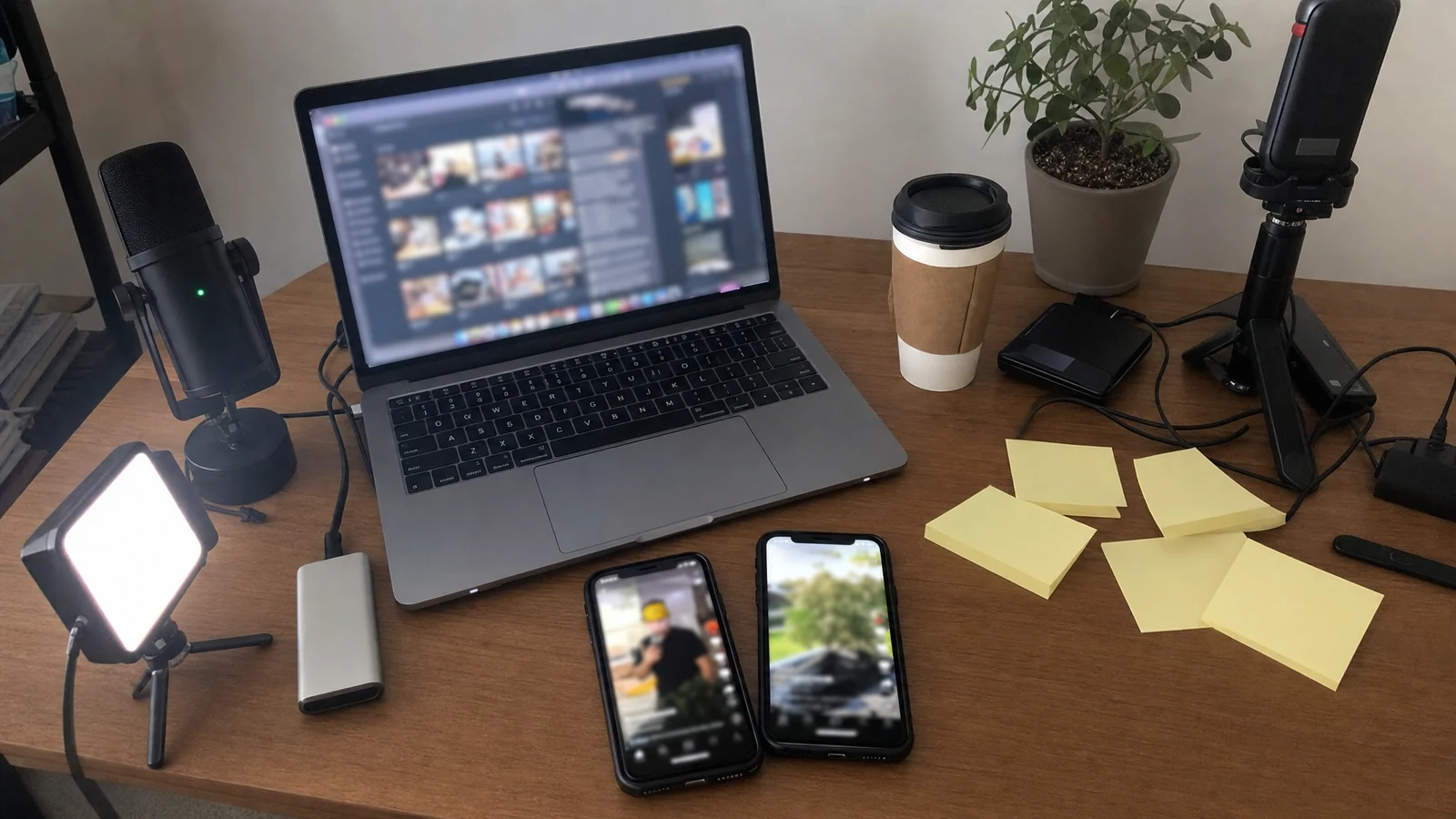
Discovery Moved to the Feed
Google's Prabhakar Raghavan put the shift on record: almost 40 percent of young people, he reported, now look for a lunch spot on TikTok or Instagram instead of Search. Short-form stopped being only an entertainment surface and behaves like a discovery engine that autoplays.
The Floor Is Sliding
Reach is no longer free. Metricool's 2026 study of nearly 40 million posts put numbers on the squeeze: Reels reach dropped 35 percent year over year, and Buffer's 52-million-post engagement report found engagement has gotten harder to win on several major platforms. One-off viral attempts do not compound against that math; a repeatable editorial system does.
Design Both Ends of the Clip
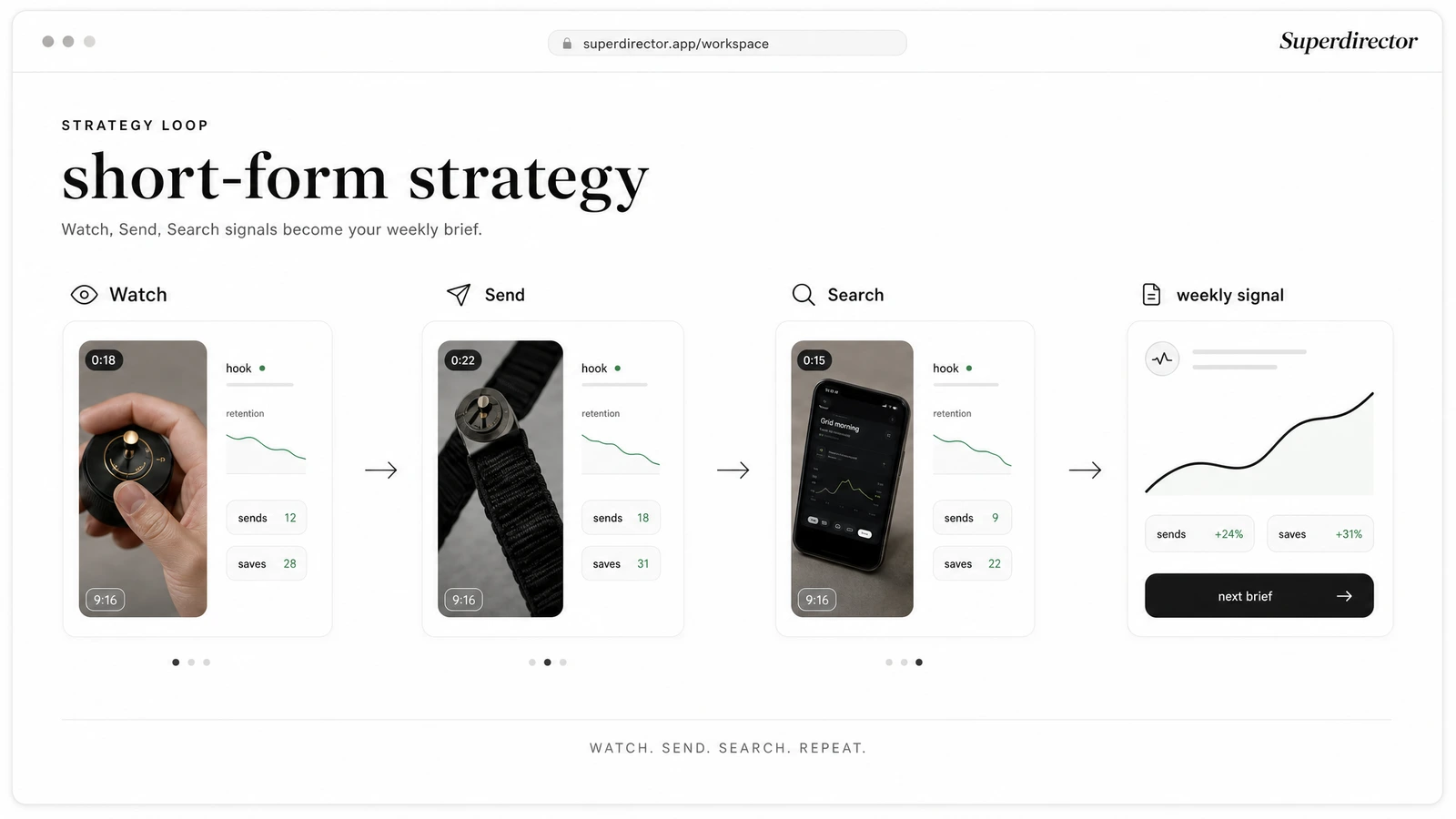
Adam Mosseri names what Reels weighs: average watch time, likes per reach, and sends per reach, with sends worth extra among viewers who do not follow you yet. Watch time is bought by pacing; the send, a forward into a DM, is bought by a payoff worth passing along.
Shoot Once, Package Locally
Filming fresh per platform burns out a small team.
- Record vertical once, narrated without platform references, so footage travels.
- Re-cut the opening per app and swap in the trending sound: rawer for TikTok, more produced for Reels, question-first for Shorts.
- Stagger releases instead of firing the same file everywhere in the same hour.
Short-Form in 2026: a search engine that looks like a feed
In 2022 a Google senior vice president, Prabhakar Raghavan, said the quiet part out loud: "In our studies, something like almost 40% of young people, when they're looking for a place for lunch, they don't go to Google Maps or Search. They go to TikTok or Instagram," per Raghavan, via TechCrunch. Short-form video stopped being only an entertainment feed and became a place people go to find things. That is the opportunity, and it is why the format deserves a real plan rather than a posting habit.
The pressure is the other half of the story. Buffer's State of Social Media Engagement in 2026, built on 52 million posts from more than 200,000 accounts across ten platforms, found engagement has gotten harder to win on several major platforms. Metricool's 2026 Social Media Study of nearly 40 million posts put numbers on the squeeze: Reels reach dropped 35% year over year, even as accounts posted more often. More people are posting more often into a feed that hands back less reach per post.
Those two facts set the whole strategy. Discovery has moved to short-form, but the baseline is sliding and reach is no longer free. One-off viral attempts do not compound against that math; a repeatable editorial system does. The rest of this guide is that system: understand what each platform actually measures, choose content pillars you can sustain, repurpose without re-shooting, and track the two or three numbers that change next week's plan.
What every short-form algorithm actually measures
Strip the branding off TikTok, Reels, and Shorts and the ranking signals start to rhyme. The clearest public statement comes from Adam Mosseri, who runs Instagram. In his January 21, 2025 ranking explainer, he said: "The top three signals that matter most for ranking are watch time, likes and sends. So when looking at your insights, pay close attention to average watch time, likes per reach, and sends per reach." He added one nuance: likes weigh slightly more for people who already follow you, sends slightly more for people who do not.
Read that closely and you have a content brief. Watch time is bought by the hook and the pacing. The send, someone forwarding your video into a DM or to their Story, is bought by the payoff: the line, twist, or takeaway worth passing to a friend. A clip that opens well but ends flat wins the first signal and loses the second, which is why so many otherwise-decent videos plateau. The discipline is to design both ends of the clip, not just the first three seconds.
TikTok and YouTube have never published a list this explicit, but the working model is the same family: completion rate (did they watch to the end), re-watches and loops, and shares. So the practical takeaway is platform-agnostic. Stop optimizing for the like, which is the cheapest action a viewer can take, and optimize for the watch-through and the send, the two signals that actually move distribution.
YouTube Shorts: the searchable, evergreen exception
Most short-form video is perishable. A TikTok or a Reel does most of its work in the first 48 hours and then fades. YouTube Shorts is the exception, and the reason traces back to Raghavan's point: YouTube is a search engine. A Short that answers a real question keeps surfacing in YouTube search, in suggested videos, and sometimes in Google itself, months after you posted it. That changes the economics. On the feed platforms you are renting attention; on YouTube you are building an asset.
Metricool's 2026 study measured Reels reach down 35% year over year (press release), and the same squeeze is what makes searchable formats worth the extra craft. The implication is to write Shorts the way you would write a headline you want found, not just a hook you want watched. Lead with the question or the specific claim, use the words a person would actually type, and keep the title and on-screen text searchable.
This also makes Shorts the cheapest place to test. Because they keep earning views, an evergreen Short that explains one idea well can validate a topic before you commit to a longer video or a paid push. The feed chases what is hot this week; YouTube keeps what stays useful. Build the searchable version once and let it compound.
Instagram Reels: built for the send
Instagram tells you most plainly what it wants, so Reels strategy should start from Mosseri's three signals rather than from a list of trending formats. Of the three, the send is the one most creators underuse. Watch time you can engineer with pacing, and likes follow naturally, but a send, someone forwarding your Reel into a DM or to their Story, is a deliberate act. It is also, in Mosseri's framing, the signal that weighs most for reaching people who do not yet follow you.
So the Reels question is concrete: would a viewer send this to one specific person? Save-worthy reference content (a checklist, a "keep this for later"), a genuinely useful tip, a relatable observation that names a shared experience, or a result worth showing off all earn sends. Pretty-but-empty footage does not. Instagram's roots make production quality matter more here than on TikTok, but polish without a reason to share still stalls.
There is a reach reality to plan around. Metricool's 2026 study measured Reels reach down 35% year over year, so the unfollowed-discovery pool is smaller and more contested than it was. That raises the value of the send, because a forwarded Reel lands with a warm viewer the feed would never have handed you. Design for the forward and you are working with the one signal that still expands reach while organic reach shrinks.
Repurpose without re-shooting
Filming something new for every platform is the fastest way to burn out, and it is unnecessary. The durable approach is to shoot once, vertically, with a frame clean enough that you can re-dress the same clip for each destination. The one rule at capture time is to record without platform-specific references ("like I said in my last TikTok") so the footage travels.
Repurposing is not posting the identical file three times. Each platform gets a native-feeling version. Swap in audio that is trending on that specific app, because a sound climbing on Reels can be invisible on TikTok. Re-cut the open: a rawer, faster hook for TikTok, a more produced one for Reels, a searchable question-first title for Shorts. Match the captions and the hashtag conventions each app expects. The raw material is shared; the packaging is local.
Sequencing matters too. Posting the same clip everywhere within the same hour tends to underperform, so stagger releases and let the platform where the idea fits best lead. A trend-driven piece usually opens on TikTok; an evergreen explainer is often better held for YouTube. Then close the loop with measurement: watch which platform actually drives views, and which drives the sends and saves that signal real value, and shift effort toward the surfaces that pay you back.
Content pillars: the system that beats trend-chasing
The failure mode of trend-chasing is precise: every post starts to look the same, trends perform but do not build brand equity, and the strategies that used to work begin to fall flat. Content pillars are the antidote. They are the three to five themes you commit to owning, so any given video advances a body of work instead of standing alone.
Good pillars share three traits: you can make fifty pieces about each without straining, your audience actually wants them, and you have a real point of view on them. Pick fewer than you think. An account with three sharp pillars is more legible to both the audience and the ranking system than one with eight fuzzy ones. A workable split is 70-20-10: roughly seventy percent on the core themes you want to be known for, twenty percent adjacent, ten percent experiments that might become tomorrow's pillar.
Pillars are also what make measurement honest, and there is a useful rule for that too: keep reporting to the broad strokes, the two or three numbers that would actually change what you do next, not a spreadsheet of vanity metrics. Tagged by pillar, your analytics answer the only question that matters week to week: which themes earn the watch-through and the send, and which ones you should quietly retire. Pillars are not a permanent contract. Add the ones that emerge, drop the ones you dread making, and let the numbers prune the list.
The growth engine: consistency, trends with a twist, honest measurement
The accounts that compound are not the ones that go viral once; they are the ones that hold a sustainable cadence and improve at the margin. Pick a posting rhythm you can keep for a year, not a heroic week, because consistency is what gives the feed enough signal to learn who your work is for. One breakout video is a spike; a steady stream of good ones is a slope, and the slope is what builds an audience.
Trends are the accelerant, but only with a point of view. The cleanest public example is Ramp, the finance startup whose Brian Baumgartner glass-box livestream became a marketing case study. As Kendall Hope Tucker, Ramp's head of creative experimentation, told Marketing Brew: "Accountants have been using the same software for 30 years, they're not looking for alternatives. So we're like, 'How do we make that pain feel visceral?'" A trend you ride with no angle is a costume; a trend bent to your pillars is reach you can actually convert.
Then let measurement run the loop. Watch retention curves to find where viewers drop, double down on the formats that earn watch-through and sends, retire what does not, and review weekly instead of reacting to every post. This is the part I built a tool for. Superdirector analyzes a brand's winning videos and turns the patterns into scripts and shot plans, but the discipline is the point and it works with whatever analytics you already have. Disclosure: I am Bell Chen, the founder; the sources above (Raghavan via TechCrunch, Mosseri, Tucker, and the Buffer and Metricool reports) are cited inline so you can check them.
FAQ
Is short-form video still worth the effort in 2026?
What do the algorithms actually measure?
Should I post the same video to every platform?
How is YouTube Shorts different from TikTok and Reels?
Are content pillars better than chasing trends?
Turn the technique into a plan
Paste your Instagram or TikTok profile URL to get a niche reference feed, then turn the strongest signal into scripts and shot plans built for your next video.
Continue Learning
The Complete Guide to Video Hooks
Hook frameworks anchored to verified named-creator examples (Hormozi, Hoyos, MrBeast, Mosseri, Ramp, Cluely) with view counts, permalinks, and what moves retention.
Beat Structure in Short-Form Video
Learn how to structure your videos using beats, the building blocks of narrative pacing that keep viewers watching until the end.