Skincare Social Video Strategy: Formats and Metrics
The formats that hold up in Skincare, and what a small team can film this week.
Turn this page into a campaign built for your brand.
Connect Superdirector to ChatGPT and it adds current social-video references, public-video analysis, Brand DNA, and a ready-to-send campaign brief.
By Bell Chen, founder of Superdirector — how the analysis works.
One Inch From a Warning Letter
Beauty copy sits one step from regulated territory. Cosmetic claims describe appearance: firmness, glow, hydration, evenness. Drug claims describe physiological change and require clearance. The operating answer is a written claims library every script passes before filming, and before-and-after content only on substantiated cosmetic outcomes.
The Hero-SKU Loop
Catalog rotation flattens a feed; Charlotte Tilbury's Pillow Talk loop is the standing correction. One hero per quarter, 10 to 20 hook angles each, recognized inside a second. Repetition compounds; brands rotating a dozen SKUs a quarter ship flatter posts because no product earns its hook depth.
Available Light as Proof
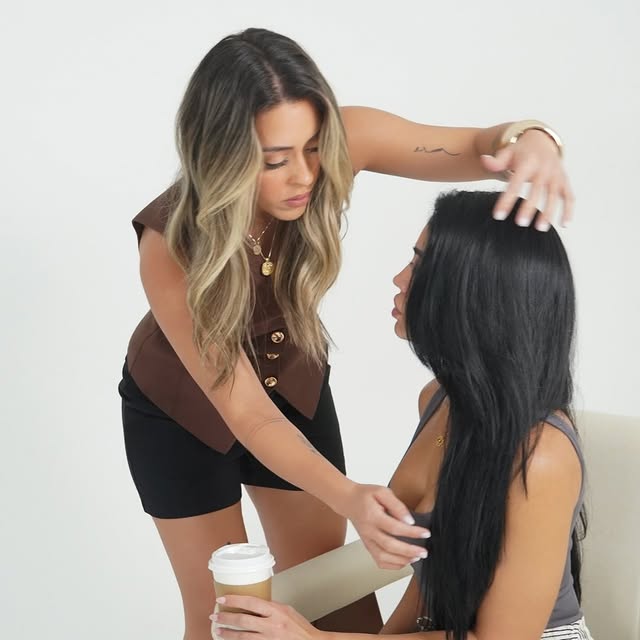
Polished product-shot Reels are the format being downgraded, and beauty was overweight in it. The Rhode pattern answers: a founder in an actual bathroom, applying the product a half-step above what the viewer films themselves. On-camera comfort comes from one weekly recurring slot, same day, same setting; repetition builds it, training does not.
Formats Matched to the Category
Four pattern shapes carry the category, each needing different assets:
- Founder routine in available light, narrating a real serum order.
- Ingredient maximalism: named concentrations on screen, cosmetic-only claims.
- Tutorial-first cold open by a recurring face, product as payoff.
- Product-as-text minimalism, no face, for brands whose science is the differentiator.
Best Platforms
Selena Gomez has framed Rare Beauty around one operating idea: that the brand is about more than how we look, and about embracing what makes each person unique. That framing is the entire content thesis behind a brand that has built a first-mover lead in TikTok-native beauty by treating product launches as conversations about audience identity rather than as ingredient demonstrations.
Read the Gomez framing alongside Hailey Bieber’s public framing of Rhode. Bieber has described starting the brand to create something she personally wanted to use and that filled a gap in her own routine. Rhode sold to E.l.f. Beauty for $1 billion (with up to $200 million in earn-outs) per Bloomberg’s May 7, 2025 coverage. The two founders are different humans selling different products, but the content pattern is the same: the brand exists because a specific identity claim was made, the audience is invited into that claim, and the product is the second beat, not the first. Most beauty short-form fails in 2026 because the product is still the first beat.
This page is the operator playbook for the beauty or skincare founder, brand director, or in-house social lead running short-form on TikTok, Reels, and YouTube Shorts in 2026. The category sits one inch away from regulated claims. Cosmetic positioning is the safe zone; therapeutic claims about acne, eczema, hair loss, or skin disease are the moment FDA and FTC oversight starts.
What is working in beauty short-form right now
The category is in the middle of a founder-led reset. Across beauty brands’ recent TikTok performance, brands shipping founder-on-camera or in-house-creator content tend to hold a meaningful reach advantage over brands running studio-produced product-shot content in the same paid-spend bracket. The compression is not cosmetic; the brands losing ground are the ones still feeding their TikTok with print-campaign assets and lookbook stills.
Beauty’s operating shift in 2026 is the one this page has been naming throughout: the beauty brand as a daily publisher, with editorial calendars, on-camera talent, and visible house voices rather than agency briefs. The macro context behind that shift is documented in Business of Fashion and McKinsey’s State of Fashion 2026 report(published November 2025); the brand-as-publisher reading of it is this page’s synthesis, not the report’s own headline.
Reels reach has been falling year over year across the platform, and the overcrowding is real. Beauty feels the compression more acutely than other DTC categories because the average beauty brand was already overweight in polished product-shot Reels that the platform is actively downgrading.
Adam Mosseri’s December 31, 2025 year-end memo on @mosseri, cross-confirmed in Om Malik’s January 1, 2026 reading, named the underlying signal change. Mosseri wrote that “we’ll need to shift our focus to who says something instead of what is being said” and later that “rawness isn’t just aesthetic preference anymore—it’s proof.” The beauty translation: a 4K macro shot of serum hitting glass now reads as a negative signal on Reels. A founder applying the product over the bathroom sink in soft window light is the positive signal.
The third shift, the one most beauty operators underrate: TikTok Shop is now the dominant first-purchase surface for beauty SKUs under $50. Beauty and Personal Care has grown into one of TikTok Shop’s largest commerce verticals, and the under-$30 range behaves as impulse inventory — the buy decision closes inside the feed session that surfaced the content. Brands shipping organic founder-led content with a Shop sticker are running the operational baseline. Brands still treating TikTok as a top-of-funnel awareness channel are leaving the impulse beat on the table.
The named-brand beauty playbook
Rare Beauty, founder identity as the platform
3.4M followers, 76.6M likes as of Q1 2026; Soft Pinch Liquid Blush as the marquee SKU
Account at @rarebeauty. Selena Gomez’s brand built the most-imitated content engine in beauty by inverting the standard order. The TikTok feed opens on Gomez’s voice (often a tutorial filmed in available light, often pulling from her own mental-health advocacy), and the product (the Soft Pinch Liquid Blush in particular) lands as the payoff. The operating principle is that Rare Beauty feels like a friend you trust telling you what works on her face, not a brand telling you what to buy.
Soft Pinch Liquid Blush became the brand’s marquee SKU, repeatedly selling out after launch waves. The pattern is replicable at smaller scale. A recurring on-camera face, a tutorial-first cold open, and a recurring product payoff compound faster than catalog rotation. The Gomez specificity is the brand voice; the structural pattern is the playbook.
Rhode, founder routine as the format
1.9M followers as of Q1 2026; sold to E.l.f. for $1B + up to $200M earn-outs on ~$212M TTM
Account at @rhode. Hailey Bieber’s Rhode runs a content engine that is almost entirely Bieber’s own face, her own routine, and her own product callouts. The Vogue interview cited above quantified the result through a single SKU. Bieber said of the original Peptide Lip Treatment, “It became this thing that people wanted, and the demand was so far beyond what we expected.”
Bloomberg’s May 7, 2025 coverage on the E.l.f. acquisition reported the $1 billion sale price (plus up to $200 million in earn-outs based on growth) on roughly $212 million in annual net sales over the trailing twelve months.
The Rhode content engine is the operational extreme of the founder-as-format pattern. The brand ships almost no studio content. The feed is Bieber’s iPhone, Bieber’s mirror, Bieber’s voiceover. Any indie founder running an under-$50 SKU set can apply a less-glossy version of the same pattern without the celebrity reach floor; the pattern is the format, not the famous face.
Charlotte Tilbury, the hero-SKU loop
3.7M followers; Pillow Talk hero-SKU run since 2013
Account at @charlottetilbury. The brand has run the Pillow Talk lipstick family as the content surface for nearly a decade. The operational discipline is that the brand films hundreds of variations of the same SKU (a sold-out moment, a celebrity wearing it, a tutorial, an archival reference) without rotating off the hero.
Tilbury has framed the discipline as intentional, describing Pillow Talk as a love letter that the brand has kept telling the same way over the years.
The pattern: one hero SKU per quarter, ten to twenty hook variations against that SKU, and a brand-voice continuity that lets a returning viewer recognize the format inside a second. The brands that try to feature their whole catalog ship flatter content every time.
Drunk Elephant, ingredient maximalism on iPhone
786.2K followers; "suspicious six" blacklist as the brand identity
Account at @drunkelephant. Tiffany Masterson built Drunk Elephant on a five-ingredient blacklist (essential oils, drying alcohols, silicones, chemical screens, fragrance/dyes) that lives in every brand artifact. The operating principle is that the brand does not argue with skincare; it just keeps the blacklisted ingredients out of the bottle and shows people what it did put in.
The TikTok feed runs heavy on ingredient education filmed in bathroom and product-lab settings on phone cameras, and the brand voice carries cosmetic-only claims (firmness, glow, smooth-look) without crossing into therapeutic territory. The discipline matters. Drunk Elephant has been a category leader in masstige clean beauty without taking a single drug-claim FDA letter, because the script discipline pre-dates the post.
The Ordinary, minimalism as the voice
1.4M followers; product-as-text with no on-camera face
Account at @theordinary. The Ordinary, the masstige line from Deciem, runs a content engine that is almost entirely product-as-text with no on-camera face. The feed is white-label bottles, a single ingredient call-out per video (Niacinamide 10%, Hyaluronic Acid 2%, Retinol 0.5%), and a stripped voice that mirrors the brand’s pharmacy-counter packaging.
The operational signal in Deciem’s content is that the brand’s reach scales because the audience reads the no-face minimalism as ingredient honesty, not as corporate distance. The pattern only works for indie brands whose science credibility is the differentiator. For any other beauty positioning, the founder-on-camera pattern compounds faster.
Tatcha, founder narrative as the brand spine
478.2K followers; acquired by Unilever 2019 for reported $500M per WSJ
Account at @tatcha. Vicky Tsai built Tatcha around a Japanese-tradition narrative spine that Unilever acquired in 2019 for a reported $500 million per The Wall Street Journal. Tsai has described her job as translating a centuries-old beauty tradition into something a modern customer understands and can use in her everyday routine.
The Tatcha feed runs founder-narrative cuts (Tsai on camera, archival footage, factory and ritual references) alongside ingredient explainers from in-house aestheticians. The pattern only works when the brand spine is genuinely specific and ownable. Tatcha owns the Japanese-ritual claim because the founder spent a decade building the partnership infrastructure to defend it.
What pre-production looks like in beauty
The unglamorous half. The named brands above all run a production discipline that compresses on-camera time while protecting the cosmetic-claim line.
A written claims library, cleared by counsel. This is the discipline beauty operators most often skip and most regret. The library names the cosmetic claims the brand can make (firmness, smoothness, glow, evenness, hydration, color payoff), the structure-function claims it can make when supported by ingredient evidence (antioxidant support, barrier support), and the drug claims it cannot make under any circumstance (cures acne, treats eczema, regrows hair, prevents disease). The FTC’s December 2022 Health Products Compliance Guidance names the same line: substantiation must precede the claim, not follow the post. Every script and every creator brief flows through the library before filming.
Shot list and SKU rotation before filming. Charlotte Tilbury’s Pillow Talk content engine runs a quarterly shot list of ten to twenty hook variations per hero SKU. Rare Beauty’s Soft Pinch engine runs a similar quarterly plan. The discipline is to write the list before the camera turns on, then film three to five variations per session against the same SKU.
Talent rights, FTC disclosure, and creator briefing. Every paid creator post needs a #ad or #paid tag per the FTC Endorsement Guides (updated 2023). The disclosure cannot be buried at the end of a caption. Every employee post needs employer disclosure under the same rules. The brands that compound bake the disclosure into the creator brief as a line item, treat the legal cost as a per-post fixed cost, and accept the modest reach hit the disclosure carries.
Recurring location and on-camera face. Rare Beauty’s recurring Gomez bathroom and at-home shoots, Rhode’s recurring Bieber mirror, Charlotte Tilbury’s recurring Tilbury vanity, and Tatcha’s recurring Tsai library set are all the same operating signal. The brand voice compounds when the location and face are visually consistent across hundreds of posts.
Sensitivity and inclusion review for tutorial content. Beauty short-form draws audience sensitivity faster than most categories. A tutorial that demonstrates a technique on one skin tone, hair texture, or body without explicit shade range or inclusivity context will be read by the audience as exclusionary. The brands that compound run a tutorial review (often two or three voices including in-house creators of color) before the post ships.
What goes wrong
- 1The drug-claim slip. A founder or a paid creator improvises a line like “this cleared my acne” or “this regrows my hair,” and the brand has either taken a warning letter or has to scrub the post within the week. The fix is the claims library above. The brands that compound never let a script ship without the library check, even from the founder, even from a long-running creator partner.
- 2The before-and-after without timeline or substantiation. A brand posts a side-by-side photo with a 30-day caption and no substantiation, and the audience reads the post as deceptive. The FTC Endorsement Guides and the 2022 Health Products Compliance Guidance both name the substantiation requirement. The brands that compound either skip before-and-after content entirely (the Drunk Elephant approach) or run it only on substantiated cosmetic outcomes (firmness measured, hydration measured) with the methodology visible in the caption or first comment.
- 3The catalog rotation. A brand with 60 SKUs tries to feature each one and ships a daily product-of-the-day Reel. The feed reads as a catalog. Charlotte Tilbury’s hero-SKU loop is the answer. Pick two or three hero SKUs per quarter, write ten to twenty hook angles each, and rotate. Repetition is the compounding mechanism; catalog coverage is the flattening mechanism.
- 4The deeper failure pattern under all three: treating beauty short-form as a paid amplification channel rather than a publishing surface. The brands that compound treat the feed as a daily editorial product, with a voice, a face, a SKU loop, and a claims library that pre-dates the camera.
What to track week-to-week
- Saves per reach on Instagram, shares per view on TikTok
- The intent metric. Correlates with first-purchase behavior inside 7 to 14 days for under-$50 beauty SKUs.
- Profile visits per reach
- Whether the post drove brand investigation or registered as a scroll past.
- Question-mark comments per reach
- The cleanest proxy for buyer-question demand and the cleanest signal of which SKU to feature next.
- TikTok Shop or website click-through
- Direct conversion read for the brands running Shop stickers or link-in-bio.
- Follower growth attributable to the post
- The hardest unconditional commitment.
A metric that does not change what you do next does not belong in the report. What to skip: total likes, total impressions, total views reported at the brand level. The aggregate hides the SKU-level cluster signal that lets a beauty operator decide which hero to extend next. Hand-cluster the week’s posts against hook, SKU, format, and face. Find the 3x outliers. Write next week’s calendar against the winners.
Where a planning-first tool fits
For a beauty operator shipping fifteen to twenty-five posts a month across TikTok, Reels, and Shorts, the bottleneck is rarely the camera. It is deciding which hero SKU to feature next, against the brand’s claims library and last week’s performance. Superdirector’s Analysis tab surfaces hook patterns across competitor accounts (the named brands above) and across the brand’s own back-catalog, and compresses the Friday-afternoon cluster review to a Friday-morning read. The judgment about which hook to ship stays with the operator; the tool surfaces the data and the operator picks the hypothesis.
Example Ideas
Bathroom-mirror founder routine
Instagram Reels"Here's the order I use my serums in winter"
Angle: Founder demonstrates routine in available light, narrating product callouts
Planning note: Rhode's Hailey Bieber and Rare Beauty's Selena Gomez both run this format. The viewer reads the post as a friend sharing a routine, not a brand pitching a product. Builds trust faster than studio-produced application shots.
Hero-SKU sold-out moment
TikTok"Pillow Talk is back in stock for 48 hours"
Angle: Quarter-long hero-SKU loop with recurring scarcity beats
Planning note: Charlotte Tilbury runs Pillow Talk year-round with hundreds of variation hooks (sold-out moment, celebrity wearing it, tutorial, archival reference). The loop compounds because the audience recognizes the format inside a second.
Ingredient-name product reveal
TikTok"Niacinamide 10% + Zinc 1% is the actual name"
Angle: Product-as-text minimalism with white-label clarity
Planning note: The Ordinary pattern. No face, ingredient and concentration on screen, pharmacy-counter brand voice. Works only for brands whose science credibility is the differentiator. For other positioning, founder-on-camera compounds faster.
Frequently asked questions
What is the line between a cosmetic claim and a drug claim in beauty short-form?
How should an indie beauty brand under $5M revenue be on TikTok Shop?
How do you film founder content without making the founder cringe?
How many hero SKUs should a beauty brand feature per quarter?
Is a $40,000 produced video ever worth it for beauty short-form?
How should a beauty brand handle creator partnerships in 2026?
What is the right way to feature before-and-after content?
Get a campaign brief built for your brand in 30 seconds
Get a beauty brand profile with hook patterns from named-brand competitors
Other Industries
Related Content
By Bell Chen, founder. The named-brand examples above were reverse-engineered from public posts, named-publication coverage, and verbatim quotes attributed inline. Where I have a first-person take from running brand-profile workflows against live URLs across the last six months, I name it inline. The planning-first tool I run, Superdirector, surfaces hook patterns across competitor and own-brand back-catalogs; it does not film, post, or buy media.